
How to Get Paid for Upgrading Your Arizona AC
Discover Arizona energy rebates for HVAC upgrades: federal tax credits, state HEAR rebates up to $14K, utility incentives from SRP/APS/TEP. Save thousands now!

Why Arizona Energy Rebates for HVAC Upgrades Can Put Real Money Back in Your Pocket
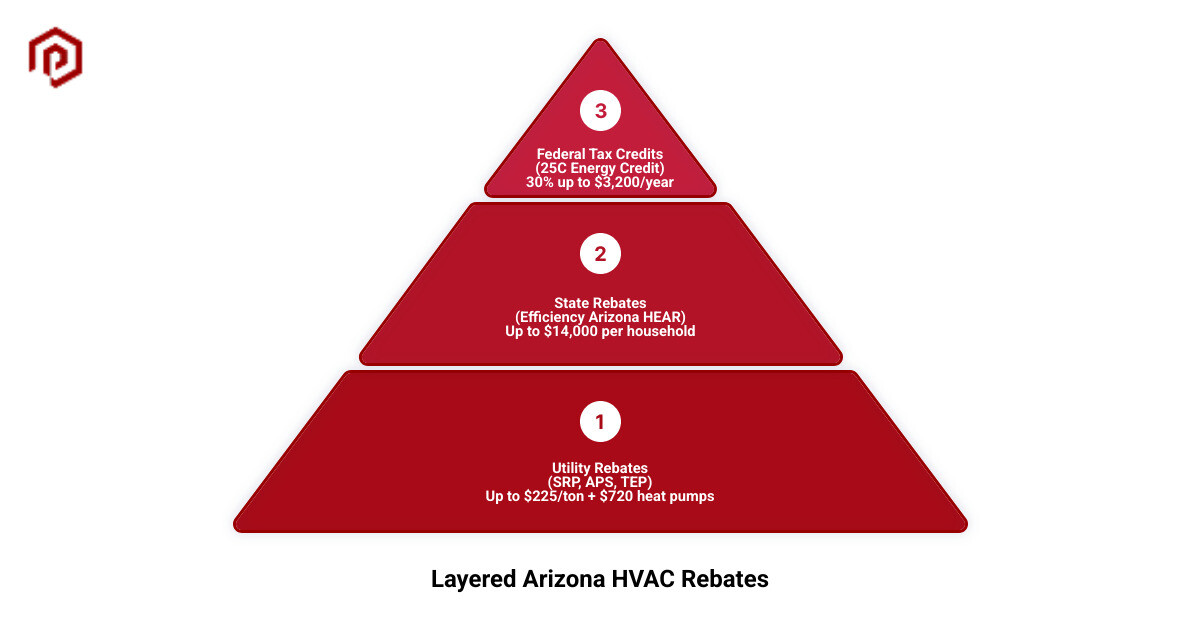
Arizona energy rebates for HVAC upgrades can help homeowners save hundreds — or even thousands — of dollars when replacing or upgrading heating and cooling equipment. Here is a quick look at what is currently available:
| Incentive | Who Offers It | Max Value |
|---|---|---|
| Energy Efficient Home Improvement Credit (25C) | Federal (IRS) | Up to $3,200/year |
| Heat pump tax credit | Federal (IRS) | Up to $2,000/year |
| Central AC tax credit | Federal (IRS) | Up to $600/year |
| Efficiency Arizona (HEAR) | State of Arizona | Up to $14,000 per household |
| Heat pump rebate (HEAR) | State of Arizona | Up to $8,000 |
| SRP Cool Cash rebate | SRP utility | Up to $225 per ton |
| TEP heat pump rebate | Tucson Electric Power | Up to $720 |
| TEP AC rebate | Tucson Electric Power | Up to $600 |
| APS residential rebate | Arizona Public Service | Varies by equipment |
Living in Arizona means your air conditioner works harder than almost anywhere else in the country. According to Energy.gov, AC alone accounts for 40% to 50% of a summer energy bill — and in a Phoenix-area home, that adds up fast. The good news is that a layered set of financial incentives from the federal government, the State of Arizona, and local utilities like SRP, APS, and TEP can dramatically offset the cost of upgrading to a high-efficiency system.
What surprises many homeowners is how much money is being left on the table. As of a recent report, only about 800 rebates had been issued statewide through the Efficiency Arizona program — meaning thousands of Arizona households have not yet taken advantage of savings that are already available to them.
Whether you are in Chandler, Gilbert, Mesa, Queen Creek, or San Tan Valley, this guide breaks down every major incentive program, what equipment qualifies, how to apply, and how to stack multiple rebates together for the biggest possible return.
Federal Tax Credits: The Energy Efficient Home Improvement Credit (25C)
One of the most reliable ways to save on your cooling and heating costs is through the federal tax system. Under IRS Section 25C, the Energy Efficient Home Improvement Credit has been significantly expanded by the Inflation Reduction Act. As of April 2026, homeowners can claim a tax credit of 30% of the qualified expenses for energy-efficient home improvements.
Unlike a standard deduction, a tax credit is a dollar-for-dollar reduction in the actual tax you owe. The annual limit for this credit is $3,200, but there are specific caps depending on what you install:
- Heat Pumps: You can receive a credit of up to $2,000 per year for qualified electric or natural gas heat pumps.
- Central Air Conditioners: High-efficiency central AC units qualify for a credit of up to $600.
- Furnaces: Efficient natural gas, propane, or oil furnaces also qualify for up to $600.
Energy Efficiency Matters: The Benefits of Upgrading Your Old Furnace go beyond just the tax credit; a new system can lower your monthly bills significantly. To claim these credits, you must file IRS Form 5695 with your annual tax return.
That these credits apply only to existing primary residences. New construction homes and rental properties where you do not reside generally do not qualify for the 25C credit. Because these are non-refundable credits, they can only reduce your tax liability to zero; they won't result in a refund check if you don't owe taxes. However, since the credit resets every year through 2032, you can spread out your upgrades—doing a Heating System Upgrade one year and windows or insulation the next—to maximize your total savings.
Efficiency Arizona: State-Level Rebates for Homeowners
The Governor’s Office of Resiliency has launched Efficiency Arizona, a massive initiative designed to help us transition to more efficient home technologies. The most significant part of this for many families is the Home Efficiency Rebates (HOMES) program.
The HOMES program is "performance-based," meaning the amount of money you get back depends on how much energy your upgrades actually save. If your home improvements result in a 20% to 35% energy reduction, you could be eligible for thousands in rebates. For those achieving over 35% savings, the rebates can be even higher.
This program is particularly beneficial for underserved communities. Eligibility is often tied to Area Median Income (AMI) thresholds:
- Low-Income Households: Those making less than 80% of the AMI may have 100% of their project costs covered, up to $14,000.
- Moderate-Income Households: Those making between 80% and 150% of the AMI can receive 50% of project costs, also capped at $14,000.
For many in the East Valley, a Heat Pump Installation is the gold standard for these state-level savings because these units handle both cooling and heating with incredible efficiency.
Qualifying for Arizona Energy Rebates for HVAC Upgrades via HEAR
The Home Electrification and Appliance Rebate (HEAR) is another branch of the Efficiency Arizona initiative. This program focuses on point-of-sale discounts, meaning you see the savings immediately rather than waiting for a tax refund.
HEAR provides substantial support for specific electrification projects:
- Electric Heat Pumps: Up to $8,000 for space heating and cooling.
- Heat Pump Water Heaters: Up to $1,750.
- Electric Wiring and Panels: If your new HVAC system requires a panel upgrade, you could get up to $4,000 for the breaker box and $2,500 for wiring.
Whether you are looking into a Mini Split Install for a new addition or replacing a whole-home system, these point-of-sale discounts make high-efficiency technology accessible for more families in Chandler and Mesa.
Utility Rebates from SRP, APS, and TEP
Beyond federal and state programs, our local utility providers offer some of the most accessible arizona energy rebates for hvac upgrades. If you live in a service area covered by Salt River Project (SRP) or Arizona Public Service (APS), you have several options.
SRP Cool Cash RebatesSRP offers a "Cool Cash" program that provides rebates based on the type of system you install. For variable-capacity systems (which are the most efficient), you can receive up to $225 per ton of cooling capacity. For a standard 3-ton unit, that is a $675 rebate right off the bat. SRP estimates that upgrading to a 21-SEER (20.0 SEER2) variable-capacity unit could save a homeowner $5,500 over 15 years in energy costs alone.
APS Residential Energy EfficiencyAPS also provides rebates for high-efficiency AC Installation. Their program focuses on ensuring systems are properly sized and installed. Like SRP, APS incentives vary based on the SEER2 rating of the equipment. They also offer Promotions for related services like duct sealing and smart thermostats.
TEP Efficient Home ProgramFor those in the southern parts of our service region, Tucson Electric Power (TEP) offers up to $720 for high-efficiency heat pump installations and up to $600 for air conditioners. These rebates are often applied instantly by participating contractors, reducing your out-of-pocket costs immediately.
Local Utility Incentives and Arizona Energy Rebates for HVAC Upgrades
Utility companies don't just care about the AC unit itself; they want your whole home to be efficient. Many offer additional credits for:
- Duct Sealing: Up to $300 to $400 depending on the leakage reduction.
- Smart Thermostats: Rebates typically ranging from $50 to $75.
- AC Tune-ups: Small rebates (around $80) to ensure your current system is running at peak performance.
When you schedule an AC Replacement, we ensure all the technical requirements are met, such as Manual J load calculations. These calculations prove the unit is the correct size for your home, which is a requirement for many utility rebates. Check our Coupons page to see if we have any current specials that can be combined with these utility offers.
Technical Requirements and Eligibility Standards
To qualify for arizona energy rebates for hvac upgrades, your new equipment must meet specific efficiency standards. The industry recently shifted from the old SEER (Seasonal Energy Efficiency Ratio) to the more stringent SEER2 testing standards.
| Equipment Type | Minimum SEER2 for Rebates | Other Requirements |
|---|---|---|
| Split System AC | 15.2+ | Energy Star Certified |
| Heat Pumps | 15.2+ | Energy Star "Most Efficient" preferred |
| Mini-Splits | 16.0+ | Varies by manufacturer |
| Gas Furnaces | N/A | 97% AFUE or higher |
Understanding SEER Ratings: What They Mean for Your AC and Heating System is vital because a unit that was considered "high efficiency" five years ago might not meet the 2026 standards for a rebate. Furthermore, What You Need to Know About the 2025 Shift in HVAC Refrigerants and Efficiency Standards explains how new environmental regulations have changed which models are eligible for federal credits.
Most of these programs are strictly for existing homes. If you are building a brand-new home in Queen Creek or San Tan Valley, the builder may receive incentives (like the 45L credit), but the homeowner typically cannot claim the 25C residential credit for the initial installation.
Maximizing Your Savings with Arizona Energy Rebates for HVAC Upgrades
The secret to getting the most money back is "stacking." You don't have to choose just one program. In many cases, you can combine a federal tax credit, a state rebate, and a utility rebate on the same project.
For example, if you invest in a high-efficiency HVAC Replacement involving a heat pump, you might:
- Receive an instant $2,000+ rebate from the state (HEAR program) if you meet income requirements.
- Get a $600 to $1,000 rebate from SRP or APS.
- Claim a $2,000 tax credit on your federal returns next year.
To ensure you don't miss out, follow a strict documentation checklist. You will need your paid-in-full itemized invoice, the AHRI (Air Conditioning, Heating, and Refrigeration Institute) reference number, and the model numbers of both the indoor and outdoor units. Most utility rebates require you to submit your application within 90 days of installation.
We also recommend Maximizing Energy Efficiency: Tips for Your AC Unit such as adding insulation or sealing air leaks, as these smaller projects also qualify for federal credits and can be done at the same time as your AC upgrade. If the upfront cost is a concern, check out our Financing Page to see how you can pay for the system while waiting for your rebates to arrive.
Frequently Asked Questions about Arizona HVAC Rebates
What is the difference between SEER and SEER2 for rebate eligibility?
SEER2 is the new testing standard that more accurately reflects how an AC unit performs in real-world conditions, especially with the high external static pressure found in modern ductwork. For most arizona energy rebates for hvac upgrades, units must meet a minimum of 15.2 SEER2. A unit labeled as "16 SEER" under the old rules might only be a "15.2 SEER2," so always check the specific SEER2 rating before buying.
Can I claim a rebate if I install the unit myself?
Generally, no. Most utility and state programs require installation by a licensed contractor who is a "participating member" of their program. This ensures the unit is charged with the correct amount of refrigerant and that the airflow is properly balanced. DIY installations often void the manufacturer's warranty and disqualify you from federal and state incentives.
Are these rebates available for rental properties or new builds?
The federal 25C tax credit is only for primary residences. However, some state rebates and utility programs are available to landlords or for new construction. For example, the HEAR program is available to both homeowners and landlords, provided the tenants meet the income eligibility requirements.
Conclusion
Navigating arizona energy rebates for hvac upgrades can feel overwhelming, but the financial rewards are well worth the effort. By combining federal tax credits with state initiatives like Efficiency Arizona and local utility programs from SRP or APS, you can turn a necessary home upgrade into a major financial win.
At Paragon Service Pros, we specialize in helping our neighbors in Chandler, Gilbert, Mesa, Queen Creek, and San Tan Valley maximize their comfort and their savings. We prioritize transparency and quality workmanship, ensuring your new system isn't just "installed," but optimized for the Arizona heat.
Start your high-efficiency upgrade today with Paragon Service Pros and let us help you claim every dollar you deserve.
Keep reading: Air Conditioning
Browse every article in Air Conditioning or head back to the Learning Center .
Comfort you can count on, all year long.
Same-day service, honest diagnostics, and 24/7 emergency help with no overtime fees. A real Greater Phoenix team is standing by.