
Beginner's Guide to How a Heat Pump Works
Learn how does a heat pump work year-round for efficient Arizona home comfort and energy savings.

How a Heat Pump Works: The Quick Answer for Arizona Homeowners
How does a heat pump work is one of the most common questions homeowners ask before upgrading their HVAC system — and the answer is simpler than you might think.
Here's the short version:
- A heat pump moves heat from one place to another — it does not generate heat by burning fuel.
- In summer, it pulls heat out of your home and releases it outside, cooling your indoor air.
- In winter, it extracts heat from outdoor air (yes, even cool air contains heat energy) and moves it inside.
- A single component called the reversing valve switches the system between heating and cooling modes.
- Because it moves heat rather than creates it, a heat pump can deliver 3 to 5 times more energy as heat than the electricity it consumes.
For Arizona homeowners in Chandler, Gilbert, Mesa, Queen Creek, San Tan Valley, and Gold Canyon, this technology is a natural fit. The mild winters and blazing summers here are exactly the conditions where heat pumps shine — keeping you comfortable year-round without the inefficiency of older heating and cooling systems.
But if you've ever stood in front of your thermostat wondering whether a heat pump is actually right for your home, or whether it can really handle a 110°F Arizona summer, you're not alone. This guide breaks it all down in plain language so you can make a confident decision.
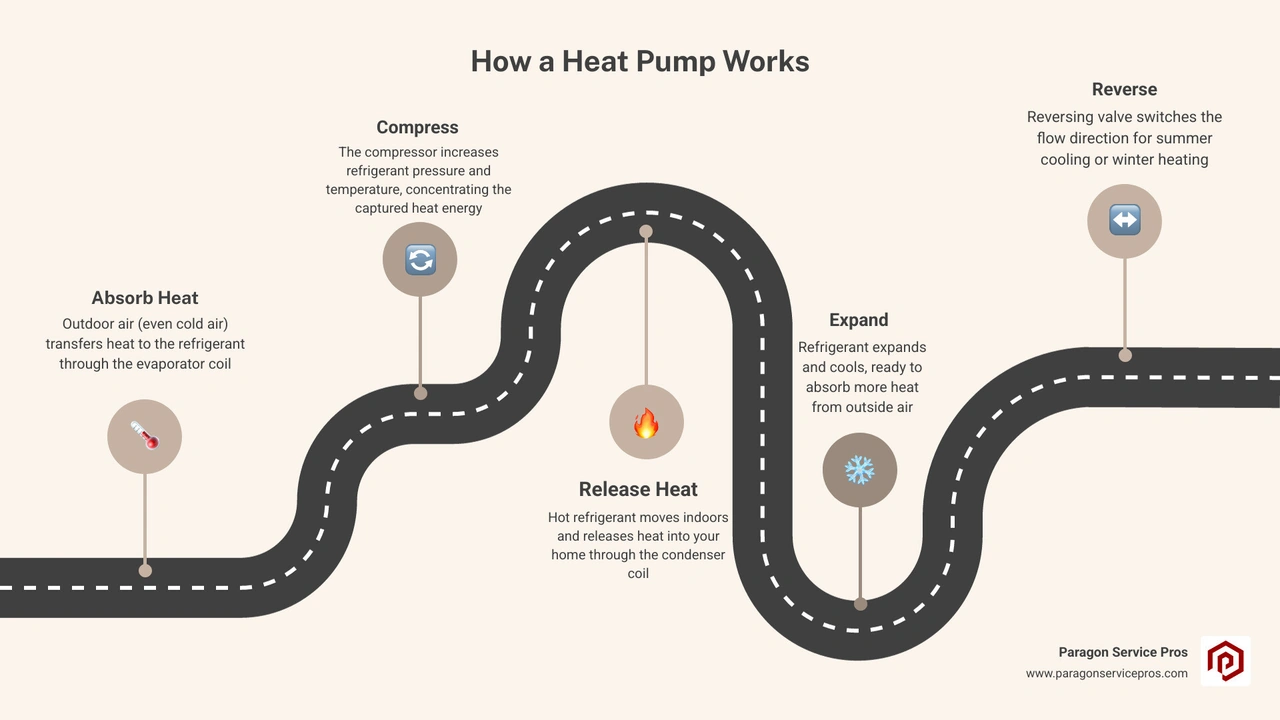
What is a Heat Pump and How Does a Heat Pump Work?
To understand how a heat pump operates, it helps to throw out the idea that heating systems must "create" warmth. Traditional systems like gas furnaces or electric baseboard heaters burn fuel or use high-resistance electric coils to generate heat from scratch.
A heat pump takes a completely different approach. It relies on the laws of thermodynamics, specifically the principle that heat naturally flows from a warmer area to a cooler one. By utilizing a closed loop of chemical refrigerant, a heat pump forces this process to run in reverse when needed. It captures existing heat from the air outside (or from the ground) and pumps it indoors.
Think of it like a refrigerator. Your fridge doesn't actually "cool" your milk by injecting cold air into the cabinet; instead, it extracts the heat from inside the fridge and expels it into your kitchen. If you've ever felt the warm air blowing from the bottom or back of a running refrigerator, you have felt a heat pump cycle in action.
Because they move heat instead of generating it, heat pumps are incredibly efficient. In fact, a typical household heat pump operates with a Coefficient of Performance (COP) of around 4. This means that for every 1 kilowatt-hour (kWh) of electricity the system consumes, it delivers roughly 4 kWh of thermal energy into your home. That represents an efficiency rate of 400%, compared to even the most advanced gas boilers or furnaces, which max out around 95% to 98% efficiency.
This remarkable efficiency is a primary reason why heat pump adoption has skyrocketed globally. As of May 2026, the combined capacity of heat pumps installed in buildings worldwide exceeds 1,000 GW. In Europe alone, 3 million units were sold in 2023, while decentralized systems in China account for over 250 GW of capacity. In the United States, research shows that 70% of homes could significantly reduce their carbon emissions by transitioning to this technology. To learn more about how this fits our local climate, check out the Heat Pump Benefits for Arizona Homeowners.
The Science Behind How Does a Heat Pump Work in the Summer
During our intense Arizona summers, a heat pump acts exactly like a high-performance central air conditioner. The process relies on a continuous vapor-compression cycle that moves through four primary stages:
- Evaporation: The cycle begins indoors. Cool, low-pressure liquid refrigerant circulates through the indoor evaporator coil. As warm indoor air is blown across this coil by your blower fan, the refrigerant absorbs the heat from your air. This causes the indoor air to drop in temperature before it is distributed back through your ductwork. As the refrigerant absorbs this heat, it reaches its boiling point and evaporates into a low-pressure gas.
- Compression: This low-pressure gas travels through copper refrigerant lines to the outdoor unit. Here, the compressor compresses the gas, packing its molecules tightly together. This dramatic increase in pressure causes the temperature of the refrigerant gas to spike, turning it into a superheated, high-pressure vapor.
- Condensation: The hot gas enters the outdoor condenser coil. A large fan blows outdoor air across this coil. Because the refrigerant is much hotter than the outdoor air (even on a 110°F day!), the heat naturally transfers from the coil to the outdoor air. As it loses this heat, the refrigerant condenses back into a high-pressure liquid.
- Expansion: Finally, the warm liquid refrigerant passes through an expansion valve. This valve acts as a metering device, rapidly dropping the refrigerant's pressure. As the pressure plummets, so does the temperature, turning the refrigerant back into a cold, low-pressure liquid, ready to return indoors and repeat the process.
If your system struggles to keep up during a blistering summer afternoon, it could indicate a refrigerant leak or a failing compressor. In those moments, prompt Heat Pump Repair is essential to restore your home's cool comfort.
Reversing the Cycle: How Does a Heat Pump Work in the Winter
When our desert nights turn chilly, you don't need a separate heating system. By adjusting your thermostat, the heat pump simply runs its refrigeration cycle in reverse.
This magic is made possible by a specialized component called the reversing valve. When activated, the reversing valve physically alters the flow of the refrigerant gas.
- The outdoor coil, which acted as a condenser in the summer, now becomes the evaporator.
- Cold liquid refrigerant flows into this outdoor coil. Because the refrigerant is formulated to have an extremely low boiling point, it is much colder than the outdoor air—even when the thermometer drops into the 30s or 40s.
- This temperature difference allows the refrigerant to absorb ambient heat from the outdoor air.
- The compressor then squeezes this warmed gas, raising its temperature significantly.
- The hot gas is sent indoors to the indoor coil, which now acts as the condenser. As indoor air blows across the coil, it absorbs the heat from the hot refrigerant, warming your home.
- The refrigerant cools, condenses, passes through the expansion valve to drop its pressure, and heads back outside to collect more heat.
If you are looking to upgrade an aging, inefficient furnace and AC combo to a unified system, scheduling a professional Heat Pump Installation is the perfect way to secure year-round comfort.
Key Components and Types of Heat Pump Systems
To keep a heat pump running smoothly year after year, it helps to understand what is happening under the hood. Like any precision mechanical system, a heat pump relies on a network of parts working in perfect harmony. Regular Heat Pump Maintenance ensures these components remain clean and calibrated, preventing premature wear and unexpected breakdowns.
Essential System Components
A standard air-source heat pump consists of several critical components divided between your indoor and outdoor spaces:
- The Compressor: Often called the heart of the system, this outdoor component pumps the refrigerant through the loop and increases its pressure and temperature.
- The Reversing Valve: The brain of the operation. This slide-valve redirects the path of the refrigerant, allowing the system to switch between cooling and heating modes seamlessly.
- The Expansion Valve: A thermal expansion valve (TXV) or electronic expansion valve (EEV) regulates the flow of refrigerant, lowering its pressure and temperature before it enters the evaporator coil.
- Coils (Indoor and Outdoor): These copper or aluminum tube-and-fin structures facilitate the heat exchange. The indoor coil is housed in your air handler, while the outdoor coil wraps around the exterior unit.
- Refrigerant: The chemical transport medium (such as R-410A or newer low-GWP alternatives) that cycles between liquid and gas states to carry heat.
- The Air Handler and Blower Fan: Located indoors, this system circulates the conditioned air through your home's ductwork.
Air-Source, Ground-Source, and Ductless Mini-Split Types
While all heat pumps utilize the same vapor-compression cycle, they pull heat from different sources and distribute it in different ways:
- Air-Source Heat Pumps: The most common residential type. These systems extract heat from the outdoor air. They can be configured as ducted systems (connecting to your home's existing central ductwork) or split systems.
- Ductless Mini-Splits: A variation of the air-source system. Instead of using central ducts, a ductless mini-split connects an outdoor condenser to one or more compact indoor air handlers mounted directly on your walls or ceilings. This allows for precise zone-by-zone temperature control.
- Ground-Source (Geothermal) Heat Pumps: These systems utilize a series of underground pipes (loops) filled with water or refrigerant to exchange heat with the earth. Because ground temperatures remain constant (typically between 50°F and 60°F) just a few feet below the surface, geothermal systems are incredibly efficient, though they require significant excavation for installation.
- Absorption Heat Pumps: Rather than using electricity to power a compressor, these systems utilize a heat source—such as natural gas, solar-heated water, or geothermal water—to drive a chemical absorption process (often using an ammonia-water solution) to move heat.
Energy Efficiency and Performance in Extreme Climates
A common misconception is that heat pumps only work in mild, temperate climates. While it is true that older models struggled when temperatures dropped below freezing, modern technology has completely rewritten the rules.
Today's cold-climate heat pumps feature variable-speed compressors and advanced electronic expansion valves that allow them to operate efficiently at outdoor temperatures as low as -22°F. In fact, heat pumps are the primary heating source in over 60% of homes in Norway and 40% in Sweden and Finland, proving their reliability in harsh winter environments.
In hot climates like Arizona, heat pumps are exceptionally robust. High-efficiency models carry SEER2 (Seasonal Energy Efficiency Ratio 2) ratings up to 23+, allowing them to deliver powerful cooling even when outdoor temperatures soar past 110°F. Because they run on electricity and do not burn fossil fuels, they provide a cleaner, safer, and more sustainable way to manage your indoor climate.
To keep these high-efficiency systems running at peak performance, seasonal tune-ups are highly recommended. If you live in the East Valley, scheduling local maintenance is easy with our dedicated teams:
Frequently Asked Questions About Heat Pumps
Do heat pumps work in extreme cold or heat?
Yes. Modern heat pumps are fully capable of handling extreme temperatures. In extreme heat, they function exactly like a standard air conditioner, transferring indoor heat outside.
In extreme cold, standard heat pumps can lose efficiency as the temperature drops below 25°F. To ensure your home stays warm during unusual cold snaps, most ducted heat pumps are equipped with an auxiliary electric heat strip (or can be paired with your existing gas furnace in a "dual-fuel" or hybrid configuration). However, with variable-speed compressor technology, modern units can easily extract sufficient heat from the outdoor air without relying heavily on backup heating.
If your system is blowing lukewarm air or cycling constantly during a weather extreme, don't hesitate to reach out for professional diagnostics, such as Heat Pump Repair Queen Creek AZ or Heat Pump Repair San Tan Valley AZ.
How do heat pumps compare to traditional furnaces?
The primary difference lies in how they manage heat. A furnace burns natural gas, propane, or heating oil (or uses electric resistance coils) to create heat. A heat pump simply moves heat.
Here is a quick comparison of how these systems stack up:
| Feature | Heat Pump | Gas Furnace | Standard Air Conditioner |
|---|---|---|---|
| Primary Function | Both Heating & Cooling | Heating Only | Cooling Only |
| Energy Source | Electricity | Natural Gas / Propane | Electricity |
| Efficiency Rating | SEER2 (Cooling) / HSPF2 (Heating) | AFUE (Annual Fuel Utilization Efficiency) | SEER2 (Cooling Only) |
| Typical Efficiency | 300% to 400% (COP of 3-4) | 80% to 98% AFUE | Up to 100% equivalent |
| Carbon Footprint | Low (Zero direct emissions) | Moderate to High (Fossil fuel combustion) | Low to Moderate (Cooling only) |
| Lifespan | ~15 Years | 15 to 20 Years | 15 to 20 Years |
What incentives are available for heat pump installation?
Because heat pumps are highly efficient and environmentally friendly, there are excellent financial incentives available to help offset your upgrade.
Under the federal Inflation Reduction Act, homeowners can claim a 30% tax credit (up to $2,000 annually) for installing qualified ENERGY STAR certified heat pumps. You can learn more about these savings in our guide on Federal Tax Credits for Heat Pump Upgrades.
Additionally, local utility companies often offer lucrative rebates for upgrading to high-efficiency systems. Our team can help you navigate these incentives and select a system that qualifies for maximum savings in your area:
- Heat Pump Installation Chandler AZ
- Heat Pump Installation Mesa AZ
- Heat Pump Installation Gilbert AZ
- Heat Pump Installation Queen Creek AZ
- Heat Pump Installation San Tan Valley AZ
Conclusion
A heat pump is one of the smartest, most efficient investments you can make for your home's year-round comfort. By moving heat rather than creating it, these systems deliver exceptional climate control while keeping your energy bills manageable.
At Paragon Service Pros, we are proud to serve homeowners across Arizona, including Chandler, Gilbert, Gold Canyon, Mesa, Queen Creek, and San Tan Valley. Whether you need a seasonal safety inspection, a quick repair, or a complete system replacement, we are committed to providing unparalleled service, complete transparency, and quality workmanship.
To keep your system running reliably through every season, remember to schedule regular maintenance:
Ready to upgrade your home's comfort and efficiency? Schedule professional HVAC service today with the friendly experts at Paragon Service Pros!
Keep reading: Heat Pumps & Ductless
Browse every article in Heat Pumps & Ductless or head back to the Learning Center .
Comfort you can count on, all year long.
Same-day service, honest diagnostics, and 24/7 emergency help with no overtime fees. A real Greater Phoenix team is standing by.