
Cooler Than a Cactus: Finding the Best HVAC Setup for AZ
Beat AZ heat! Discover the best hvac setup for arizona weather, from sizing to heat pumps and SEER2 efficiency. Stay cool!

Why Finding the Best HVAC Setup for Arizona Weather Is a Matter of Survival
The best HVAC setup for Arizona weather depends on your home's size, existing ductwork, and location — but for most Arizona homeowners, a high-efficiency central AC or heat pump with a SEER2 rating of 16.2 or higher is the strongest starting point.
Quick answer — best HVAC configurations for Arizona:
| Home Type | Best System | Why It Works |
|---|---|---|
| Larger home with existing ductwork | High-efficiency central AC or heat pump (SEER2 16.2+) | Whole-home cooling, cost-effective, quieter |
| Home without ductwork | Ductless mini-split system | No duct losses, zoned control, easier install |
| All-electric home | Heat pump (dual heating + cooling) | 2–3.5x more efficient than resistance heat in mild AZ winters |
| Additions, casitas, garages | Single-zone ductless mini-split | Targeted cooling without extending ductwork |
| Mixed needs (zone control) | Multi-zone mini-split or zoned central system | Independent room control, energy savings |
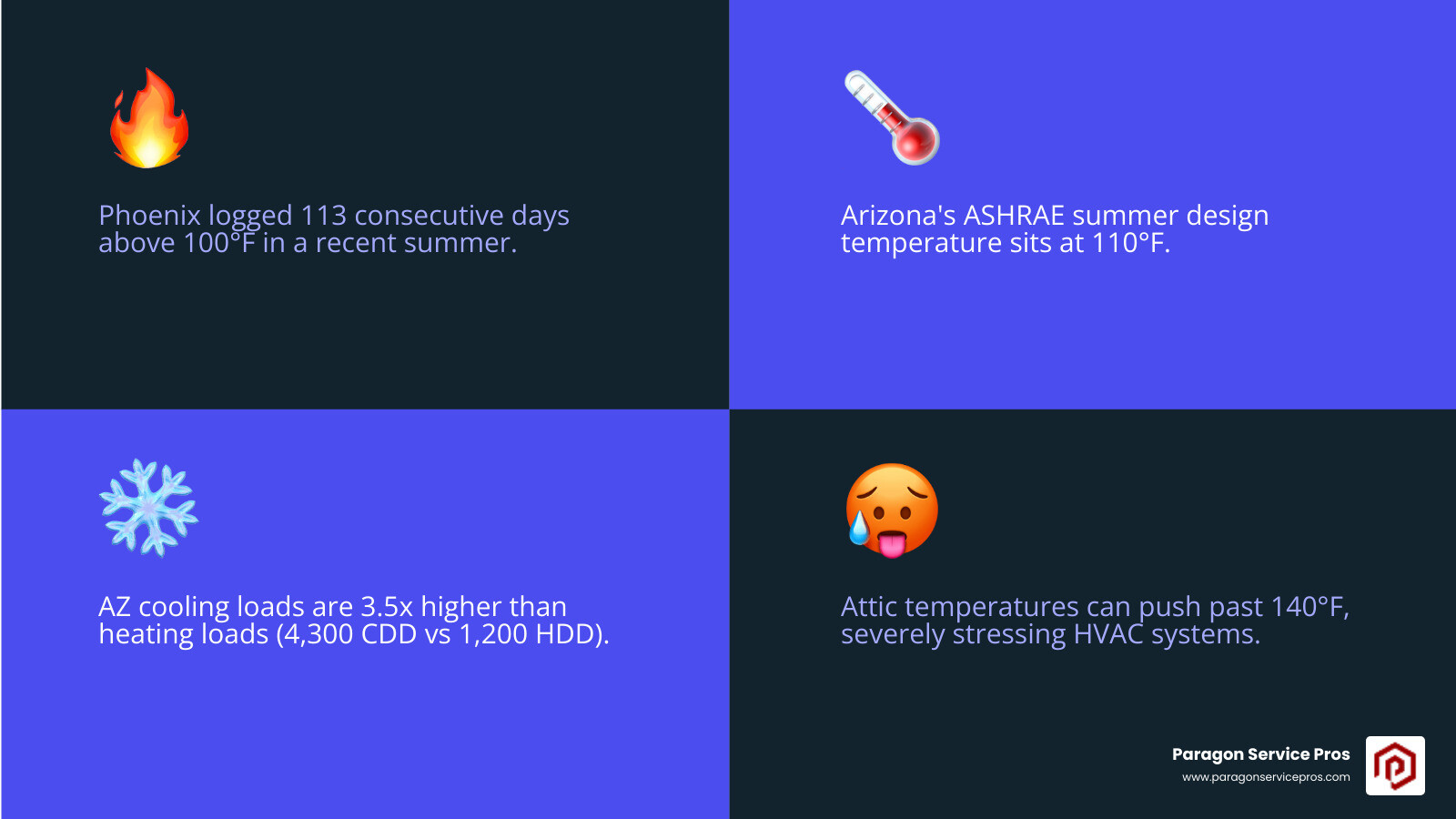
Phoenix logged 113 consecutive days above 100°F in a recent summer. That is not a comfort problem — it is a health problem. In the East Valley cities of Chandler, Gilbert, Mesa, Queen Creek, and San Tan Valley, your air conditioner runs from April through October, sometimes longer. It works harder than virtually any other AC system in the country.
Arizona's ASHRAE summer design temperature sits at 110°F, which means your compressor is constantly working near its limit. Add monsoon humidity spikes, dust storms, and attic temperatures that can push past 140°F, and you have conditions that expose every weakness in an undersized, oversized, or poorly matched HVAC system fast.
The good news: when you choose the right system for your home and have it properly installed, you can cut energy bills significantly and stay genuinely comfortable — even on the worst days of a desert summer.
Unique Climate Challenges for Arizona HVAC Systems
Living in the Sonoran Desert means our relationship with our HVAC system is different than almost anywhere else in the country. In many states, air conditioning is a luxury used for a few weeks in July. Here in cities like Mesa and Gilbert, it is a survival necessity for nearly half the year.
The first major challenge is the sheer intensity of the heat. Phoenix averages approximately 4,300 Cooling Degree Days (CDD) compared to only 1,200 Heating Degree Days (HDD). This means our cooling loads are 3.5 times higher than our heating loads. When the outdoor temperature hits that 110°F design dry-bulb temperature, your HVAC unit isn't just "running"—it’s in a marathon.
Then come the monsoons. While Arizona is generally arid, the monsoon season (June through September) introduces humidity spikes and violent dust storms, or haboobs. High humidity makes it harder for your AC to cool the air because it has to work double-duty to remove moisture. Meanwhile, dust storms can clog your outdoor condenser coils and indoor filters in a matter of hours. If you find your system struggling during a storm, you might need HVAC Repair Gilbert AZ to clear out the desert grit that’s choking your airflow.
Finally, we have to talk about the "attic oven." Most Arizona homes are slab-on-grade with ductwork running through the attic. During a 115°F day, your attic can easily reach 150°F. If your ducts aren't perfectly sealed and insulated, you’re losing a massive amount of cooling before the air even reaches your living room. This is why regular HVAC Service Mesa AZ is so critical; we ensure your system isn't fighting a losing battle against your own roof.
Determining the Best HVAC Setup for Arizona Weather Through Proper Sizing
One of the most expensive mistakes an Arizona homeowner can make is guessing the size of their new unit. Many people fall for the "bigger is better" myth, thinking a 5-ton unit will cool a 3-ton house faster. In reality, an oversized unit "short-cycles," turning on and off rapidly. This leads to uneven temperatures, high energy bills, and poor humidity control during monsoon season.
To find the best HVAC setup for Arizona weather, we use a professional Manual J load calculation. This isn't just a square footage estimate. It’s a deep dive into your home’s specific "X-factors," including:
- Insulation Levels: What’s hiding in your walls and attic?
- Window Orientation: Do you have massive west-facing windows soaking up the afternoon sun?
- Radiant Heat: How much heat is your stucco or brick holding onto?
- Ceiling Height: Vaulted ceilings require more "throw" from your vents.
If you’re looking at a Central HVAC Installation Guide Queen Creek AZ, you’ll see that sizing is the foundation of efficiency. A properly sized unit runs longer, steadier cycles, which is exactly what you need for consistent comfort. For those considering HVAC Installation Chandler AZ, always insist on a Manual J calculation rather than a "rule of thumb."
Symptoms of Improper HVAC Sizing
| Feature | Undersized System | Oversized System |
|---|---|---|
| Run Time | Runs constantly without reaching thermostat goal | Turns on/off every few minutes (short-cycling) |
| Humidity | May dehumidify well but can't lower temp | House feels "clammy" because it doesn't run long enough to pull out moisture |
| Energy Bills | Extremely high due to constant operation | High due to frequent "startup" power surges |
| Lifespan | Shortened due to overwork | Shortened due to excessive wear on the compressor |
Comparing System Types: Central AC, Heat Pumps, and Ductless Mini-Splits
When choosing the best HVAC setup for Arizona weather, you generally have three main contenders. Each has its place depending on your home's architecture and your comfort goals.
Traditional Central Air Conditioning: These are the standard split systems most of us grew up with. They use an outdoor condenser and an indoor evaporator coil (often paired with a gas furnace). They are excellent for whole-home cooling if you already have functional ductwork. If you need HVAC Service San Tan Valley AZ, we often find these systems are the workhorses of the desert.
Heat Pumps: Don't let the name fool you—a Heat Pump is essentially an air conditioner that can run in reverse. In the summer, it pumps heat out of your house. In our mild Arizona winters, it pulls heat from the outdoor air and moves it inside. Because it moves heat rather than generating it, it’s incredibly efficient for Heating when the desert nights get chilly.
Ductless Mini-Splits: These systems consist of an outdoor unit connected to one or more indoor air handlers mounted on the wall. They are the champions of Air Conditioning efficiency because they eliminate duct loss entirely. Since Arizona attics are so hot, not having ducts in that 150°F space can save you up to 30% on your energy bill.
Why a Heat Pump is Often the Best HVAC Setup for Arizona Weather
In the Phoenix metro area, we rarely see the deep freezes that require a heavy-duty gas furnace. This makes the heat pump an ideal candidate for the best HVAC setup for Arizona weather.
Heat pumps deliver heating at Coefficient of Performance (COP) values of 2.0–3.5. In plain English, that means they are 2 to 3.5 times more efficient than electric resistance heaters. They provide a gentle, consistent warmth that is perfect for a January night in Mesa. If you are considering HVAC Installation Mesa AZ, a high-efficiency heat pump is often the most balanced technical and economic choice for year-round comfort.
Using Ductless Mini-Splits as the Best HVAC Setup for Arizona Weather in Specific Rooms
Sometimes, your central AC is fine, but you have that one "problem room." Maybe it’s a garage conversion, a backyard casita, or a home office with a west-facing wall that stays five degrees warmer than the rest of the house.
For these scenarios, a ductless mini-split is the best HVAC setup for Arizona weather. It allows for "zoned cooling," meaning you only cool the room you’re actually using. If you’re planning an HVAC Installation Queen Creek AZ for a new addition, a mini-split avoids the massive expense and mess of trying to tie new ductwork into an old system.
Maximizing Efficiency with SEER2 and Variable-Speed Technology
As of 2023, the federal government updated efficiency standards from SEER to SEER2. In the Southwest region (including Arizona), the minimum SEER2 rating for central AC and heat pumps is 15.2. However, for the best HVAC setup for Arizona weather, we recommend looking at 16.2 SEER2 or higher.
The real "magic" in modern HVAC technology is the variable-speed compressor. Traditional AC units are either 100% on or 100% off—it’s like driving a car that only goes 0 or 70 mph. Variable-speed systems are like cruise control. They can ramp down to 30% or 40% capacity to maintain a steady temperature.
This technology is a game-changer for Arizona homeowners because:
- It manages humidity: By running at a lower speed for longer periods, it pulls more moisture out of the air during monsoon season.
- It’s quieter: You won't hear that giant "clunk" every time the system kicks on.
- It saves money: Lower speeds use significantly less electricity.
If your current system is over 10 years old, an HVAC Replacement Chandler AZ with a variable-speed unit could cut your energy bills by up to 50%. To keep that high-tech system running perfectly, don't forget your seasonal HVAC Maintenance Gilbert AZ to ensure the sensors and electronics stay clean and calibrated.
Essential Features for Durability and Indoor Air Quality
Arizona's environment is harsh on machinery. To ensure your system lasts its full 12–15 year expected lifespan, you need to prioritize durability features.
Corrosion-Resistant Coils: Monsoon moisture combined with desert dust can lead to "formicary corrosion" on copper coils. We recommend systems with all-aluminum or specially coated coils to prevent leaks. This is especially important for HVAC Repair Queen Creek AZ calls where we often see older copper coils failing prematurely.
Advanced Filtration: Desert dust isn't just an outdoor problem; it gets into your lungs and your HVAC equipment. We recommend using filters with a MERV rating between 8 and 11. These are strong enough to catch dust and allergens without putting too much "static pressure" or strain on your blower motor. For those in the East Valley, HVAC Maintenance San Tan Valley AZ should always include a thorough check of your filtration system.
UV Air Purifiers: With our long cooling seasons, condensation can sit in the drain pan, potentially leading to biological growth. Installing a UV germicidal lamp inside your air handler can neutralize these particles before they circulate through your home.
Common Misconceptions About Desert HVAC Performance
We hear a lot of "neighborly advice" that can actually hurt your HVAC system. Let's clear up the two biggest myths:
Myth 1: "Bigger is Better." As we mentioned, an oversized unit is a disaster for your energy bill and your comfort. It cools the air so fast that it doesn't have time to pull the humidity out, leaving you with a home that feels like a cold, damp cave.
Myth 2: "Turning the AC off when you leave saves money." In Arizona, if you turn your AC off at 8:00 AM and come home at 5:00 PM, your house might be 95°F. Your AC will then have to run at 100% capacity for hours to cool down the "thermal mass" of your walls, furniture, and flooring. It’s much more efficient to set the thermostat up about 5-7 degrees while you’re gone.
If you’re constantly having "thermostat wars" in your house, it might be time for HVAC Service Chandler AZ to look at your ductwork or suggest a zoned system. And remember, the best way to avoid a mid-July breakdown is a pre-season HVAC Maintenance Mesa AZ visit.
Frequently Asked Questions about Arizona HVAC Systems
How long does an HVAC system last in the Arizona heat?
In more temperate climates, a system might last 20 years. In the Arizona desert, the extreme stress of 110°F+ summers means a properly maintained system typically lasts 12–15 years. If you neglect regular HVAC Maintenance Chandler AZ, that lifespan can drop to under a decade.
What SEER2 rating is recommended for Phoenix-area homes?
While 14.3 is the absolute minimum, we strongly recommend a 16.2 SEER2 or higher. Because our cooling season is so long (April to October), the "return on investment" for a higher-efficiency unit happens much faster here than it would in the Midwest. An HVAC Replacement Mesa AZ with a high-efficiency unit is one of the few home upgrades that actually pays for itself in utility savings.
Are there rebates available for high-efficiency upgrades in AZ?
Yes! Local utilities like APS and SRP frequently offer rebates ranging from $200 to $1,000 for high-efficiency installations. Additionally, federal tax credits under the Inflation Reduction Act can provide significant savings for qualifying heat pumps and central AC units. When we perform an HVAC Installation Gilbert AZ, we can help you identify which current incentives apply to your new system.
Conclusion: Partner with the Desert Experts
Choosing the best HVAC setup for Arizona weather is about more than just picking a brand name; it’s about engineering a system that can stand up to the relentless Sonoran sun. At Paragon Service Pros, we live and work in the same heat you do. We know that a broken AC in July isn't just an inconvenience—it’s an emergency.
Whether you need a quick repair in Gilbert, a seasonal tune-up in San Tan Valley, or a full system replacement in Mesa, our team is committed to quality workmanship and complete transparency. We don't just install boxes; we provide long-term comfort solutions tailored to the East Valley.
Ready to upgrade your home's "survival system"? As your premier HVAC Company Chandler AZ, we are here to ensure your home stays cooler than a cactus all summer long. Contact us today for all your HVAC needs!
Keep reading: Air Conditioning
Browse every article in Air Conditioning or head back to the Learning Center .
Comfort you can count on, all year long.
Same-day service, honest diagnostics, and 24/7 emergency help with no overtime fees. A real Greater Phoenix team is standing by.