
Switching from Heat to Cool This Spring
Master your spring hvac transition from heating to cooling with our Arizona checklist: switch thermostats, clean units, test AC, and boost efficiency now!

Why the Spring HVAC Transition From Heating to Cooling Matters in Arizona
The spring hvac transition from heating to cooling is one of the most important things Arizona homeowners can do before summer heat arrives. In places like Mesa, Gilbert, Queen Creek, and Chandler, daytime temperatures can swing 40 degrees or more in a single day during April — meaning your system may need heat at 6 a.m. and cooling by early afternoon.
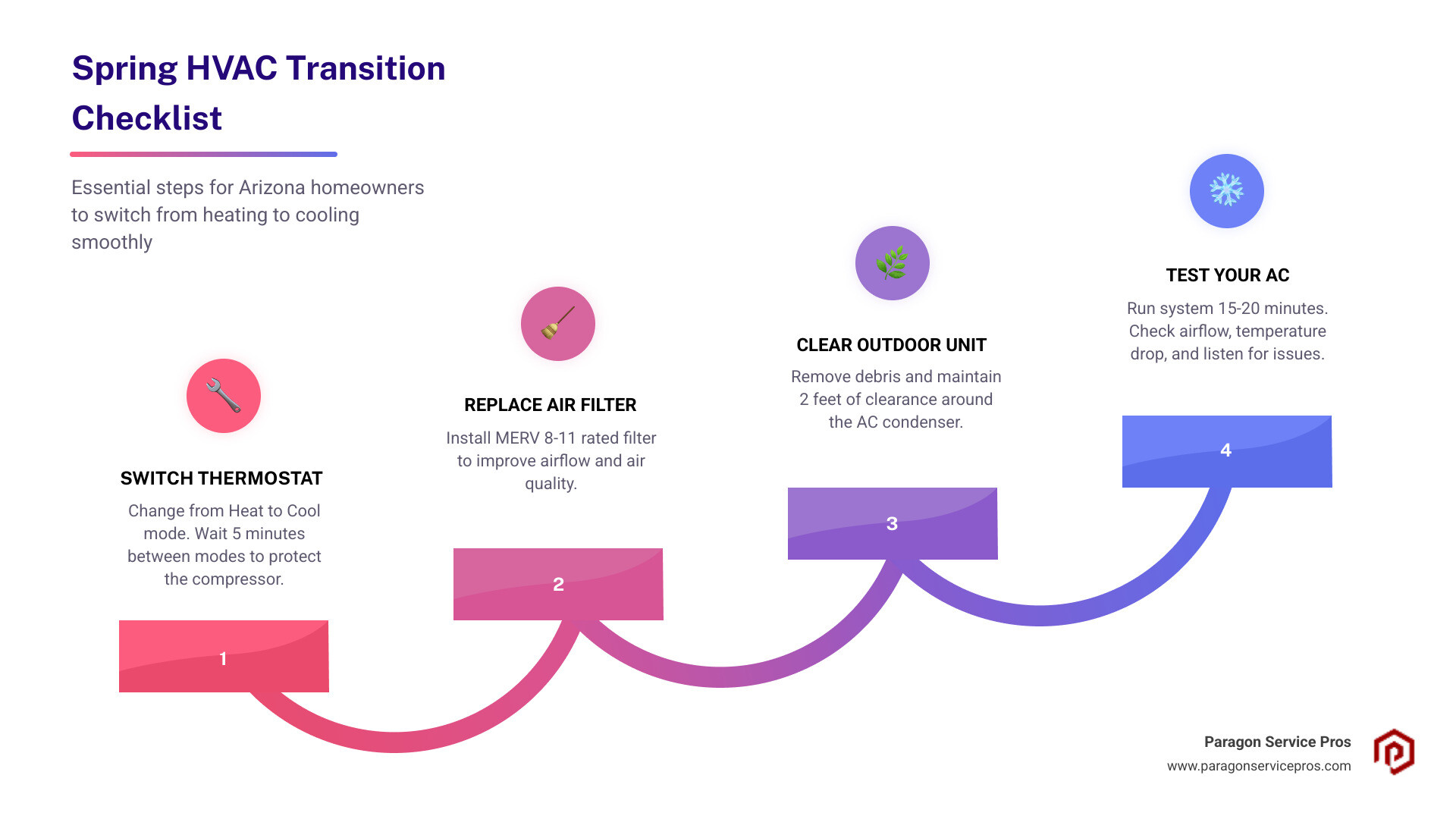
Here is a quick overview of what the spring HVAC transition involves:
- Switch your thermostat from Heat to Cool mode (wait 5 minutes between modes)
- Replace your air filter with a MERV 8-11 rated filter
- Clear debris from around your outdoor unit (keep 2 feet of open space)
- Test your AC by running it for 15-20 minutes before peak heat arrives
- Flush the condensate drain line to prevent clogs and water damage
- Schedule a professional tune-up before HVAC companies get fully booked
Most Arizona homeowners should make the switch when daytime highs consistently reach the mid-70s to mid-80s and nighttime lows stay above 60°F — typically between mid-March and mid-April.
If you wait until the first 105-degree day to find out your AC isn't working, you could be looking at days without cooling while waiting for a technician. Spring is the window to get ahead of that.
This guide walks you through every step of the process — from knowing exactly when to flip the switch, to testing your system, to spotting problems before they become expensive repairs.
When to Schedule Your Spring HVAC Transition From Heating to Cooling
Timing is everything when it comes to your home comfort system. In the East Valley, we don't have a long "shoulder season." One week we’re wearing light jackets, and the next, the sun is beating down on the pavement. Generally, mid-March is the "sweet spot" to begin your Seasonal Air Conditioning Preparation Tips.
By April 2026, the desert sun is already gaining strength. You want to ensure your system is ready before the first triple-digit spike. If you wait until the mercury hits 100°F, you'll find that every HVAC company in Mesa and Gilbert is booked out for days. Scheduling your AC Maintenance Mesa AZ in early spring ensures you get a priority slot and that your system is clean before it has to work its hardest.
Temperature Thresholds for a Smooth Spring HVAC Transition From Heating to Cooling
So, how do you know when to officially put the heater to bed for the year? A good rule of thumb for our Arizona climate is the "70/60 Rule."
- Daytime Highs: When afternoon temperatures consistently reach the 70°F to 80°F range.
- Nighttime Lows: When lows stay above 60°F.
Once you hit these markers, you likely won't need the furnace to kick on in the middle of the night. This is the perfect time to review AC Maintenance San Tan Valley Tips and prepare for the cooling season. If you still feel a slight chill in the early morning, consider using a light blanket or opening the curtains to let the sun naturally warm your home rather than toggling the heat back on.
How to Properly Switch Your Thermostat Mode
It sounds simple—just flip the switch, right? Not quite. Abruptly switching between heating and cooling can actually strain your compressor. To protect your equipment, follow these steps:
- Turn the system to "Off": Let the current cycle finish completely.
- Wait 5 Minutes: This allows the refrigerant pressures to equalize. This "dead time" prevents a "hard start," which can damage the compressor over time.
- Select "Cool": Switch the mode to cooling.
- Set the Temperature: Adjust the setpoint to about 5 degrees below the current indoor temperature to trigger a test run.
If your thermostat screen is fading or unresponsive, it might be time for AC Thermostat Calibration or a simple battery replacement. Many homeowners prefer the "Auto" setting during the spring hvac transition from heating to cooling, which allows the system to switch between modes automatically based on a set temperature range.
Essential Steps to Prepare Your System for Summer
Preparing for an Arizona summer is like preparing a car for a cross-country road trip. You wouldn't just start driving through the Mojave Desert without checking the oil and tires. Your HVAC system needs the same level of care.
First, let's talk about the "lungs" of your system: the air filter. During the spring, desert winds kick up a lot of dust and pollen. A clogged filter restricts airflow, forcing your system to work harder and use more energy. We recommend using a filter with a MERV 8 to 11 rating. This provides excellent filtration for dust and allergens without putting too much "static pressure" or strain on your blower motor. Regular HVAC Maintenance starts with a fresh filter every 30 to 60 days during peak use.
Next, head outside to your condenser unit. Over the winter, dead leaves, spider webs, and desert debris can accumulate around the base.
- Clear the Area: Ensure there is at least a 2-foot clearance around the entire unit. Air needs to flow freely into the coils to release heat.
- Gentle Cleaning: Use a garden hose (never a pressure washer!) to gently rinse away dust from the exterior fins.
- Check the Drain: Locate your condensate drain line (the PVC pipe). Algae and mold love the warm, moist environment inside these pipes. A simple vinegar flush can prevent a clog that might otherwise lead to water damage inside your home. This is a standard part of a professional AC Annual Service.
Testing Your Air Conditioning Before the Arizona Heat Hits
Don't wait for a heatwave to find out your AC is blowing lukewarm air. Perform a "stress test" on a mild April afternoon. Turn the system to cool and let it run for about 15 to 20 minutes.
While it's running, check for these 11 Signs Your AC Needs Professional Maintenance:
- Supply Air Temperature: The air coming out of the vents should be 15-20 degrees cooler than the air going into the return.
- Airflow: Check that air is blowing strongly from all vents.
- Noises: Listen for rattling, grinding, or squealing.
- Odors: A musty smell could indicate mold in the ducts, while a metallic or burning smell could mean electrical issues.
Optimizing Efficiency During the Spring HVAC Transition From Heating to Cooling
Efficiency isn't just about saving money; it's about reducing the wear and tear on your system so it lasts longer. One of the best ways to manage Maximizing Energy Efficiency: Tips for Your AC Unit is by upgrading to a smart thermostat.
Smart thermostats allow you to set a "deadband"—a temperature range where neither the heat nor the AC runs. This prevents the system from "short cycling" or hunting for a specific degree during those 40-degree Arizona temperature swings.
Manual vs. Smart Thermostat Comparison
| Feature | Manual Thermostat | Smart Thermostat |
|---|---|---|
| Schedule | Must be adjusted daily | Learns your routine & automates |
| Remote Access | None | Control via smartphone in Chandler or Gilbert |
| Energy Savings | Approx. 0-3% | Approx. 10-12% annually |
| Mode Switching | Manual only | Automatic "Auto" mode with built-in delays |
Don't forget your ceiling fans! In the spring, ensure your fans are rotating counter-clockwise. This creates a downdraft that provides a "wind chill" effect, allowing you to set your thermostat a few degrees higher without losing comfort. Also, take a walk around your home to check for air leaks. Sealing gaps around windows and doors keeps the cool air in and the desert heat out, which is a vital part of HVAC Maintenance Gilbert AZ.
Addressing Humidity and Allergens in the Desert
While Arizona is known for its "dry heat," spring brings its own set of air quality challenges. Pollen season can be brutal in Queen Creek and San Tan Valley, and those infamous dust storms (haboobs) can begin as early as late spring.
Using high-quality MERV filters is your first line of defense. If you suffer from severe allergies, you might consider an indoor air quality system or a whole-home air purifier. These systems work alongside your Air Conditioning Services to scrub the air of microscopic irritants, keeping your family breathing easy even when the desert wind is howling.
Troubleshooting Common Issues and When to Call a Professional
Sometimes, despite your best efforts, the spring hvac transition from heating to cooling reveals underlying problems. If you notice any of the following, it’s time to call in the pros:
- Short Cycling: If the AC turns on and off every few minutes, it could be a failing capacitor or a clogged filter.
- Frozen Coils: If you see ice on the indoor or outdoor lines, turn the system off immediately. This usually indicates a refrigerant leak or severe airflow restriction.
- Electrical Smells: A "burning plastic" scent often points to overheating wires or a failing motor.
- Tripped Breakers: If your AC keeps tripping the circuit breaker, there is an electrical draw issue that needs professional AC Maintenance Chandler AZ.
Your system has been under stress all winter providing heat. Transitioning to cooling adds a different kind of pressure. Catching a small refrigerant leak or a worn-out fan belt during a spring Heating Maintenance Mesa AZ visit can save you from a total system collapse in July.
Frequently Asked Questions About Spring HVAC Transitions
Is it okay to switch between heat and AC on the same day?
Yes, it is perfectly safe as long as you follow the 5-minute delay rule. In Arizona, it’s common to need the heater at 5 a.m. and the AC by 2 p.m. Most modern smart thermostats handle this automatically in "Auto" mode, ensuring the compressor doesn't start too quickly after the heat cycle ends.
Why is my AC blowing warm air during the first spring test?
First, check your thermostat settings to ensure it’s actually on "Cool" and not just "Fan." Next, check your breaker panel. If the indoor fan is blowing but the outdoor unit isn't running, the air will feel warm. If the outdoor unit is running but the air isn't cold, you likely have a refrigerant issue or a failing compressor component. This is a common reason for AC Maintenance Queen Creek AZ calls.
How often should I change my filters in the Arizona spring?
In the East Valley, we recommend checking your filters every month. While a filter might last three months in other climates, our dust accumulation is much higher. If you live near new construction in San Tan Valley or have pets, you may need a fresh filter every 30 days to maintain proper HVAC Maintenance San Tan Valley AZ.
Conclusion: Ensuring a Comfortable Summer in Arizona
The spring hvac transition from heating to cooling doesn't have to be a stressful event. By following these simple steps—changing your filters, clearing your outdoor unit, and testing the system early—you can head into the summer months with confidence.
At Paragon Service Pros, we know that your home is your sanctuary against the Arizona heat. We take pride in providing unparalleled service and quality workmanship to our neighbors in Mesa, Chandler, Gilbert, and beyond. Don't wait for the first heatwave to find out if your system is up to the task.
Whether you need a quick tune-up or a comprehensive Maintenance Plan to protect your investment year-round, our team is here to help. Reach out to us for expert HVAC Maintenance Mesa AZ and ensure your home stays cool, efficient, and comfortable all summer long.
For more information on our full range of services, visit /hvac.
Keep reading: Heating & Furnaces
Browse every article in Heating & Furnaces or head back to the Learning Center .
Comfort you can count on, all year long.
Same-day service, honest diagnostics, and 24/7 emergency help with no overtime fees. A real Greater Phoenix team is standing by.