
The Ductless Diaries: How to Cool an Older Home Without Vents
Discover adding cooling without ductwork options compared: Mini-splits vs. window units for older Arizona homes. Efficient, vent-free cooling!

Adding Cooling Without Ductwork Options Compared: What Arizona Homeowners Need to Know
Adding cooling without ductwork options compared side by side is the fastest way to find the right fit for your home. Here's a quick overview:
| Option | Best For | Efficiency | Installation |
|---|---|---|---|
| Ductless mini-split | Whole-home or multi-room cooling | Highest (up to 35 SEER2) | Professional required |
| Window AC unit | Single room, budget-conscious | Moderate (10–15 EER) | DIY-friendly |
| Portable AC | Renters, temporary use | Lowest (8–12 EER) | No installation |
| Through-the-wall unit | Permanent single-room solution | Moderate (12–16 SEER2) | Moderate complexity |
| Evaporative cooler | Dry climates only | High in arid regions | Professional or DIY |
Older homes in Mesa, Gilbert, Chandler, and across the East Valley were built long before central air conditioning became standard. Many have narrow walls, no attic space for ductwork, and layouts that make retrofitting traditional HVAC a costly, disruptive project. According to industry data, adding new ductwork to an existing home can cost tens of thousands of dollars on top of the AC system itself — before a single room gets cool.
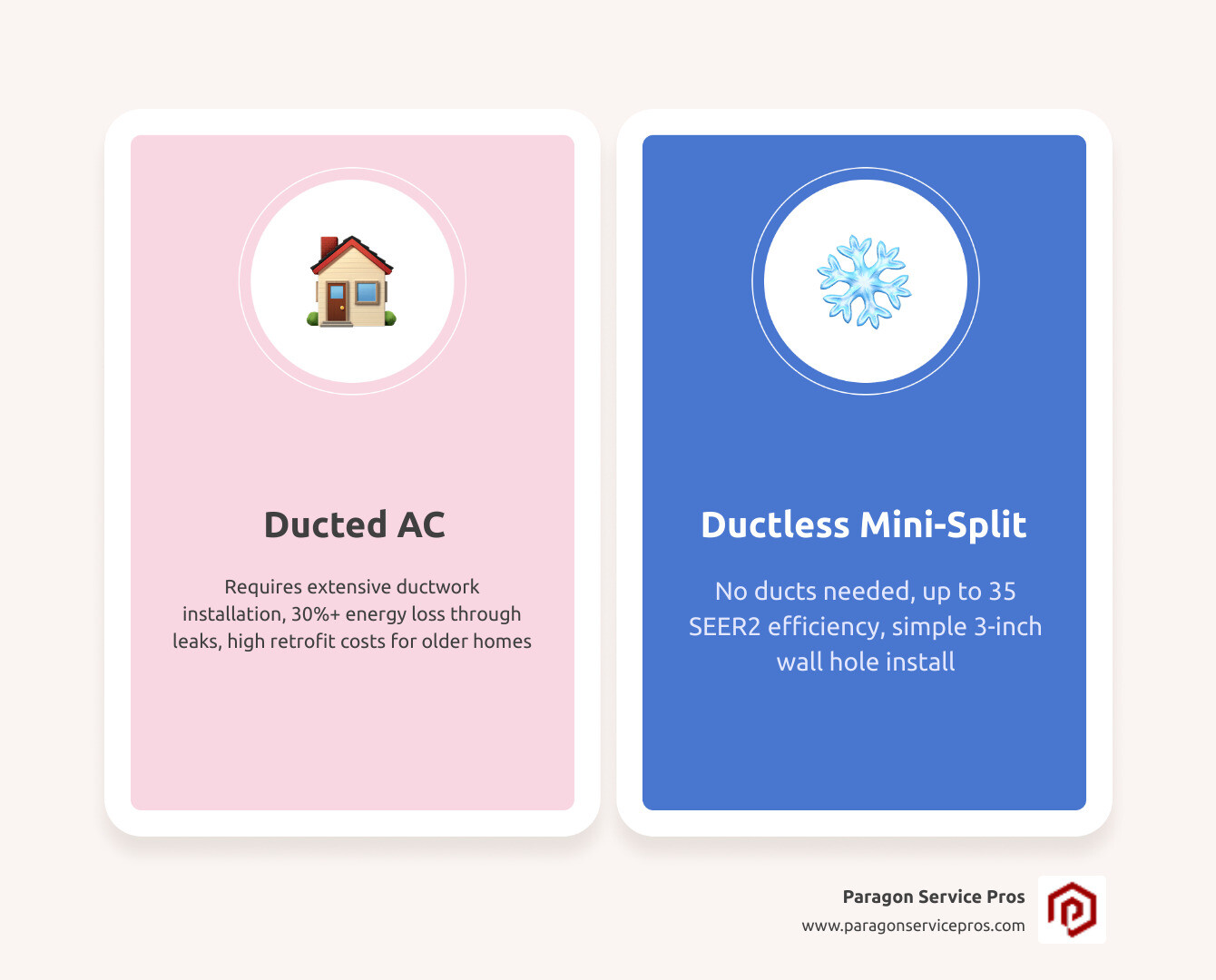
That's where ductless technology changes the game. Modern ductless systems — especially mini-splits — deliver powerful, zoned comfort through a small refrigerant line that passes through a three-inch hole in an exterior wall. No vents. No major renovation. And because they skip the ductwork entirely, they also avoid the energy losses that can eat up more than 30% of a central system's output.
This guide breaks down every practical option for cooling an older home without vents, so you can make a confident, informed decision.
Understanding Ductless Mini-Split Systems for Arizona Homes
When we talk about the gold standard of cooling without vents, we are talking about Mini-Split Systems. Unlike a central unit that sits in a closet or on the roof and pushes air through a spiderweb of metal pipes, a mini-split is a "split" system because it separates the cooling process into two main parts: an outdoor compressor and one or more indoor air handlers.
These components are connected by a small conduit housing the power cable, refrigerant tubing, and a condensate drain. For homeowners in Queen Creek or San Tan Valley, this means we don't have to tear apart your beautiful lath-and-plaster walls or drop your ceilings to find space for bulky ducts.
One of the most impressive features of these systems is inverter technology. Traditional AC units are either "on" or "off." They blast cold air until the thermostat is satisfied, then shut down. Inverter-driven compressors, however, act more like a dimmer switch. They adjust their speed to maintain a perfectly consistent temperature. This makes our Mini-Split Service a favorite for those who want to avoid the "hot and cold" cycles common with older technology.
Zoned comfort control is the other major win. Each indoor unit has its own thermostat. If you want the master bedroom at 68 degrees but the guest room at 75, you can do that. This flexibility is perfect for Arizona homes where certain rooms might get blasted by the afternoon sun while others stay shaded.
Adding Cooling Without Ductwork Options Compared: Mini-Splits vs. Traditional Units
When adding cooling without ductwork options compared to traditional portable or window units, the differences in performance and long-term value become clear very quickly. While a window unit might seem like a quick fix for a hot San Tan Valley afternoon, it comes with several "hidden" drawbacks that homeowners often regret.
Window Air Conditioners
Window units are the most common alternative, but they are often noisy and inefficient. They block your natural light, create a security risk by making windows easier to breach, and often allow hot Arizona air to leak in around the edges. Furthermore, they struggle with the extreme 110-degree days we see in Gilbert and Mesa, often running constantly without ever truly reaching a comfortable temperature.
Portable AC Units
Portable units are popular for renters because they require no permanent changes to the home. However, research shows that single-hose portable units are remarkably inefficient. They actually create negative pressure in the room, pulling hot outdoor air in through cracks in doors and windows to replace the air they are blowing out the exhaust hose. In our dry, hot climate, this often feels like fighting a losing battle.
Through-the-Wall Units
These are essentially more permanent window units. They require cutting a large hole in your exterior wall, which can be structurally tricky in older homes. While they offer a better seal than window units, they remain significantly louder and less efficient than a modern mini-split.
When looking at Ductless vs. Ducted Air Conditioning, the energy efficiency gap is staggering. Ductless systems can achieve SEER2 ratings as high as 35, while even high-end ducted systems often top out around 25. If you currently have an old, failing central unit or a series of loud window shakers, a Mini-Split Replacement can drastically reduce your monthly utility consumption.
Why a Mini-Split is Often the Best Choice for Older Properties
Older properties in Gold Canyon or Chandler often have a unique architectural charm that we want to preserve. Installing a central HVAC system usually means sacrificing closets, lowering ceilings for bulkheads, or adding unsightly soffits to hide ductwork. A mini-split allows us to keep the historical integrity of the home intact.
Room Additions and Garage Conversions
If you’ve recently added a "mother-in-law" suite or converted your Mesa garage into a workspace, extending your existing central AC is rarely the best move. Most central systems aren't sized to handle the extra square footage, which can lead to the entire system wearing out prematurely. Our Ductless Mini-Split Guide Gilbert, AZ highlights how these units provide independent cooling for these specific spaces without straining your main system.
Energy Standards in 2026
As of April 2026, energy standards have become even more stringent. Modern ductless units are designed to meet these new SEER2 requirements, ensuring they use the absolute minimum amount of electricity. Many of these units carry ENERGY STAR certifications, which not only signifies high performance but also makes them eligible for various incentives. For those looking for a deep dive into the technical side, checking out a Ductless Mini-Split Installation Provo Guide can provide further context on how these systems are implemented in various climates, though our focus remains on the specific needs of the Arizona desert.
Alternative Solutions for Desert Climates: Evaporative Coolers and High-Velocity Systems
While mini-splits are the most popular choice, they aren't the only way to cool a home without traditional ducts. In Arizona, we have a few other specialized options to consider.
Evaporative "Swamp" Coolers
In the low-humidity environment of the East Valley, evaporative coolers can be highly effective during the "dry" heat of early summer. They work by pulling hot air through water-soaked pads, using evaporation to lower the air temperature. They use significantly less electricity than standard AC. However, once the monsoon season hits and humidity rises, swamp coolers lose their effectiveness and can make your home feel sticky and uncomfortable.
High-Velocity Systems
If you absolutely want the look of central air (small vents) but don't have space for standard 12-inch ducts, a high-velocity system might be the answer. These use flexible, small-diameter tubing (about 2 inches wide) that can be snaked through walls and ceilings like electrical wiring. While they are great for historic preservation, they can be noisier than mini-splits due to the high speed of the air coming through the small vents.
Passive Strategies and Fans
We often recommend "stacking" your cooling strategies. Whole-house fans can flush out hot attic air in the evenings, and thermal mass cooling (keeping blinds closed during the day) helps reduce the workload on your primary system. Whether you choose a swamp cooler or a high-velocity setup, professional Mini-Split Installation remains the most reliable year-round solution for the Arizona heat. You might also find helpful tips in a Ductless Mini-Split Installation American Fork, UT resource regarding how these systems handle different architectural styles.
Professional Installation and Maintenance for Long-Term Comfort
One of the biggest mistakes we see homeowners make is attempting a "DIY" mini-split installation. While "pre-charged" kits exist, they often fail to meet the rigorous 2026 energy standards and can violate local building codes in Chandler or Gilbert.
Precision Installation
Professional installation ensures that the refrigerant lines are properly flared, vacuumed, and tested for leaks. If the system isn't installed perfectly, it will lose efficiency, and the sensitive inverter compressor could fail within just a few years. We handle the specialized refrigerant and electrical work so you don't have to worry about safety or performance issues.
The Importance of Maintenance
Once your system is in, Mini-Split Maintenance is the key to longevity. Because ductless units don't have large central filters, the small filters inside the air handlers need to be cleaned every few weeks during the peak of summer. We also recommend an annual professional tune-up to clean the outdoor coils (which get very dusty in the Arizona desert) and check the condensate lines for clogs. If you ever notice water dripping from your indoor unit or a sudden lack of cooling, prompt Mini-Split Repair can prevent a small issue from becoming a total system failure.
How to select the right size when adding cooling without ductwork options compared
Sizing is everything. If a unit is too small, it will run 24/7 and never cool the room. If it's too large, it will "short cycle," meaning it turns off before it has a chance to properly dehumidify the air. We use detailed BTU (British Thermal Unit) calculations that take into account:
- Total square footage of the zone.
- Ceiling height (vaulted ceilings require more power).
- Number and orientation of windows (west-facing glass is a major heat source).
- Insulation quality in your walls and attic.
For a deeper look at how regional factors influence these choices, you can review a Ductless Mini-Split Guide Orem, UT, which explains the importance of matching capacity to local climate demands.
Maximizing efficiency after adding cooling without ductwork options compared
To get the most out of your investment, we recommend using smart thermostats. Many modern mini-splits can be controlled via an app on your phone, allowing you to turn up the temperature while you're at work in Mesa and cool the house down just before you arrive home.
Furthermore, the Inflation Reduction Act of 2026 has provided significant federal tax credits for homeowners who install high-efficiency heat pumps. By choosing a qualifying system, you can offset a substantial portion of the project cost. For Gilbert residents, our Ductless AC Install Gilbert Guide provides more localized tips on maximizing these newer efficiency incentives.
Frequently Asked Questions about Ductless Cooling
Can a ductless mini-split provide heating during Arizona winters?
Absolutely. Most of the systems we install are actually "heat pumps." They work by reversing the refrigeration cycle. In the summer, they move heat from inside your home to the outside. In the winter, they extract heat from the outdoor air (even when it feels cold to us!) and move it inside. They are incredibly efficient heaters for our moderate Arizona winters.
How long does the installation process typically take for a multi-zone system?
For a single-zone system (one indoor unit and one outdoor unit), we can often finish the job in just a few hours. For a larger, multi-zone system covering four or five rooms, it typically takes one full day. We pride ourselves on clean workmanship, ensuring that we leave your home exactly as we found it—just much cooler!
Are ductless systems significantly quieter than window air conditioners?
Yes, the difference is night and day. A window AC unit has the compressor (the loudest part) sitting right in your window, often vibrating the frame. In a ductless system, the compressor is located outside, often 20 to 50 feet away. The indoor air handlers are "whisper-quiet," often operating at decibel levels lower than a library or a soft hum. You’ll likely forget it’s even running.
Conclusion
Cooling an older home in the East Valley doesn't have to mean a massive construction project or settling for loud, ugly window units. By adding cooling without ductwork options compared thoughtfully, you can find a solution that fits your lifestyle, your home’s architecture, and your energy goals for 2026.
At Paragon Service Pros, we specialize in helping homeowners in Mesa, Gilbert, Chandler, Gold Canyon, Queen Creek, and San Tan Valley reclaim their comfort. Whether you need a brand-new Mini-Split System for a historic remodel or a precision tune-up for your existing unit, we are here to help. We prioritize complete transparency and quality workmanship, offering same-day appointments to ensure you never have to suffer through an Arizona heatwave.
Ready to see how ductless cooling can transform your home? Give us a call today and let's get your "Ductless Diary" started with a system that truly delivers.
Keep reading: Heat Pumps & Ductless
Browse every article in Heat Pumps & Ductless or head back to the Learning Center .
Comfort you can count on, all year long.
Same-day service, honest diagnostics, and 24/7 emergency help with no overtime fees. A real Greater Phoenix team is standing by.