
The Complete Guide to Garage Air Conditioning Worth the Investment
Discover if garage air conditioning is worth the investment for year-round comfort, vehicle protection, and energy efficiency in Arizona homes.

Is Garage Air Conditioning Worth the Investment in Arizona?
Is garage air conditioning worth the investment? For most Arizona homeowners, the answer is yes — especially if you use your garage for anything beyond parking a car. Here is a quick breakdown:
Quick Answer: When Garage AC Is Worth It
- You use the space regularly — as a gym, workshop, hobby room, or home office
- You store valuables — vehicles, electronics, tools, or temperature-sensitive items
- You live in a hot climate — Arizona garages routinely hit 120°F or more in summer
- You want to protect your home — a conditioned garage reduces heat transfer into adjoining rooms
- You plan to stay in your home — a properly installed system adds functional square footage and resale appeal
If your garage sits empty most of the year, simpler solutions may be enough. But if you spend real time out there, unconditioned air in an Arizona summer is more than uncomfortable — it can be dangerous.
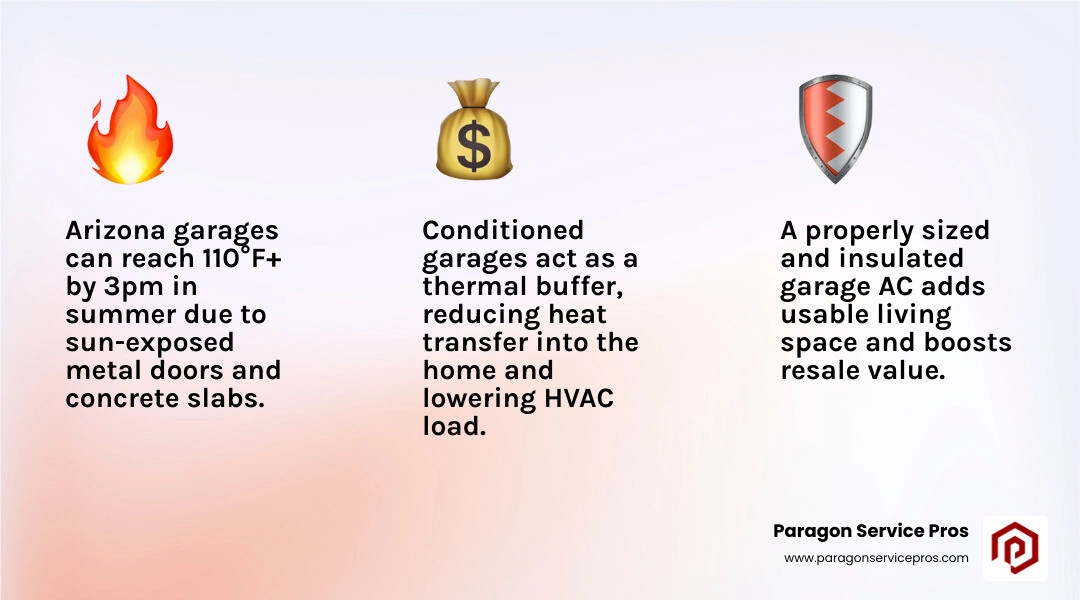
By 3pm on a July afternoon, a typical garage with a south-facing door can reach 110°F or higher inside. Metal door panels radiate heat like a stovetop, the concrete slab holds warmth long after sundown, and without insulation, no fan on earth will make that space livable. The good news is that the right cooling system — sized and installed correctly — can transform your garage into a year-round usable space without dramatically spiking your energy bill.
This guide walks you through everything you need to know: the real benefits, the best system types for Arizona, how to prepare your garage, what safety rules apply, and how to make sure your investment actually pays off.
Evaluating the Benefits: Is Garage Air Conditioning Worth the Investment?
In the East Valley—from the sun-drenched streets of Gilbert to the foothills of Gold Canyon—the garage is often the most neglected part of the home when it comes to climate control. However, when we consider how much we use this space, the question of whether is garage air conditioning worth the investment becomes much clearer.
Year-Round Comfort and Usability
The most immediate benefit is the conversion of "dead space" into a functional living area. If you’ve ever tried to finish a woodworking project in a Queen Creek garage in July, you know that the heat doesn't just make you sweat; it makes the tools hot to the touch and the air thick and still. By installing a dedicated cooling system, you gain a year-round home gym, a comfortable workshop, or even a protected area for a golf simulator or art studio.
Understanding How Arizona Desert Climate Affects Your HVAC is crucial here. Our extreme temperatures mean that an uncooled garage acts like a thermal battery, soaking up heat all day and radiating it into your home long after the sun goes down.
Vehicle and Asset Protection
Your car is likely one of your biggest investments. Extreme heat in Arizona can wreak havoc on vehicle batteries, degrade interior plastics, and cause fluids to break down faster. A conditioned garage provides a stable environment that preserves the lifespan of your vehicles. Furthermore, if you store bulk food, electronics, or expensive tools, humidity control and temperature stability prevent rust, mold, and premature deterioration.
Property Value and Appeal
From a real estate perspective, a climate-controlled garage is a significant selling point. It adds "conditioned square footage" to the home's profile. Buyers in Mesa and San Tan Valley are increasingly looking for homes that offer versatile spaces for remote work or fitness. A professionally installed system demonstrates that the home has been meticulously maintained and upgraded.
| Benefit | Unconditioned Garage | Conditioned Garage |
|---|---|---|
| Max Temperature | Can exceed 120°F | Controlled (e.g., 75°F) |
| Humidity | High during Monsoon season | Consistently low |
| Usability | 4–6 months/year | 12 months/year |
| Storage Safety | High risk for electronics/food | Safe for all items |
| Home Efficiency | Acts as a heat source for the house | Acts as a thermal buffer |

Choosing the Right System for Arizona Garages
When it comes to cooling a garage in our climate, not all systems are created equal. We often see homeowners try "quick fixes" that end up costing more in energy and frustration than they are worth.
The Limitations of Portable and Window Units
While portable air conditioners are convenient, they often struggle in large, uninsulated spaces. Most portable units use a single hose to vent hot air, which creates negative pressure in the garage. This literally "sucks" hot Arizona air in through every crack and gap in your garage door, making the unit work twice as hard for half the result.
Window units are more efficient than portables but require a window—something many Arizona garages lack. They also pose a security risk and can be quite noisy. When we look at Mini Split vs Window Unit for Arizona Rooms, the mini-split almost always wins on efficiency and performance for long-term use.
The Power of Ductless Mini-Splits
For almost every garage application in Chandler or Gilbert, a ductless mini-split is the "gold standard." These systems consist of an outdoor compressor and a sleek indoor air handler. They don't require ductwork, which is ideal because extending your home's central AC into the garage is often illegal and dangerous (more on that later).
When Adding Cooling Without Ductwork Options Compared, mini-splits stand out because they offer SEER2 ratings that can exceed 20 or even 30. This means they use a fraction of the electricity required by other methods.
Why Mini-Splits are the Best Garage Air Conditioning Worth the Investment
Mini-splits are designed for independent operation. You only run the unit when you are actually in the garage, or you can set a "maintenance temperature" to protect your stored items without cooling the space to living-room levels.
- Zoned Cooling: You aren't forcing your main home HVAC to work harder. The garage has its own thermostat.
- Quiet Performance: Unlike window units that rattle, mini-splits are whisper-quiet, perfect for a home office or a peaceful workout.
- Efficiency: Comparing a Central AC vs Ductless Mini Split Comparison, mini-splits avoid the energy losses associated with ductwork, which can account for 30% of energy waste in traditional systems.
- Heating Capabilities: Most mini-splits are heat pumps, meaning they can also keep your garage warm during those chilly January mornings in Queen Creek.
For residents in specialized communities, our Ductless Mini Split Installation Gold Canyon Guide provides deeper insights into how these systems integrate into local architecture. While some might worry about the Mini Split vs Central AC Cost Comparison, the long-term energy savings and added home value often make the mini-split the most financially sound choice.
Essential Preparation: Insulation and Sizing
You wouldn't try to cool your living room with the front door wide open. In many ways, an uninsulated garage door is exactly that—a giant "open door" for heat. Before we install any cooling equipment, we must address the "envelope" of the garage.
Insulation: The First Step
The garage door is usually the weakest link. Most standard doors are thin sheets of metal that act as radiant heaters. Installing a high-quality garage door insulation kit (foam board or reflective barriers) can make the space feel 10–15°F cooler before the AC even turns on.
Don't forget the ceiling. If there is an attic space above your garage, adding blown-in insulation is one of the most effective ways to keep the heat out. We also look at Arizona Room Heating and Cooling Solutions as a reference for how to properly seal these transitional spaces.
Sizing with BTU Requirements
Getting the right "size" unit is about more than just square footage. A standard 2-car garage (about 400–600 sq ft) typically needs between 12,000 and 18,000 BTUs. However, in the Arizona heat, we often recommend "oversizing" slightly or being very aggressive with insulation.
A general rule of thumb is 20–30 BTUs per square foot, but for a garage with high ceilings or a south-facing door, you might need to bump that up by 15-20%.
Determining if Your Garage Air Conditioning Worth the Investment Requires Extra BTUs
Several factors in the East Valley can increase the "thermal load" of your garage:
- Sun Exposure: Does your garage door face West? If so, it’s soaking up the most intense heat of the day right when you want to use it.
- Ceiling Height: Many modern homes in Mesa have 10-foot or 12-foot ceilings. That’s a lot of extra air volume to cool.
- Wall Insulation: Are the exterior-facing walls of your garage insulated? Often, builders only insulate the walls shared with the living space.
- Usage: If you are running high-heat equipment like a welder or a treadmill, you are adding to the heat load.
If you’ve looked into How to Extend Your HVAC to an Arizona Room, you’ll recognize that treating the garage as a "conditioned space" requires the same level of attention to detail regarding air sealing and envelope integrity.
Safety and Maintenance for Long-Term Reliability
Safety is the number one reason we advise against DIY garage cooling or "hacking" your existing home system.
Carbon Monoxide and Fume Management
Your garage is home to cars, lawnmowers, and chemicals. These produce carbon monoxide (CO) and toxic fumes. If you were to connect your garage to your home's central ductwork, you would create a direct path for these deadly gases to enter your bedrooms and kitchen. This is why a separate, dedicated system like a mini-split is the only safe way to go.
Even with AC, you need proper ventilation. We recommend pairing your cooling system with a high-quality exhaust fan to ensure that when you start your car, the fumes are cleared out quickly.
Electrical Requirements
Most high-efficiency garage AC units require a dedicated circuit. This ensures that the system has a steady power supply and doesn't trip your breakers when the compressor kicks on. During our Ductless AC Replacement Gilbert services, we always verify that the home's electrical panel can handle the load safely.
Ongoing Maintenance
To keep your investment worth it, you have to take care of it. Garage environments are dustier than the rest of the home.
- Filter Cleaning: Clean your filters at least once a month if you use the garage as a workshop.
- Coil Cleaning: Dust and sawdust can clog the indoor coils, reducing efficiency.
- Professional Tune-ups: An annual visit from a pro ensures the refrigerant levels are correct and the condensate drain is clear.
When you are Understanding the Cost of AC Installation What to Expect, remember to factor in these small maintenance steps—they are what prevent expensive repairs down the road.
Frequently Asked Questions about Garage Cooling
Can I use a portable AC in my garage?
You can, but it’s rarely the best choice for an Arizona summer. As mentioned, the single-hose design creates negative pressure, pulling in hot air from outside. They are also less durable and typically only last 2–3 years in high-use environments. If you only need to cool a tiny corner of the garage for an hour a week, it might suffice, but for real comfort, they usually fall short.
Does cooling a garage improve home energy efficiency?
Yes! A garage that is 120°F is constantly pushing heat through the shared wall into your kitchen or living room. By keeping the garage at a more reasonable 80°F, you create a thermal buffer. This reduces the workload on your main home AC, which can lead to lower energy bills for the entire house.
Is it safe to connect my garage to my home's central AC?
No. In Arizona, it is generally against building codes to connect a garage to a residential HVAC system. Beyond the safety risks of carbon monoxide and gasoline fumes, your home's AC was sized specifically for the square footage of your living area. Adding the massive heat load of a garage will cause the system to "short cycle," wear out prematurely, and fail to cool either space effectively.
Conclusion
So, is garage air conditioning worth the investment? If you live in Chandler, Gilbert, Mesa, or the surrounding areas, the answer is a resounding yes. It transforms a sweltering storage unit into a comfortable, functional part of your home. Whether you want to crush your morning workout in a home gym or protect your classic car from the brutal desert sun, the right cooling system makes it possible.
At Paragon Service Pros, we specialize in helping Arizona homeowners reclaim their garages. We focus on high-efficiency, professionally installed solutions that provide long-term comfort and reliability. Don't let another summer pass with a garage that’s too hot to touch.
Ready to transform your space? From Queen Creek to San Tan Valley, we are here to help you find the perfect cooling solution. Explore our full range of HVAC Services and let’s make your garage the coolest room in the house.
Keep reading: Air Conditioning
Browse every article in Air Conditioning or head back to the Learning Center .
Comfort you can count on, all year long.
Same-day service, honest diagnostics, and 24/7 emergency help with no overtime fees. A real Greater Phoenix team is standing by.