
A Practical Guide to Heat Pump Benefits for Arizona Homeowners
Discover heat pump benefits for Arizona homeowners—efficient year-round comfort, energy savings, and reliable performance in extreme desert climates.

Why Heat Pump Benefits for Arizona Homeowners Are Changing the HVAC Game
The heat pump benefits for Arizona homeowners are real, measurable, and increasingly hard to ignore — especially as electricity rates climb and summers get longer. Here's a quick look at what you gain by switching:
- Year-round comfort — one system handles both scorching summers and chilly desert nights
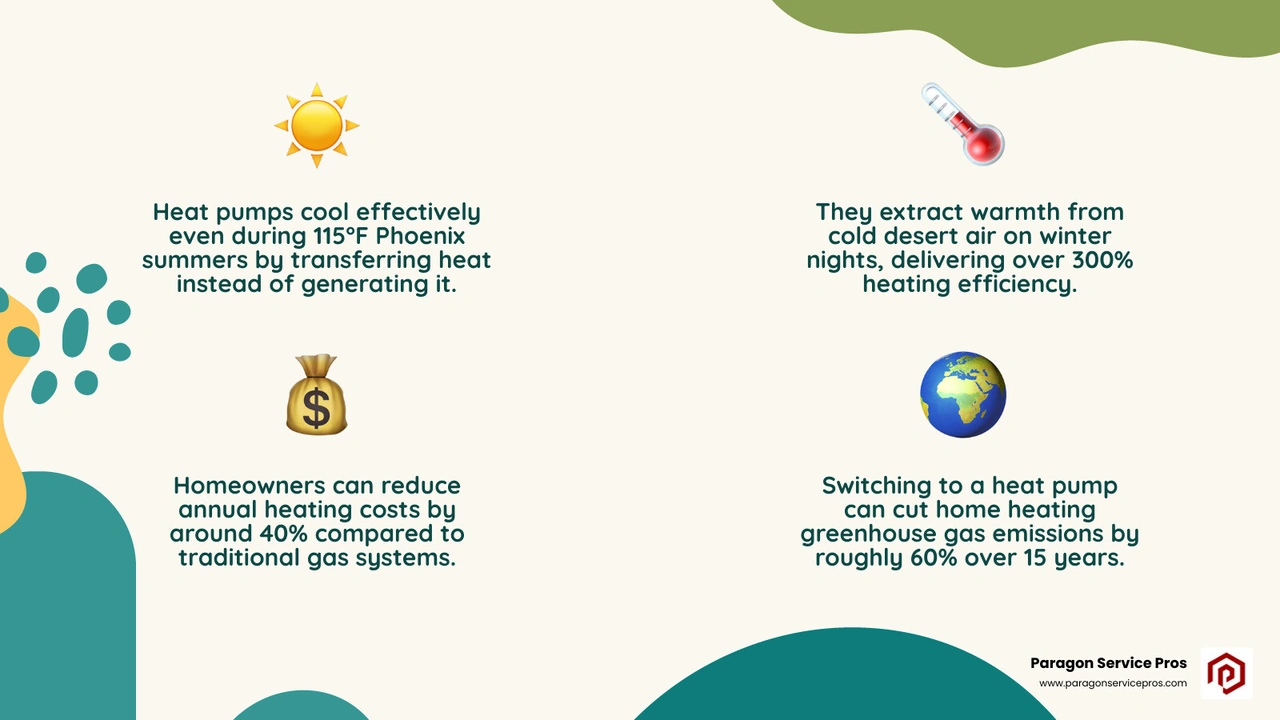
- Energy efficiency — heat pumps move heat instead of generating it, achieving over 300% efficiency
- Lower energy bills — can reduce annual heating costs by around 40% compared to gas systems
- Cleaner air indoors — longer run cycles filter dust, allergens, and monsoon-season humidity more effectively
- Reduced emissions — can cut home heating greenhouse gas emissions by roughly 60% over 15 years
- Financial incentives — federal tax credits up to $2,000, plus utility rebates from APS and SRP
- Long lifespan — 15 to 20 years with proper maintenance
Most Arizona homeowners grew up thinking heat pumps were built for somewhere else — somewhere with mild summers and cold winters. Phoenix has neither. But modern heat pumps are built differently now. They use inverter technology and variable-speed compressors that maintain cooling capacity up to 120°F and pull warmth from outside air even on the coldest desert nights.
With Arizona averaging around 1,200 heating degree days versus 4,300 cooling degree days, the math strongly favors a system that excels at cooling and handles heating with exceptional efficiency. That's exactly what a well-sized heat pump does.
This guide breaks down everything you need to know — from how these systems perform across different Arizona climates, to available rebates, air quality improvements, and what to look for when choosing an installer.
How Heat Pumps Master Arizona’s Extreme Temperature Swings
To understand the heat pump benefits for Arizona homeowners, we first need to look at how these systems handle our unique environment. Unlike a furnace that burns gas to create heat, a Heat Pump acts like a heat transporter. It uses a specialized refrigerant to move thermal energy from one place to another.
In the summer, it works exactly like a high-end air conditioner, extracting heat from inside your home and dumping it outside. When the desert sun sets and the winter chill arrives, the system reverses its refrigerant flow. It pulls existing heat out of the outdoor air—yes, even when it feels cold to us—and brings it inside. Because it is moving heat rather than creating it through combustion or electrical resistance, it is incredibly efficient.
Finding the Best HVAC Setup for Arizona Weather means choosing a system that can pivot instantly between these modes. This flexibility is vital because of How Arizona Desert Climate Affects Your HVAC; we often deal with 30-to-40-degree temperature swings in a single 24-hour period.
Maximizing Heat Pump Benefits for Arizona Homeowners in Summer
For residents in Chandler, Gilbert, and Mesa, the real test of any HVAC system is the triple-digit summer. Modern heat pumps feature variable-speed compressors and inverter technology. Unlike older "single-stage" units that are either 100% on or 100% off, variable-speed units can adjust their output to match your home's exact needs.
This precision is a cornerstone of heat pump benefits for Arizona homeowners. By running at lower speeds for longer periods, these units maintain a consistent temperature without the "blast of cold" followed by a warm-up period. When shopping for a system, Understanding SEER Ratings What They Mean for Your AC and Heating System is crucial. Modern units often reach SEER2 ratings of 20 or higher, providing meaningful savings as Arizona electricity rates have risen nearly 20% since 2021.
Reliable Performance During Chilly Desert Nights
When the temperature drops in Queen Creek or San Tan Valley, heat pumps truly shine. While an electric furnace is capped at 100% efficiency, a heat pump can achieve 300% to 400% efficiency during the mild Arizona winter. This means for every one unit of electricity consumed, the system delivers three to four units of heat.
Because our winters rarely stay below freezing for long, the system almost always has plenty of ambient heat to pull from the outside air. This results in a gentler, more consistent warmth compared to the scorched-air feeling often associated with gas furnaces.
Comparing Heat Pumps to Traditional Gas Furnaces and AC Units
When we look at the Heat Pump versus the traditional gas furnace and AC combo, the advantages become clear for the Phoenix East Valley.
| Feature | Heat Pump | Gas Furnace + AC |
|---|---|---|
| Efficiency | 300% - 400% (Heating) | 80% - 98% (Heating) |
| Energy Source | All-Electric | Gas + Electric |
| Components | Single Unit | Two Separate Systems |
| Environment | Zero On-site Emissions | CO2 Combustion Emissions |
| Comfort | Consistent, Gentle Air | Hot, Dry Bursts |
Many homeowners are also considering "dual-fuel" or hybrid systems. These pair a heat pump with a gas furnace, using the heat pump for the vast majority of the year and only switching to gas on those rare, freezing nights. However, for most of our service area, a stand-alone heat pump is more than sufficient. Energy Efficiency Matters The Benefits of Upgrading Your Old Furnace because switching to all-electric can simplify your home maintenance and eliminate the risks associated with gas combustion.
Why Heat Pumps Outshine Traditional Systems in the East Valley
The shift toward heat pumps is a major part of 2024 HVAC Industry Trends What to Expect in the Air Conditioning Market. Beyond the two-in-one functionality, there is a significant environmental push. Heat pumps can cut greenhouse gas emissions by roughly 60% over 15 years.
Furthermore, the industry is moving toward more eco-friendly refrigerants. Knowing What You Need to Know About the 2025 Shift in HVAC Refrigerants and Efficiency Standards is important, as newer heat pumps use refrigerants like R-454B, which have a much lower global warming potential (GWP) and offer better efficiency in extreme heat.
Enhancing Indoor Air Quality and Home Comfort in Arizona
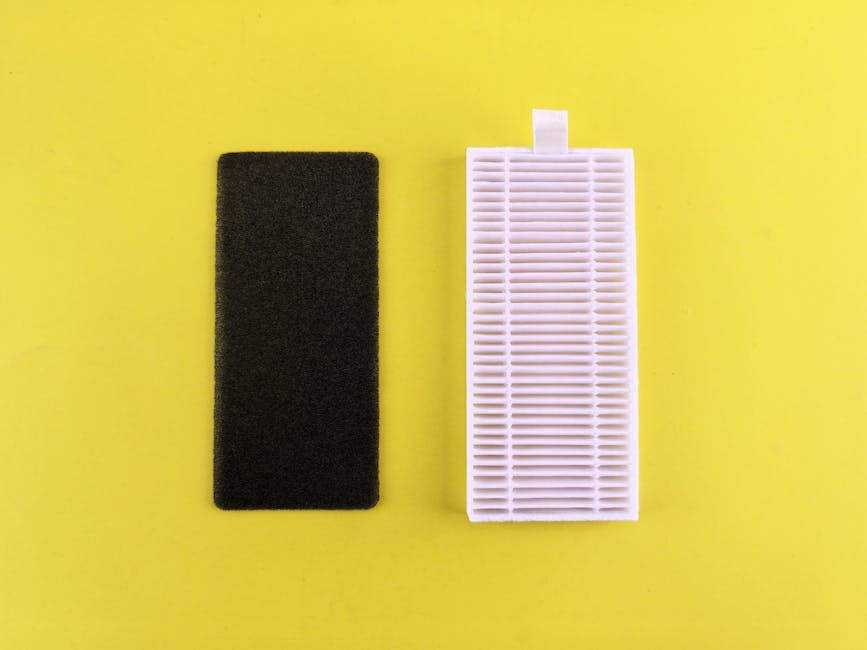
Indoor air quality (IAQ) is a massive part of the heat pump benefits for Arizona homeowners. Because heat pumps (especially variable-speed models) run longer, lower-intensity cycles, they are constantly circulating and filtering the air in your home.
This is a game-changer during the Arizona monsoon season (June through September). These longer cycles allow the system to remove more humidity from the air, preventing that "sticky" feeling even when the outdoor humidity spikes. Additionally, consistent filtration is the best defense against the heavy dust and allergens common in areas like Mesa and Gilbert.
To keep this air clean, regular maintenance is non-negotiable. Heat Pump Maintenance Mesa AZ and Heat Pump Maintenance Gilbert AZ ensure that your filters are clean and your coils are free of desert grime, keeping the air fresh and the system whisper-quiet.
Financial Incentives and Heat Pump Benefits for Arizona Homeowners
One of the most compelling reasons to switch right now is the array of financial incentives available. The Federal Tax Credits for Heat Pump Upgrades under the Inflation Reduction Act allow homeowners to claim up to 30% of the project cost, capped at $2,000 per year.
On top of federal help, there are numerous Arizona Energy Rebates for HVAC Upgrades. Local utilities offer significant "cool cash" or efficiency rebates. For example, SRP and APS Rebates for Phoenix Area Homeowners can provide hundreds or even thousands of dollars back for installing high-efficiency units. When you combine these upfront savings with the fact that heat pumps use 50% less electricity than traditional systems, the long-term financial picture is very bright.
Choosing the Right System for Your Arizona Microclimate
Not all heat pumps are created equal, and not every home in the East Valley has the same needs. A proper Heat Pump Installation Queen Creek AZ or Heat Pump Installation San Tan Valley AZ must begin with a Manual J load calculation. This process accounts for your home's square footage, insulation levels, window orientation, and ductwork condition.
In the desert, an oversized unit is just as bad as an undersized one. If the system is too big, it will "short cycle," turning on and off rapidly. This wastes energy, fails to remove humidity, and wears out the compressor. We also pay close attention to ductwork; sealed and properly sized ducts can reduce energy consumption by 20-30%.
Essential Maintenance for Heat Pump Benefits for Arizona Homeowners
A heat pump is a year-round workhorse, meaning it works twice as hard as a system that only runs for half the year. Bi-annual tune-ups are the secret to reaching that 15-to-20-year lifespan. There are at least 11 Reasons Annual HVAC Maintenance Saves You Money, including preventing emergency breakdowns during a 115-degree July afternoon.
Whether you need Heat Pump Service in Gold Canyon AZ or a routine check-up in Chandler, professional maintenance ensures your coils are clean and your refrigerant levels are perfect. In our dusty climate, even a thin layer of dirt on the outdoor coils can force the system to work 10-15% harder, spiking your bills and shortening the unit's life.
Frequently Asked Questions about Arizona Heat Pumps
Can a heat pump handle 115-degree Phoenix summers?
Absolutely. Modern air-source heat pumps are designed to operate efficiently at temperatures up to 120°F. When properly sized and installed with high SEER2 ratings, they provide cooling that is identical to—and often more consistent than—traditional central AC units.
Do I need a backup furnace for Arizona winters?
For the vast majority of homeowners in the Phoenix Valley (Chandler, Gilbert, Mesa, etc.), a backup gas furnace is not necessary. Modern heat pumps can handle temperatures well below freezing. For rare extreme cold snaps, most systems come equipped with auxiliary electric heat strips as a safety net.
Are heat pumps suitable for high-altitude areas like Flagstaff?
While heat pumps are incredibly efficient in the desert, high-altitude areas like Flagstaff present more of a challenge. In those regions, many homeowners opt for "cold-climate" heat pumps or hybrid (dual-fuel) systems that use a gas furnace when temperatures drop into the single digits. However, for the warmer regions we serve, a standard high-efficiency heat pump is the gold standard.
Conclusion
The heat pump benefits for Arizona homeowners are clear: superior efficiency, lower operating costs, and a simplified, all-electric home. At Paragon Service Pros, we live and work in the same communities you do—from the quiet streets of Gold Canyon to the growing neighborhoods of San Tan Valley. We understand that your comfort isn't just about the temperature on the thermostat; it's about reliability, air quality, and peace of mind.
If you are ready to stop overpaying for comfort and start enjoying a more efficient home, we are here to help. Whether you need a new Heat Pump installation or expert maintenance for your current system, our team provides the quality workmanship and transparency you deserve. Reach out to us today to see how we can transform your Arizona living experience.
Keep reading: Heat Pumps & Ductless
Browse every article in Heat Pumps & Ductless or head back to the Learning Center .
Comfort you can count on, all year long.
Same-day service, honest diagnostics, and 24/7 emergency help with no overtime fees. A real Greater Phoenix team is standing by.