
Can You Duct It? Extending Your Home HVAC to the Arizona Room
Learn how to extend your hvac to an arizona room with duct extensions, mini-splits & expert tips for Chandler, Mesa & Gilbert homes. Cool efficiently!

The Real Challenge of How to Extend Your HVAC to an Arizona Room
How to extend your HVAC to an Arizona room is one of the most common questions homeowners in Chandler, AZ and the surrounding Valley ask when they finish or enclose a sunroom — and for good reason. Without a dedicated cooling plan, that beautiful glass-wrapped space can easily become the most uncomfortable room in the house.
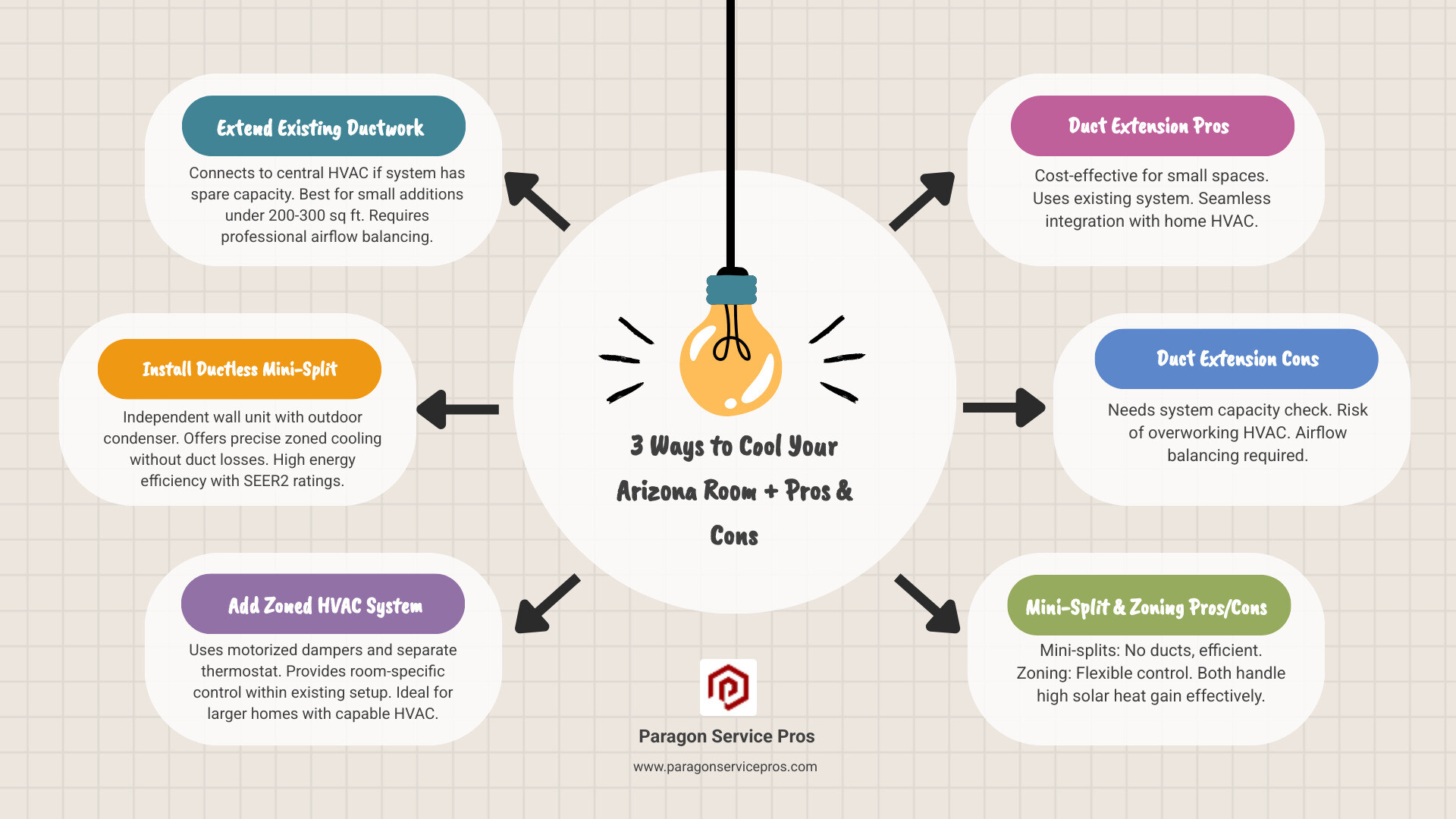
Here are the three main ways to cool an Arizona room:
- Extend existing ductwork - Connect your current central HVAC system to the new space, if your system has enough spare capacity (generally only viable for additions under 200-300 sq ft)
- Install a ductless mini-split - Add an independent wall-mounted unit with its own outdoor condenser for precise, zoned cooling with no ductwork required
- Add a zoned HVAC system - Use motorized dampers and a separate thermostat to give your Arizona room its own temperature control within your existing system
The challenge is that Arizona rooms are uniquely difficult to cool. Their large glass surfaces are designed to let in light — but in a desert climate where summer temperatures regularly climb past 110°F, all that glass also lets in an enormous amount of heat. Without proper planning, a new addition can run 15-20°F warmer than the rest of your home, making it genuinely unusable for most of the year.
The right solution depends on your existing system's age and capacity, the size and orientation of your addition, and how your home is insulated. This guide walks you through each option clearly so you can make a confident, informed decision.
Why is my sunroom so much hotter than the rest of my home in Chandler, AZ?
If you’ve noticed that your sunroom feels like a literal sauna while your kitchen stays crisp and cool, you aren’t imagining it. In Chandler, AZ, summer temperatures frequently soar above 100°F, and we often experience triple-digit heat streaks that put immense pressure on residential cooling systems.
The primary culprit is "solar heat gain." Arizona rooms are designed for maximum sunlight penetration, featuring expansive glass windows that act as heat magnets. While beautiful, these windows are often the weakest spot for home energy efficiency. Even with high-quality glass, the thermal load—the amount of heat that must be removed to maintain a comfortable temperature—is significantly higher in a sunroom than in a standard bedroom with insulated walls.
Furthermore, many Arizona rooms were originally porches or patios that were later enclosed. This means they may lack the robust wall and ceiling insulation found in the rest of your home. When you combine high solar exposure with insulation gaps, you get a space that fights against your air conditioner every minute of the day. To ensure your home remains a sanctuary, professional HVAC service in Chandler, AZ is essential to evaluate these specific thermal challenges before you make a move.
How to extend your hvac to an arizona room using existing ductwork
The most common initial thought for homeowners is simply to "tap into" the existing AC system. While this sounds straightforward, it is a complex engineering task. To successfully extend your ductwork, your current HVAC unit must have "reserve capacity."
Most AC systems are sized specifically for the original square footage of the home. If your system was already working hard to cool your house during a 115°F July afternoon, adding even a small 200-square-foot room could push it over the edge, potentially leading to total system failure.
When we look at how to extend your HVAC to an Arizona room via ducts, we must evaluate the main trunk lines. Splicing into a small branch duct meant for a bathroom won't provide enough airflow (CFM) to cool a sunroom. Instead, a new run usually needs to be tied directly back to the furnace or air handler. Even then, the system requires professional balancing to ensure you aren't stealing all the cool air from your master bedroom just to lower the temperature in the sunroom.
If you are considering this route, a professional HVAC installation in Gilbert, AZ can help determine if your unit can handle the "heavier load," much like a car engine pulling a trailer.
Duct Extension vs. Ductless Mini-Split Comparison
| Feature | Extending Existing Ductwork | Ductless Mini-Split System |
|---|---|---|
| Best For | Very small additions (<200 sq ft) | Large sunrooms, guest suites, garages |
| Installation | Complex (cutting into drywall/ceilings) | Simple (small 3-inch wall hole) |
| Control | Tied to main house thermostat | Independent remote/smartphone control |
| Efficiency | Can strain the main system | Highly efficient (SEER2 up to 22+) |
| Energy Loss | Up to 30% loss through ducts | Near zero (direct air delivery) |
Is a ductless mini-split the better choice for my Mesa, AZ addition?
For many homeowners in Mesa, a ductless mini-split is considered the "gold standard" for Arizona rooms. These systems consist of a sleek indoor air handler mounted on the wall and a small outdoor compressor. Because they don't rely on the main house's ductwork, they offer several distinct advantages.
First is independent temperature control. If you have guests who prefer the sunroom at 72°F while you like the rest of the house at 78°F, a mini-split makes everyone happy. You can even turn the unit off entirely when the room isn't in use, which is a major win for your utility bills.
Second, mini-splits are incredibly efficient. Modern units carry high SEER2 ratings (often between 18 and 22), compared to older central systems that might only be rated at 13 or 14. Because there are no ducts, you eliminate the 30% energy loss that often occurs as air travels through hot Arizona attics where temperatures can exceed 140°F. If your current system is struggling, you might need HVAC repair in Mesa, AZ for your main unit while supplementing the new room with a mini-split.
Critical planning steps for cooling your new living space in Gilbert, AZ
Planning the climate control for your Arizona room should never be an afterthought. In the desert, getting the HVAC wrong doesn't just mean a slightly warm room; it means creating a "sweatbox nightmare" that no one wants to enter.
Before construction begins in Gilbert, two steps are non-negotiable:
- Manual J Load Calculation: This is a professional analysis that determines exactly how many BTUs of cooling your specific room needs.
- Electrical Capacity Check: New HVAC equipment, especially dedicated systems, requires its own circuit. Many older homes in the Valley have 100A or 150A panels that may already be near capacity.
Engaging in HVAC maintenance in Gilbert, AZ for your existing system during this phase is also a great idea to ensure the "heart" of your home's comfort is healthy before you ask it to do more work.
Why a Manual J load calculation is the first step in how to extend your hvac to an arizona room
A Manual J calculation is the industry-standard engineering analysis for sizing. Unlike "rule of thumb" guesses based only on square footage, a Manual J looks at:
- Window Orientation: A west-facing sunroom in Scottsdale or Mesa will need significantly more cooling than a north-facing one due to the brutal afternoon sun.
- Insulation R-values: What is in the walls and ceiling?
- Glass Type: Are you using dual-pane, Low-E glass?
- Local Climate Data: It accounts for our 110°F+ peaks.
Without this calculation, you risk installing an undersized unit that runs non-stop and never catches up, or an oversized unit that "short-cycles," turning on and off so fast that it fails to remove humidity and wears out prematurely.
Signs your current system can't handle how to extend your hvac to an arizona room
How do you know if your existing unit is a candidate for duct extension? Watch for these red flags:
- System Age: If your AC is over 10 to 12 years old, it is likely nearing the end of its lifespan. Adding more load to an aging compressor is a recipe for a breakdown.
- Short Cycling: If your unit already turns on and off frequently, it’s struggling with its current load.
- High Utility Bills: Unexpected spikes often mean the system is losing efficiency.
- Uneven Temperatures: If the back bedrooms are already warmer than the rest of the house, the system definitely doesn't have the "spare breath" to blow air into a new Arizona room.
In these cases, an HVAC replacement in San Tan Valley, AZ might be the smarter long-term investment, allowing you to install a modern, higher-capacity system that can easily accommodate the addition.
Non-HVAC strategies to keep your Arizona room comfortable in the summer heat
Even the best HVAC system needs help when it's 115°F outside. To keep your Arizona room comfortable and your energy bills manageable, consider these "passive" cooling strategies:
- Insulated Cellular Shades: These can reduce solar heat gain through windows by as much as 80 percent. They create a pocket of air that acts as a thermal barrier.
- Low-E Windows: If you haven't built yet, specify windows with a Solar Heat Gain Coefficient (SHGC) of 0.25 or lower.
- Ceiling Fans: Fans create a "wind-chill effect" on your skin. While they don't lower the room temperature, they allow you to set the thermostat about 4 degrees higher without losing comfort.
- Exterior Shading: Solar screens or strategically placed desert landscaping can block the sun before it even hits the glass.
Frequently Asked Questions about Arizona Room Cooling
Can I just cut a hole in my existing ductwork to cool the new room?
We strongly advise against this. Simply "splicing" into a nearby duct disrupts the airflow balance of the entire house. HVAC systems rely on specific pressure levels to push air to every room. If you cut a hole for the sunroom, you may find that your master bedroom suddenly stops getting cool air because the air is taking the "path of least resistance" into the new addition.
How much warmer will my addition be without dedicated cooling?
Statistically, new additions without proper HVAC planning can be 15-20°F warmer than the rest of the house. In Mesa or Queen Creek, that means if your house is 75°F, your sunroom could easily be 95°F. This makes the space unusable for five months of the year. If you find yourself in this situation, seeking HVAC service in Queen Creek, AZ can help you retrofit a solution.
When should I call a professional for my Arizona room project?
The best time is during the architectural planning or "pre-drywall" phase. It is much easier (and more affordable) to run refrigerant lines or new ductwork before the walls are closed up. Involving an HVAC company in Mesa, AZ early ensures that the cooling system is integrated into the design rather than tacked on as an afterthought.
Conclusion
Creating an Arizona room is a fantastic way to enjoy the beauty of our desert landscape from the comfort of your home. However, in our climate, comfort is something you have to plan for. Whether you choose to extend your existing ductwork, install a high-efficiency ductless mini-split, or upgrade to a zoned system, the key is professional assessment and precise sizing.
At Paragon Service Pros, we specialize in helping homeowners in Chandler, Gilbert, Mesa, and the surrounding areas find the perfect balance between comfort and energy efficiency. We provide complete transparency and quality workmanship to ensure your new addition is your favorite room in the house, even in the middle of July.
If you’re ready to reclaim your sunroom from the heat, contact us for expert HVAC service. Let’s make sure your Arizona room is as cool as it is beautiful.
Keep reading: Home & Energy Savings
Browse every article in Home & Energy Savings or head back to the Learning Center .
Comfort you can count on, all year long.
Same-day service, honest diagnostics, and 24/7 emergency help with no overtime fees. A real Greater Phoenix team is standing by.