
Inflation Reduction Act Benefits for Arizona Homeowners Explained
Arizona homeowners, maximize savings! Learn about federal tax credits for heat pump upgrades and IRA benefits for your home.

Federal Tax Credits for Heat Pump Upgrades: What Arizona Homeowners Need to Know in 2026
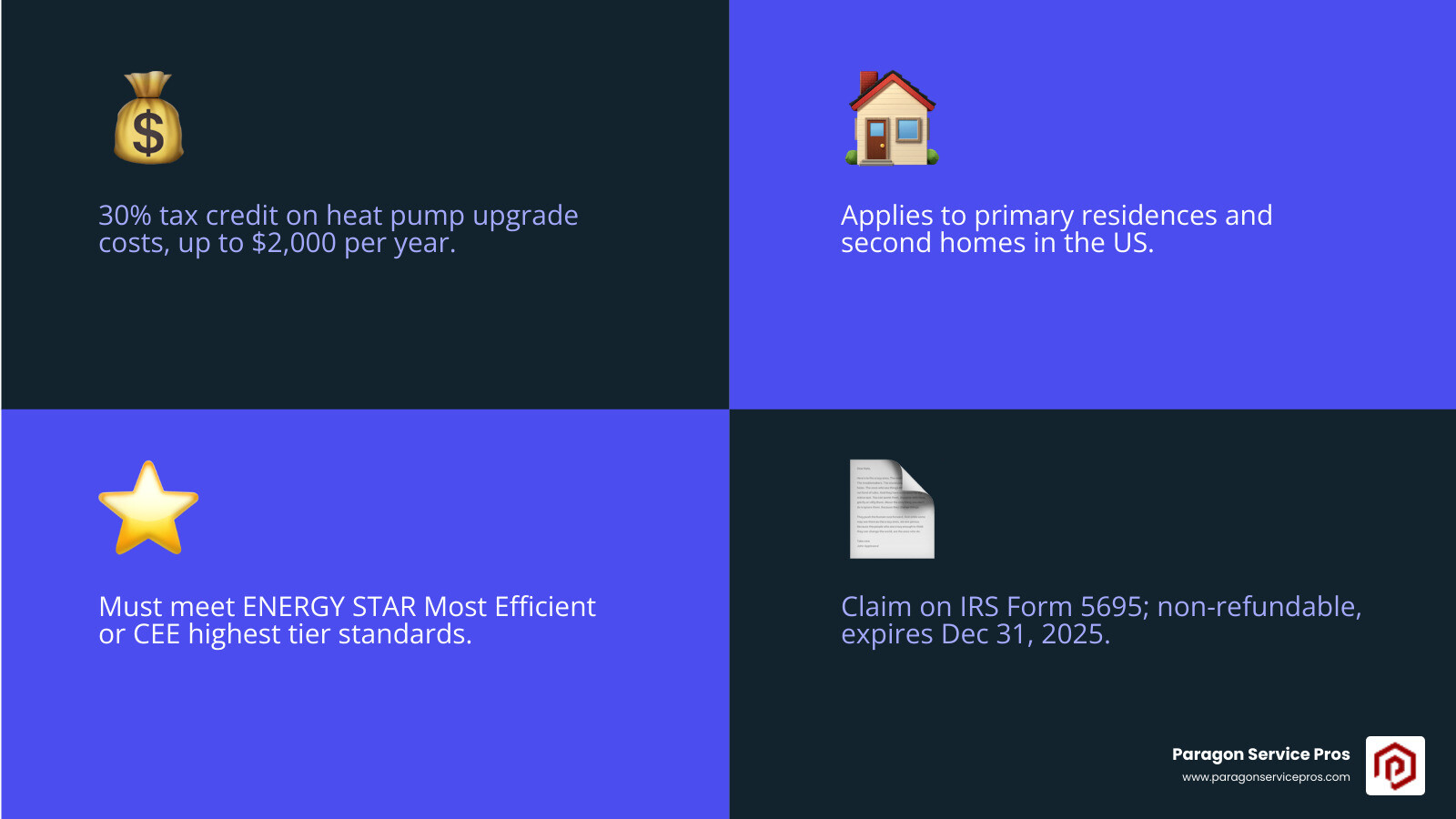
Federal tax credits for heat pump upgrades can put real money back in your pocket when you file your 2025 tax return — and if you installed a qualifying heat pump by December 31, 2025, you may still be eligible to claim it right now.
Here is a quick breakdown of what the credit covers:
| Credit Detail | Amount |
|---|---|
| Heat pump tax credit (30% of costs) | Up to $2,000 per year |
| Other energy improvements (windows, doors, etc.) | Up to $1,200 per year |
| Maximum combined annual credit | Up to $3,200 per year |
| Credit expiration date | December 31, 2025 |
| IRS form required | Form 5695 |
| Is it refundable? | No — reduces tax owed only |
This credit comes from Section 25C of the tax code, expanded under the Inflation Reduction Act of 2022. It applies to qualifying air-source heat pumps installed in existing homes used as a primary residence. There are no income limits, but the heat pump must meet specific efficiency standards to qualify.
For Arizona homeowners in Chandler, Gilbert, Mesa, Queen Creek, San Tan Valley, and Gold Canyon, this credit is especially timely. With extreme summer heat driving up energy costs, upgrading to a high-efficiency heat pump is one of the smartest investments you can make — and the federal government was willing to help cover part of the bill for 2025 installations.
Below, we break down exactly who qualifies, which systems are eligible, how to file, and how to stack your savings with Arizona utility rebates.
Understanding Federal Tax Credits for Heat Pump Upgrades
Navigating tax law can feel a bit like trying to fix an AC unit in the dark, but the Energy Efficient Home Improvement Credit (Section 25C) is actually quite straightforward once you see the numbers. Under the Inflation Reduction Act, homeowners are eligible for a tax credit equal to 30% of the qualified expenses for energy-efficient improvements.
While many home upgrades are capped at a total of $1,200 per year, heat pumps are the "VIPs" of the tax code. They have their own specific annual limit of $2,000. This means you can claim much more for a Heat Pump Installation than you could for just replacing a few windows.
The "aggregate" or total cap for all combined improvements in a single tax year is $3,200. This structure allows you to maximize your savings by pairing a heat pump with other residential energy property upgrades.
Annual Credit Limit Comparison
| Improvement Type | Annual Credit Limit |
|---|---|
| Heat Pumps / Heat Pump Water Heaters | $2,000 |
| Exterior Doors ($250 per door) | $500 total |
| Windows and Skylights | $600 |
| Home Energy Audits | $150 |
| Total Combined Annual Maximum | $3,200 |
Qualifying for Federal Tax Credits for Heat Pump Upgrades
To claim this credit, the property must be located in the United States and used as a residence by the taxpayer. In most cases, this means your primary home. However, unlike some other credits, the heat pump credit can also apply to second homes that you use as a residence, though it generally does not apply to landlords or properties used exclusively for business.
Renters aren't entirely left out in the cold (or heat!) either. If you are a tenant and you pay for a qualifying upgrade to your principal residence, you may still be eligible to claim the credit. It’s a great way to improve your comfort while living in Chandler or Mesa. To keep that new system running efficiently for years to come, we always recommend regular Heat Pump Maintenance Mesa AZ to protect your investment.
Efficiency Standards and SEER2 Requirements
Not every heat pump qualifies for the tax break. The IRS requires systems to meet high efficiency standards set by the Consortium for Energy Efficiency (CEE). Specifically, the unit must meet or exceed the highest efficiency tier (not the "advanced" tier) established by the CEE that was in effect at the start of the year the system was installed.
For 2025 installations, this usually means looking for the ENERGY STAR Most Efficient label. Technical requirements often include:
- Split-Ducted Systems: Minimum SEER2 of 15.2 or higher, along with specific EER2 and HSPF2 ratings.
- Packaged Units: Must meet ENERGY STAR requirements.
- Ductless Mini-Splits: Often require a SEER2 of 16 or higher.
Understanding these ratings is vital because of the 2025 shift in HVAC refrigerants and efficiency standards, which changed the landscape for what equipment is available and how it is rated.
How to Claim Your Credit on 2025 Tax Returns
Since we are currently in April 2026, you are likely right in the middle of filing your taxes for the 2025 calendar year. To claim your federal tax credits for heat pump upgrades, you’ll need to use IRS Form 5695, specifically Part II, Section A and B.
The process involves totaling your qualified expenses (including labor for installation) and calculating 30% of that amount. If that 30% is higher than $2,000, you simply claim the $2,000 maximum. This form is then filed along with your standard Form 1040. If you had a professional Heat Pump Service perform the installation in 2025, you should have all the documentation ready to go.
Documentation Needed for Federal Tax Credits for Heat Pump Upgrades
The IRS has become stricter about documentation for the 2025 tax year. To successfully claim the credit, you should have:
- Qualified Manufacturer Identification Number (QMID): Starting in 2025, manufacturers must provide this code.
- Manufacturer’s Certification Statement: A signed document from the manufacturer certifying that the specific model meets the required efficiency Tiers.
- Detailed Receipts: Your invoice should clearly show the cost of the equipment and the labor.
- Installation Date: The credit is claimed for the year the system was "placed in service" (fully installed and operational).
If you had a Heat Pump Repair Queen Creek AZ that turned into a full system replacement in 2025, make sure you kept that paperwork!
Handling Non-Refundable Credits and Tax Liability
It is important to understand that the Section 25C credit is non-refundable. This means it can reduce the amount of tax you owe to zero, but the IRS won't send you a check for any "leftover" credit amount. For example, if you owe $1,500 in federal taxes and qualify for a $2,000 credit, your tax bill drops to $0, but you lose the remaining $500.
Additionally, this credit cannot be carried forward to future tax years. It’s a "use it or lose it" benefit for the year of installation. If your home has a home office, be aware that business use exceeding 20% may result in a prorated credit amount. We recommend consulting a tax professional to ensure your Heat Pump Maintenance Gilbert AZ and installation costs are reported correctly based on your specific tax liability.
Maximizing Savings with Arizona Rebates and Multi-Year Planning
One of the best ways to save is to "stack" your federal credits with local Arizona incentives. While the federal credit is a tax reduction, many Arizona programs provide instant rebates or bill credits.
- SRP (Salt River Project): Often offers rebates for upgrading to high-efficiency air-source heat pumps.
- APS (Arizona Public Service): Provides various incentives for energy-efficient cooling and heating systems.
- Efficiency Arizona: This state-led initiative includes the HEAR (Home Electrification and Appliances Rebates) and HOMES (Home Energy Performance-Based, Whole-House Rebates) programs. These are often income-based and can provide thousands of dollars in additional savings for low-to-moderate-income households.
When calculating your tax credit, you must subtract any public utility subsidies or rebates from the total cost before calculating the 30% federal credit. For example, if your Heat Pump Installation Gilbert AZ cost $8,000 and you received a $500 SRP rebate, you would calculate the 30% credit based on $7,500.
Strategic Upgrades for Heat Pump Water Heaters and Electrical Panels
If you missed the 2025 deadline for a full HVAC heat pump, you can still plan for 2026 and beyond by spreading out your upgrades. The $2,000 annual limit applies to both HVAC heat pumps and heat pump water heaters. By installing an HVAC system one year and a water heater the next, you can claim the $2,000 credit twice!
Furthermore, if your new heat pump requires an electrical panel upgrade, you may be eligible for an additional $600 credit. To qualify, the panel must have a capacity of at least 200 amps and be installed in conjunction with a qualifying energy-efficient upgrade. This is a great way to modernize your home's infrastructure while the government helps pick up the tab.
Frequently Asked Questions about Heat Pump Credits
Can I still claim the credit for a heat pump installed in late 2025?
Yes! As long as the system was installed and "placed in service" on or before December 31, 2025, you can claim the credit on the tax return you are filing now in early 2026.
Do I need a specific manufacturer code to file my 2025 taxes in 2026?
Yes, for the 2025 tax year, the IRS requires a Qualified Manufacturer Identification Number (QMID). You can usually find this on the manufacturer's website or on the certification statement provided by your installer.
Can I combine federal tax credits with my SRP or APS utility rebates?
Absolutely. This is the best way to maximize your ROI. Just remember to deduct the utility rebate amount from your total project cost before you calculate your 30% federal tax credit.
Conclusion
At Paragon Service Pros, we are dedicated to helping our neighbors in Chandler, Gilbert, Gold Canyon, Mesa, Queen Creek, and San Tan Valley stay comfortable while saving as much money as possible. Upgrading your home's energy efficiency isn't just about the environment; it’s about long-term reliability and lower monthly bills.
Whether you are looking for a new installation or need to maintain your current system to keep it running at peak efficiency, our team is here to provide unparalleled service and quality workmanship. If you're ready to explore how a new HVAC system can transform your home comfort and your tax return, give us a call today!
Keep reading: Heat Pumps & Ductless
Browse every article in Heat Pumps & Ductless or head back to the Learning Center .
Comfort you can count on, all year long.
Same-day service, honest diagnostics, and 24/7 emergency help with no overtime fees. A real Greater Phoenix team is standing by.