
A Step-by-Step Guide to Claiming Your Arizona Energy Rebates
Learn how to apply for energy rebates in Arizona: step-by-step guide to HEAR, HOMES, tax credits & max savings on heat pumps, AC in 2026.

Why Knowing How to Apply for Energy Rebates in Arizona Could Save You Thousands
How to apply for energy rebates in Arizona is simpler than most homeowners realize — and the savings can be significant.
Here's a quick overview of the process:
- Check your eligibility using the Efficiency Arizona screening tool at the program's official website
- Create an account and complete the online application (takes about 10-15 minutes with documents ready)
- Choose your pathway — either a qualified contractor or a participating retailer
- Submit your documentation — proof of income, utility bills, and equipment details
- Await approval — most applicants hear back within a couple of weeks
- Schedule your upgrade — book a qualified contractor promptly after approval
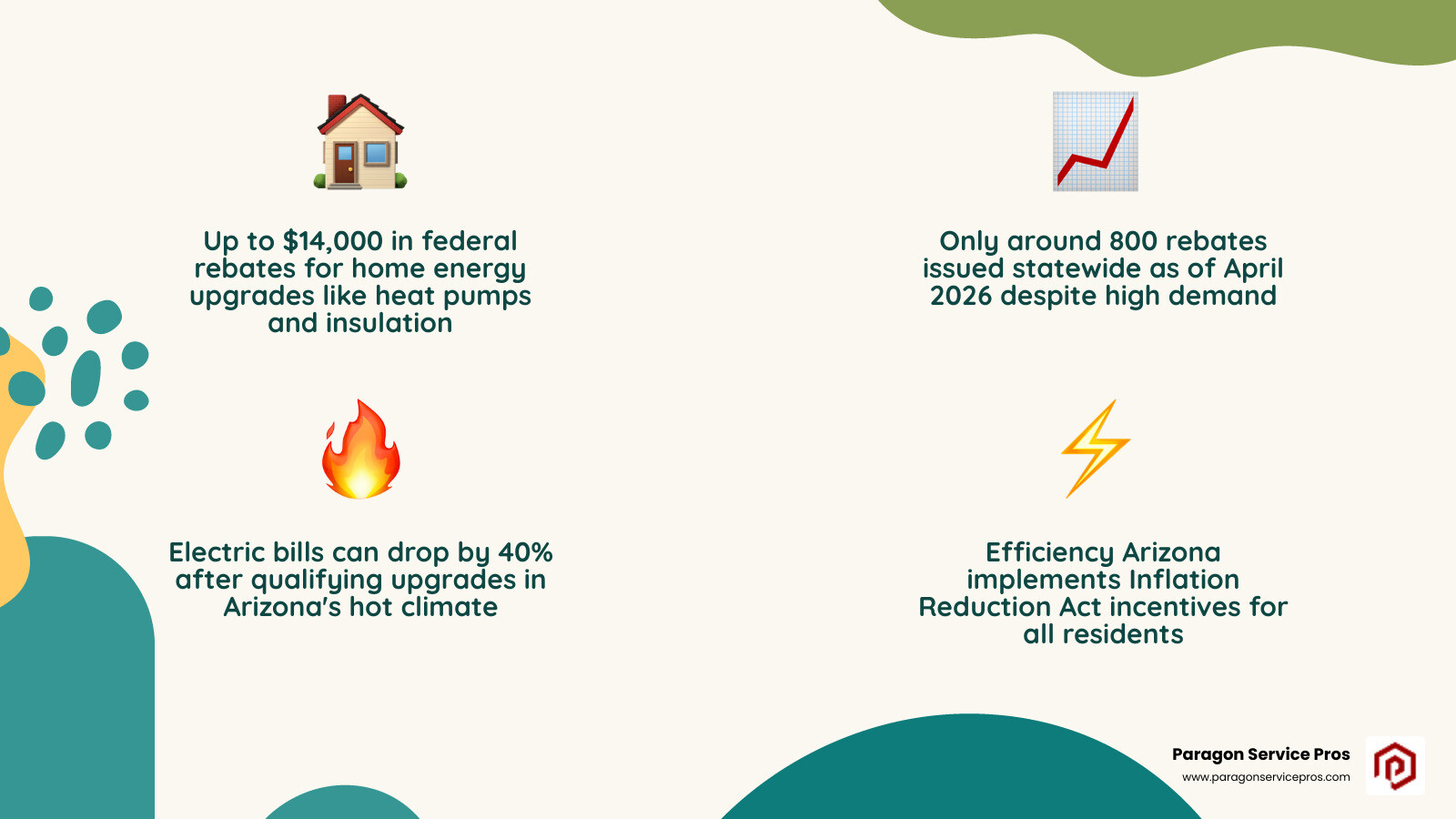
Arizona homeowners are sitting on one of the biggest untapped financial opportunities in the country right now. Thanks to the Inflation Reduction Act and Arizona's own Efficiency Arizona program, residents can access up to $14,000 in federal rebates for home energy upgrades like heat pumps, insulation, and electrical improvements — yet as of April 2026, only around 800 rebates have been issued statewide.
That means most eligible homeowners simply don't know these programs exist — or they assume the process is too complicated to bother with.
It's not. And the payoff is real. One homeowner near Tucson who went through the program saw her electric bills drop by 40% after upgrading her struggling air conditioning system. For Arizona residents dealing with brutal summer heat and skyrocketing cooling costs, that kind of relief matters.
This guide walks you through every step — from checking your eligibility to choosing a qualified contractor — so you can claim every dollar you're entitled to.
Major Energy Rebate Programs Available in Arizona
When we talk about saving money on home comfort, we aren't just talking about a few dollars here and there. In April 2026, the landscape for Arizona energy incentives is more robust than ever. The primary driver is Efficiency Arizona, an initiative from the Arizona Governor’s Office of Resiliency. This program is the state-level implementation of the federal Inflation Reduction Act (IRA).
Efficiency Arizona is divided into two main branches:
- HEAR (Home Electrification and Appliance Rebates): This is currently active and focuses on point-of-sale rebates for low-to-moderate-income households. It covers electrification projects like switching to a Heat Pump.
- HOMES (Home Efficiency Rebates): Set to be fully operational in early 2025/2026, this program focuses on "whole-home" energy savings. Unlike HEAR, which is based on specific appliances, HOMES rewards you based on how much total energy your home saves (either modeled by software or measured by actual bills).
If your old cooling system is struggling to keep up with the Mesa heat, an AC Replacement using these rebates can drastically lower your upfront investment.
Qualifying Home Upgrades for State Incentives
What exactly can you get money back for? The list is extensive because the goal is to reduce the load on Arizona's electrical grid.
- Heat Pumps: These are the "stars" of the rebate world. Because they provide both heating and cooling efficiently, they qualify for the largest incentives. If you are looking into Heat Pump Installation, you are on the right track for maximum savings.
- Weatherization: This includes air sealing, ventilation, and insulation. Keeping the cool air in is just as important as how you generate it.
- Electrical Upgrades: Often, moving to high-efficiency electric appliances requires a new breaker box or updated wiring. The HEAR program offers specific rebates for these "enabling" upgrades.
- Water Heaters: Heat pump water heaters are also eligible for significant chunks of change.
It is also important to stay informed about the 2025 Shift in HVAC Refrigerants, as newer, compliant systems are often the ones targeted for these high-value rebates.
Income Eligibility and Rebate Amounts
The amount of money you get back depends heavily on your household income relative to the Area Median Income (AMI) in your part of Arizona.
- Low-Income (Below 80% AMI): You may qualify for 100% coverage of your project costs, up to the $14,000 program cap. This essentially means you could get a new system and weatherization with zero out-of-pocket costs.
- Moderate-Income (80% to 150% AMI): You can receive up to 50% coverage of project costs, also capped at $14,000.
- Above 150% AMI: While you might not qualify for the point-of-sale HEAR rebates, you are still eligible for federal tax credits and utility-specific rebates.
| Program Feature | HEAR (Electrification) | HOMES (Efficiency) |
|---|---|---|
| Focus | Specific Appliances/Wiring | Whole-Home Energy Savings |
| Best For | Lower-Income Households | Any Income (Performance Based) |
| Max Rebate | $14,000 | Varies by Savings % |
| Timing | Available Now | Launching/Active 2025-2026 |
How to Apply for Energy Rebates in Arizona: The Step-by-Step Process
We know that paperwork can feel like a chore, but the Efficiency Arizona portal is surprisingly user-friendly. Most of our customers in Gilbert and Chandler find that the actual application takes only about 10 to 15 minutes.
There are two primary "pathways" you can take:
- The Contractor Pathway: This is the most popular. You work with a qualified contractor who handles the technical assessment and ensures the equipment meets state standards.
- The Retail Pathway: This is for smaller items (like a heat pump clothes dryer) where you apply for a coupon and redeem it at a participating store.
For major Heating Installation or cooling upgrades, the contractor pathway is generally the safest bet to ensure you don't miss a technical requirement.
Step 1: Check Your Eligibility
Before you pick out a new unit, use the Efficiency Arizona eligibility screening tool. You will need to provide your zip code, household size, and estimated annual income. This tool tells you immediately if you fall into the low or moderate-income brackets.
This is also a great time to evaluate your current system's efficiency. Understanding SEER Ratings is crucial here; most rebate programs require a minimum efficiency level to qualify.
Step 2: Gather Documentation
Do not hit "start" on the application until you have your digital files ready. The program will not accept expired documents. You generally need:
- Proof of Residency: A recent utility bill (SRP or APS) works best.
- Income Verification: Tax returns from the previous year or proof of enrollment in programs like SNAP, WIC, or AHCCCS (Medicaid).
- Equipment Specs: If you've already received a quote for HVAC Installation, keep that spec sheet handy.
Step 3: Select a Qualified Contractor or Retailer
You cannot just hire anyone and expect a rebate. The state maintains a list of approved contractors who have been trained on program requirements. Once you are approved, you will be assigned or allowed to choose from this list.
After the work is done, be prepared for a "post-inspection." The state wants to verify that the high-efficiency unit was installed correctly and is performing as promised. Regular HVAC Maintenance after installation will keep that new system running at the peak efficiency required by the program. Keeping an eye on 2024 HVAC Industry Trends can also help you choose the most future-proof technology.
Maximizing Savings with Federal Tax Credits and Utility Incentives
Rebates are fantastic, but they are only one piece of the puzzle. In Arizona, we can "stack" incentives to drive the cost even lower.
Stacking Federal and Local Rebates
While you can't use two different federal rebates for the exact same piece of equipment, you can often combine a rebate with a federal tax credit.
- 25C Tax Credit: This offers a 30% tax credit on qualified expenses, capped at $3,200 annually. Specifically, you can get up to $2,000 back for a heat pump and $1,200 for other weatherization items like windows or doors.
- 25D Tax Credit: If you are going solar in Mesa or San Tan Valley, this provides an uncapped 30% credit for solar electric, solar water heating, and fuel cells.
- Arizona State Solar Tax Credit: This offers 25% of the cost of a solar system, capped at $1,000. The best part? If you don't owe $1,000 in taxes this year, you can roll the credit over for up to five years.
By timing your upgrades across different tax years and using a Maintenance Plan to ensure everything qualifies for ongoing efficiency standards, you can maximize your return on investment.
Utility-Specific Programs for SRP and APS Customers
Don't forget your local utility provider! They have their own pots of money to help you save.
- SRP (Salt River Project): We see many Gilbert and Mesa residents take advantage of SRP's $1,125 rebate for new energy-efficient AC units. They also offer $600 for insulation, $400 for duct repair, and even discounts on smart thermostats.
- APS (Arizona Public Service): APS offers similar incentives for AC upgrades and smart thermostats.
- Shade Tree Programs: Both major utilities often host workshops where you can get free shade trees. Planting these on the west side of your home can naturally lower your cooling needs.
Common Mistakes to Avoid When Claiming Your Rebates
We have seen homeowners miss out on thousands of dollars due to simple errors. Here is how to avoid them:
- Doing it Yourself (DIY): Most Efficiency Arizona and utility rebates require professional installation by a licensed, qualified contractor. A DIY install might save you labor costs upfront, but it will disqualify you from the $14,000 rebate.
- Using Expired Documents: If your utility bill is three months old, the portal might reject your application. Use the most recent documents available.
- Installing Before Approval: For many programs, if you buy the unit before your application is approved, you cannot claim the rebate retroactively. Always wait for the "green light" from the program.
- Buying Unapproved Equipment: Not every "high-efficiency" unit qualifies. It must meet specific SEER2 or ENERGY STAR standards. Check with us or consult the program’s qualified product list first.
Frequently Asked Questions about Arizona Energy Rebates
Are there energy rebates available for renters in Arizona?
Yes! Renters are eligible for many of these programs. While you might not be able to replace the whole HVAC system without your landlord's involvement, renters can apply for rebates on portable items like heat pump clothes dryers or induction cooktops. SRP also specifically lists rebates available to renters for things like smart thermostats and weatherization kits.
How long does it take to get approved and receive my rebate?
Once you submit your application for Efficiency Arizona, you can typically expect to learn if you qualify within a couple of weeks. If you are using the point-of-sale pathway (HEAR), the discount is applied immediately at the time of purchase. For other rebates that require a claim after installation, it may take 4 to 8 weeks to receive your check or bill credit.
Can I apply for rebates for upgrades I already completed?
It depends on the program. SRP allows you to apply for rebates for upgrades completed within the last six months. However, the federal Efficiency Arizona (HEAR/HOMES) rebates generally require pre-approval before the work begins. Always check the specific program rules before signing a contract.
Conclusion
Navigating energy incentives can feel overwhelming, but the financial rewards for Arizona families are too large to ignore. Whether you are in Chandler, Gilbert, Mesa, Queen Creek, or San Tan Valley, there is a program designed to help you lower your bills and increase your home comfort.
At Paragon Service Pros, we specialize in helping our neighbors find the most efficient solutions for their homes. From professional HVAC Services to navigating the technical requirements of these rebate programs, we are here to ensure your installation is seamless and your savings are maximized.
Don't let another Arizona summer drain your bank account. Check your eligibility today and take the first step toward a cooler, more efficient home.
Keep reading: Home & Energy Savings
Browse every article in Home & Energy Savings or head back to the Learning Center .
Comfort you can count on, all year long.
Same-day service, honest diagnostics, and 24/7 emergency help with no overtime fees. A real Greater Phoenix team is standing by.