
The Ultimate Guide to Best Thermostat Settings for Energy Savings
Discover the best thermostat settings for energy savings in summer and winter to cut bills and stay comfortable year-round.

Why the Best Thermostat Settings for Energy Savings Matter More Than You Think
The best thermostat settings for energy savings can make a dramatic difference on your monthly utility bill — especially here in the East Valley, where heating and cooling account for more than half of the average home's energy costs.
Here's a quick-reference guide to the recommended settings, straight from the U.S. Department of Energy:
| Situation | Summer Setting | Winter Setting |
|---|---|---|
| Home and awake | 78°F | 68°F |
| Sleeping | 82°F | 62-65°F |
| Away (4+ hours) | 85°F or higher | 60°F or lower |
| Vacation | 88°F max | 55°F min |
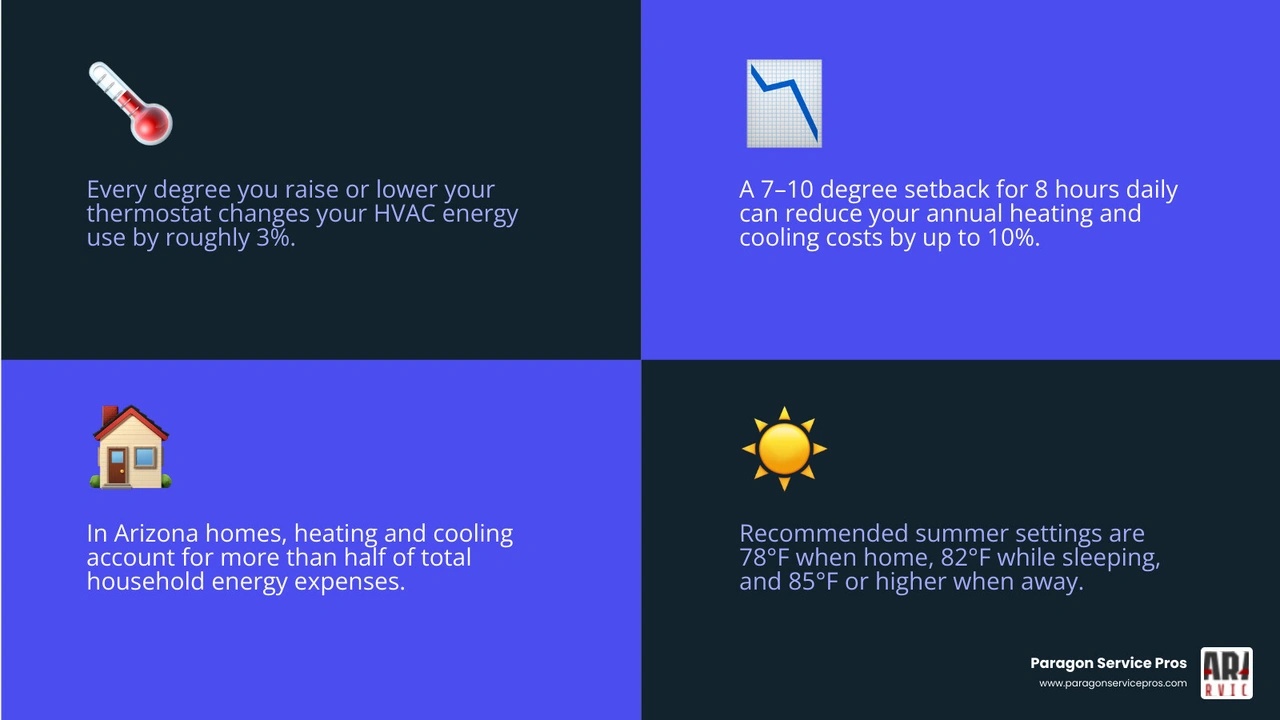
These numbers aren't arbitrary. Every degree you adjust your thermostat away from its default setting moves your HVAC bill by roughly 2-3%. A 7-10 degree setback for just eight hours a day can trim up to 10% off your annual heating and cooling costs. On a typical household energy bill where nearly half goes straight to HVAC, that adds up fast.
For Arizona homeowners in Chandler, Gilbert, Mesa, Queen Creek, San Tan Valley, and Gold Canyon, the stakes are even higher. Summer temperatures regularly push past 110°F, which means your air conditioner is already working overtime before you even touch the thermostat dial. Getting your settings dialed in correctly isn't just about comfort — it's about protecting your equipment and your budget at the same time.
The good news is that small, strategic changes to how and when you set your thermostat can deliver real, measurable savings without giving up the comfort you need at home.
Seasonal Guide: Best Thermostat Settings for Energy Savings in Summer and Winter
Living in the Arizona desert means we experience some of the most dramatic seasonal shifts in the country. While our winters are mild and beautiful, our summers are legendary for their intense, sustained heat. Because of these extremes, a single, year-round thermostat setting simply won't cut it if you want to keep your utility bills under control.
To maximize your savings, you need to adjust your approach as the seasons change. It is also highly beneficial to understand how to handle those brief, transitional weeks in the spring and fall. During these mild stretches, you can often turn your system off entirely or utilize "deadband" settings on a programmable thermostat. A deadband setting establishes a comfortable range (for example, keeping the heat off unless it drops below 65°F and the AC off unless it rises above 78°F) so your system doesn't waste energy fighting itself during mild weather.
By aligning your thermostat habits with the outdoor climate, you can give your HVAC system a much-needed break. For more ways to optimize your system's performance during the hottest months, check out our guide on Maximizing Energy Efficiency Tips for Your AC Unit.
Summer Cooling: Finding the Best Thermostat Settings for Energy Savings When It's Hot
When summer arrives in Chandler, Gilbert, or Mesa, the outdoor temperature can feel like a physical wall of heat. It is incredibly tempting to walk inside and crank your air conditioner down to a chilly 70°F. However, doing so will cause your energy bills to skyrocket.
The U.S. Department of Energy recommends setting your air conditioner to 78°F when you are home and awake.
We know what you might be thinking: "78 degrees? In July? Are you trying to melt me?"
While 78°F might sound warm at first, it is actually the ideal sweet spot for balancing physical comfort with energy efficiency. The key to surviving this baseline is minimizing the temperature difference between the inside of your home and the blazing desert outside. The smaller that temperature gap, the slower heat will seep into your home, and the less work your air conditioner has to do.
When you leave your house for more than four hours, we recommend raising your thermostat to 85°F. Keeping your home at 85°F while you are at work prevents the structure from "heat-soaking"—a phenomenon where your walls, furniture, and flooring absorb massive amounts of heat. If you turn your AC completely off, your home can easily reach 95°F or warmer. When you return, your system will have to run at peak capacity for hours just to make the space livable again, putting immense strain on your compressor.
Managing desert heat requires a strategic approach. To understand how our local environment impacts your cooling system, take a look at our article on How Arizona Desert Climate Affects Your HVAC.
Winter Heating: The Best Thermostat Settings for Energy Savings in Cold Weather
While Arizona winters are generally mild, desert nights in Queen Creek, San Tan Valley, and Gold Canyon can get surprisingly chilly, often dipping into the 30s and 40s. When the cold air rolls in, your heating system has to step up to keep your family warm.
For the winter months, the gold standard for energy savings is setting your thermostat to 68°F when you are home and awake.

This temperature is warm enough to keep your immune system protected and your indoor environment healthy, but low enough to prevent your furnace or heat pump from running continuously. When you go to sleep, you can comfortably drop the temperature down to 62°F to 65°F. According to sleep science, our bodies naturally cool down at night, and a cooler bedroom actually promotes deeper, more restful sleep. Simply throw on an extra blanket or a cozy pair of pajamas, and you will save money while sleeping like a baby.
When you are away from home during the day, you can let the indoor temperature drop to 55°F to 60°F. This lower temperature reduces the rate of heat loss from your home to the cold outdoors.
Keeping your heating system running efficiently is also directly tied to your equipment's overall design. To learn more about how your system's efficiency rating impacts your winter bills, read our post Understanding SEER Ratings What They Mean for Your AC and Heating System.
The Math of Setbacks: How the 3% Per Degree Rule Lowers Your Bills
To truly appreciate the power of thermostat optimization, it helps to look at the actual physics and math behind home heating and cooling. Many homeowners believe the common myth that letting your home warm up (in summer) or cool down (in winter) wastes more energy because the system has to "work harder" to recover.
Thermodynamically, this is completely false.
Heat naturally flows from warmer spaces to cooler spaces. The rate of this heat transfer is directly proportional to the temperature difference (known as Delta T) between the inside and outside of your home. When your home is significantly colder than the outdoor air in the summer, heat rushes in through your windows, doors, and walls at a rapid pace. By raising your indoor temperature closer to the outdoor temperature, you slow down this heat transfer, meaning your home absorbs less heat overall while you are away.
This brings us to the 3% per degree rule. On average, for every single degree you adjust your thermostat closer to the outdoor temperature for an eight-hour period, you save roughly 3% on your heating or cooling costs.
Let's look at how this math plays out in a real-world comparison:
| Time Period | Standard "Set It and Forget It" Schedule | Optimized Energy-Saving Schedule | Potential Daily Savings |
|---|---|---|---|
| Morning / Day (8 AM - 5 PM) | Constant 72°F | 80°F (Summer Away) / 60°F (Winter Away) | ~24% savings during away hours |
| Evening (5 PM - 10 PM) | Constant 72°F | 78°F (Summer Home) / 68°F (Winter Home) | ~12% savings during waking hours |
| Night (10 PM - 6 AM) | Constant 72°F | 82°F (Summer Sleep) / 64°F (Winter Sleep) | ~24% savings during sleep hours |
By shifting from a rigid, constant 72°F setting to a dynamic, optimized schedule, the average homeowner can easily shave 10% to 15% off their annual utility costs. Over the course of a year, that translates to hundreds of dollars kept right in your pocket.
Smart and Programmable Thermostats: Automating Your Efficiency
Let's be honest: manually adjusting your thermostat several times a day is a hassle. It is easy to forget to turn up the AC before leaving for work, or to wake up shivering in the middle of the night because you forgot to adjust the heater. This is where modern technology comes to the rescue.
Upgrading to a programmable or smart thermostat is one of the easiest ways to automate your energy savings. A basic programmable thermostat allows you to input a set schedule based on your weekly routine, ensuring your home is always at the perfect temperature when you arrive.
Smart thermostats take this convenience a step further by utilizing advanced automation features:
- Geofencing: By connecting to your smartphone's GPS, a smart thermostat can detect when the last person leaves the house and automatically switch to an energy-saving "Eco Mode." When you cross a pre-set boundary on your drive home, the system kicks back on to ensure your home is comfortable the moment you walk through the door.
- Learning Algorithms: Devices like Nest or Ecobee analyze your daily habits and temperature preferences. Within a couple of weeks, they build a customized schedule for you, adjusting the temperature automatically without you ever having to program a thing.
- Time-of-Use Optimization: Many local utility companies in Arizona offer cheaper electricity rates during off-peak hours. Smart thermostats can be programmed to "supercool" your home during cheap off-peak hours, allowing you to coast through expensive peak hours with minimal AC usage.
Investing in these technologies is highly cost-effective, especially when you take advantage of local incentives. Learn more about how to lower your upgrade costs by reading about Arizona Energy Rebates for HVAC Upgrades and find out how to secure these savings in our guide on How Apply for Energy Rebates in Arizona.
Special Considerations for Heat Pump Systems
If your Arizona home utilizes a heat pump system, you need to be slightly more careful with your winter thermostat adjustments. Unlike traditional gas furnaces, heat pumps are incredibly efficient electric systems that transfer heat rather than creating it. However, they have a unique limitation when recovering from large temperature drops.
If you lower your thermostat by more than 2 to 4 degrees in the winter, a standard heat pump may struggle to raise the temperature quickly when you turn it back up. To make up the difference, the system will often activate its auxiliary or "emergency" heat. This auxiliary heat relies on highly inefficient electric resistance coils—essentially a giant hair dryer inside your ductwork—which consumes up to three times more electricity than standard heat pump operation.
To avoid accidentally triggering this expensive auxiliary heat:
- Limit winter setbacks: Keep your temperature adjustments to no more than 2 to 4 degrees at a time.
- Use a smart recovery thermostat: Many modern smart thermostats feature "Smart Recovery" or "Heat Pump Balance" algorithms. These systems calculate exactly how long it will take to warm your home using only the efficient heat pump, gradually raising the temperature well ahead of your schedule without ever turning on the auxiliary coils.
If you are thinking about upgrading your heating system, you may qualify for substantial financial incentives. Check out our breakdown of Federal Tax Credits for Heat Pump Upgrades to see how you can save on a new, high-efficiency system.
Maximizing Comfort and Efficiency: Practical Tips and Proper Placement
While setting your thermostat correctly is the foundation of energy efficiency, your home's physical environment plays a massive role in how comfortable you actually feel at those temperatures.
First and foremost, thermostat placement is critical. If your thermostat is installed in a poor location, it will read the wrong temperature, causing your HVAC system to run too often or not enough.
To ensure accurate readings, your thermostat should always be installed on an interior wall near the center of your home, in a room that your family uses frequently. It should never be placed:
- In direct sunlight, which tricks the sensor into thinking the house is much hotter than it is.
- Near drafty windows, doors, or skylights.
- Directly under or near supply registers or return vents.
- In hallways, which do not represent the actual temperature of your living spaces.
- Near heat-generating appliances, such as ovens in the kitchen.
Beyond proper placement, you can use several practical "hacks" to stay perfectly comfortable at energy-saving temperatures:
- Harness the Wind-Chill Effect: Ceiling fans don't actually cool the air in a room; instead, they cool your skin by creating a gentle breeze. In the summer, make sure your ceiling fans are rotating counterclockwise to push air straight down. This wind-chill effect can make a 78°F room feel like a comfortable 74°F. Just remember to turn fans off when you leave the room—fans cool people, not spaces!
- Manage Your Window Treatments: Sunlight streaming through your windows is a major source of heat gain. During hot summer days, keep your blinds, curtains, or drapes closed—especially on south- and west-facing windows. In the winter, reverse this strategy: open your blinds during sunny days to let the sun naturally warm your home, and close them at night to add an extra layer of insulation against the cold.
- Seal Air Leaks: Drafty doors and windows allow conditioned air to escape while letting hot or cold outdoor air seep in. Use inexpensive caulk and weatherstripping to seal any gaps around your home's envelope, keeping your conditioned air right where it belongs.
Common Thermostat Mistakes That Drain Your Wallet
Even with the best intentions, it is easy to fall into bad habits that quietly drive up your energy bills. Here are the most common thermostat mistakes we see homeowners make, and how you can avoid them:
- The Constant Temperature Myth: Believing that keeping your home at a single, unchanging temperature 24/7 is more efficient than using setbacks. As we covered in the math section, letting your home drift closer to the outdoor temperature when you are asleep or away always saves energy.
- Extreme Temperature Adjustments: Walking into a hot house and setting the thermostat to 60°F in hopes of cooling the home faster. Air conditioners run at the exact same speed regardless of how low you set the temperature. Setting it to an extreme number will not cool your home any faster; it will simply cause your system to overshoot your actual target, wasting energy and freezing you out in the process.
- Manual Override Abuse: Constantly hitting the "hold" or temporary override buttons on your programmable thermostat. If you find yourself constantly fighting with your programmed schedule, it's time to adjust the schedule to better match your actual lifestyle, rather than fighting the system manually every day.
- Neglecting Routine Maintenance: A thermostat is only as good as the HVAC system it controls. Running your system with a clogged air filter or skipping your annual professional tune-ups can force your system to consume up to 20% more energy just to reach your thermostat's target temperature.
Frequently Asked Questions About Thermostat Optimization
Navigating home climate control can bring up plenty of questions. Here are some of the most common queries we hear from homeowners looking to optimize their settings.
What is the best temperature to set my thermostat when I am on vacation?
When you are leaving your home for an extended vacation, you want to set your thermostat to a level that protects your home while minimizing energy use.
In the summer, set your thermostat to 85°F to 88°F. This keeps your home cool enough to protect indoor houseplants, wood furniture, and drywall from extreme heat and humidity, without wasting money cooling an empty house.
In the winter, set your thermostat to a minimum of 55°F. While we rarely experience deep freezes in the East Valley, keeping your home at 55°F ensures that if an unexpected freeze does occur, your indoor water pipes will remain completely safe from freezing.
How does the Arizona desert climate affect my summer thermostat settings?
Our extreme desert climate means that the temperature difference between the outdoors (often 110°F+) and your indoor living space is incredibly high. Because heat transfer accelerates when the temperature gap is wide, your home absorbs heat at a rapid pace during peak daylight hours.
To prevent your home from suffering from severe "heat-soak," it is critical to use a moderate setback (like 85°F) when you are away, rather than turning your system completely off. If your home's structure and furniture are allowed to heat up to 95°F or higher, it can take your air conditioner several hours of continuous, high-load operation to cool the home back down to a comfortable level, causing massive wear and tear on your system.
Can I save money by turning my HVAC system completely off when I leave?
In moderate climates where the outdoor temperature only hovers around 75°F to 80°F, turning your system off while you are away can save a small amount of energy. However, in extreme climates like Arizona, turning your system completely off is generally not recommended.
The intense desert heat will quickly penetrate your home, creating a massive thermal load. When you turn your system back on, your AC will have to run at maximum capacity for a prolonged period to remove that heat, which can strain your compressor and lead to premature system failure. Utilizing a moderate setback of 7 to 10 degrees is always the safer, more efficient choice.
Conclusion
Optimizing your thermostat settings is one of the most powerful, cost-effective ways to take control of your home's energy consumption. By embracing the U.S. Department of Energy's recommended seasonal settings, understanding the math of setbacks, and leveraging the power of smart automation, you can enjoy a perfectly comfortable home while keeping your utility bills to a minimum.
As we look ahead through 2026, energy standards continue to rise, and maintaining an efficient home is more important than ever. Beyond immediate utility savings, maintaining a highly efficient HVAC system is a proven way to protect your long-term investments. To see how these upgrades pay off over time, read our article on the Energy Efficient HVAC and Home Value Connection.
If you are ready to maximize your savings, local utilities offer excellent programs to help offset the cost of smart upgrades. Check out our guide on SRP and APS Rebates for Phoenix Area Homeowners to see what incentives are currently available in your neighborhood.
At Paragon Service Pros, we are dedicated to helping families across Chandler, Gilbert, Gold Canyon, Mesa, Queen Creek, and San Tan Valley stay comfortable in every season. Whether you need a professional system tune-up, a smart thermostat installation, or a complete system upgrade, our team is here to provide unmatched service with complete transparency.
Schedule professional HVAC services with Paragon Service Pros today, and let us help you maximize your home's comfort and efficiency!
Keep reading: Smart Thermostats
Browse every article in Smart Thermostats or head back to the Learning Center .
Comfort you can count on, all year long.
Same-day service, honest diagnostics, and 24/7 emergency help with no overtime fees. A real Greater Phoenix team is standing by.