
The Ultimate Guide to Ideal Thermostat Temperature Settings
Discover what temperature should I set my thermostat for year-round comfort and efficiency in Arizona homes.

What Temperature Should I Set My Thermostat? Quick Answer for Every Season
If you're wondering what temperature should I set my thermostat to, here's the short answer most experts and the U.S. Department of Energy agree on:
| Situation | Recommended Setting |
|---|---|
| Home in summer | 78°F |
| Away in summer | 85°F |
| Sleeping in summer | 75°F |
| Home in winter | 68°F |
| Away in winter | 60°F |
| Sleeping in winter | 63-65°F |
These are solid starting points. Your ideal setting may shift a few degrees depending on your household, your home's insulation, and where you live.
Heating and cooling account for more than half of the average American home's energy costs — around 52%, according to the U.S. Department of Energy. That means your thermostat is one of the most powerful tools you have for controlling your comfort and your monthly bills. Yet for most homeowners, it stays stuck at one temperature year-round, quietly costing more than it should.
Here in the East Valley — whether you're in Mesa, Gilbert, Queen Creek, or San Tan Valley — that problem hits harder than almost anywhere else in the country. Arizona summers regularly push past 110°F, and even a few degrees of difference on your thermostat can mean a noticeably larger or smaller electricity bill at the end of the month.
This guide breaks down the best thermostat settings for every season, every situation, and every type of household — so you can stay comfortable without overpaying.
What Temperature Should I Set My Thermostat for Summer and Winter?
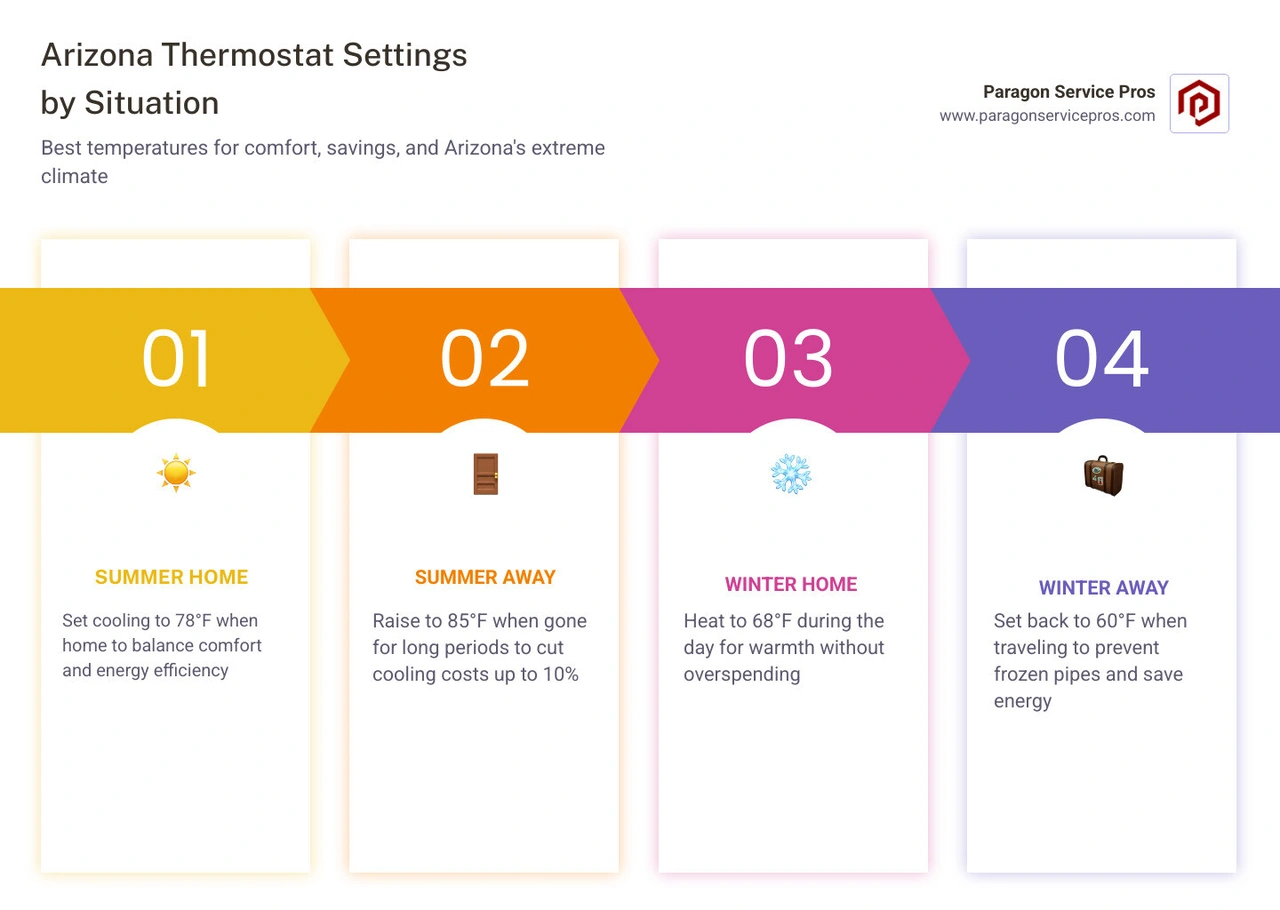
For most Arizona homes, the best energy-saving baseline is simple:
- 78°F for cooling in summer
- 68°F for heating in winter
Those numbers are not magic. They are starting points that balance comfort and efficiency for many households. In real life, plenty of people feel better at 76°F in summer or 70°F in winter, especially if they work from home, have a west-facing room, or have babies or elderly family members at home.
The trick is to avoid dramatic swings and make gradual changes. If your house has been living at 72°F all summer, jumping straight to 78°F may feel like betrayal. Try moving 1 to 2 degrees at a time over several days.
What temperature should I set my thermostat in summer for comfort and efficiency?
In Arizona, 78°F is the classic energy-efficient target when you're home and awake. A practical comfort range for many households is:
- 76°F to 80°F when home
- 80°F to 85°F when away
- Around 75°F when sleeping
Why the range? Because comfort is not just about temperature. Sun exposure, humidity, insulation, ceiling height, and how active you are all matter. A shaded, well-insulated home in Gilbert may feel fine at 78°F. A sunny west-facing room in Mesa may feel warmer at the exact same setting.
A few summer comfort boosters let you keep the thermostat a little higher:
- Run ceiling fans counterclockwise so air blows down and feels cooler
- Close blackout curtains or blinds during the hottest part of the day
- Avoid using the oven, dryer, or other heat-producing appliances in the afternoon
- Keep return vents and supply registers open and unblocked
- Use the thermostat fan setting on Auto, not On, unless your system needs otherwise
One important Arizona note: when you leave, do not turn the AC completely off for long periods in peak summer. A setting in the 80°F to 85°F range usually makes more sense. That helps control indoor humidity and reduces the chance of stale air or moisture issues.
What temperature should I set my thermostat in winter for comfort and savings?
For winter, 68°F is the standard starting point when you're home and awake. A common comfort range is:
- 68°F to 72°F when home
- 63°F to 65°F when sleeping
- About 60°F when away for the day
- 55°F to 60°F if traveling, depending on the home and weather
Even in Arizona, winter nights can feel surprisingly cold, especially in Chandler, Queen Creek, and San Tan Valley. If 68°F feels chilly, try 69°F or 70°F before jumping much higher. Every degree can affect energy use. Research commonly shows each degree you lower can save 3% or more on heating costs.
A few winter comfort tips help you stay cozy without cranking the thermostat:
- Wear layers and warm socks
- Open blinds during sunny winter afternoons
- Set the system fan to Auto so it does not circulate cool air unnecessarily
- Seal drafts around doors and windows
- Use area rugs on cold floors
The best thermostat settings when you are away, asleep, or traveling
This is where real savings often happen.
A widely cited rule is to adjust your thermostat by 7°F to 10°F for about 8 hours a day when you're asleep or away. Done consistently, that can save up to 10% per year on heating and cooling bills.
Good starting points are:
- Summer away: 80°F to 85°F
- Summer sleep: around 75°F
- Winter away: around 60°F
- Winter sleep: 63°F to 65°F
- Winter travel: 55°F to 60°F
For sleep, many people prefer a cooler room. Research often puts ideal sleeping temperatures around 60°F to 67°F, though Arizona households may choose the warmer end in summer for practical reasons.
If you have a heat pump, be careful with big winter setbacks. Large temperature jumps can trigger backup heat on some systems, which is less efficient. Smaller setbacks usually work better.
How to Balance Comfort, Humidity, and Energy Savings
A thermostat does not control comfort by itself. It controls temperature. Your body notices much more than that.
In Arizona, we often focus on heat, but humidity, airflow, insulation, and sunlight all affect how a room feels. Two homes can both be set to 78°F and feel completely different. One feels comfortable. The other feels like a toaster with windows.
Why humidity changes the temperature your home feels
Humidity changes how well your body cools itself.
When indoor air is too humid, sweat does not evaporate as easily, so the room feels warmer and stickier. When air is very dry, especially in winter, the house can feel cooler than the thermostat says.
That is why "comfortable" temperature varies so much from person to person.
A few practical guidelines:
- In winter, indoor humidity around 30% to 50% is usually comfortable
- In summer, your AC should remove some moisture as it cools
- If your home still feels muggy, there may be an airflow, sizing, or dehumidification issue
- Multi-speed or variable-speed systems often manage humidity better than basic single-stage systems
If your thermostat setting seems reasonable but the house still feels off, the problem may not be the number on the wall. It may be humidity, uneven airflow, duct leakage, insulation gaps, or thermostat placement.
How much can adjusting the thermostat really save?
Quite a bit, especially in Arizona.
A few key numbers from the research:
- Heating and cooling account for about 52% of the average household's energy costs
- Setting the thermostat back 7°F to 10°F for 8 hours a day can save up to 10% annually
- Each degree you lower in winter can save 3% or more on heating costs
- Each degree above 72°F can save up to 3% on cooling costs
In very hot Arizona summers, the impact of lower cooling settings can be even more noticeable because the system is already fighting such a large indoor-outdoor temperature difference. That means dropping from 78°F to 74°F may feel small, but your AC definitely notices.
The good news: small changes add up. You do not need to suffer through a hot house or a cold house to save energy. Often, a 1°F to 2°F adjustment plus better airflow and shading is enough.
Easy ways to feel comfortable without constantly changing the thermostat
Here are simple ways to improve comfort while using less heating and cooling:
- Use ceiling fans in occupied rooms only
- Close blinds and curtains during hot afternoons
- Let in winter sunlight during the day
- Replace weatherstripping around leaky doors
- Seal air leaks around windows
- Keep attic insulation and ductwork in good shape
- Run heat-producing appliances later in the evening during summer
- Change filters regularly
- Keep furniture away from vents
- Avoid setting the thermostat much colder than normal to "cool faster" because it will not
These small habits often matter more than people expect.
Smart, Programmable, or Manual: Which Thermostat Saves More?
Short answer: smart and programmable thermostats usually beat manual ones because they make good habits automatic.
| Thermostat type | Best for | Main benefit | Watch-outs |
|---|---|---|---|
| Manual | Very simple routines | Easy to use | Relies on you remembering adjustments |
| Programmable | Predictable schedules | Automatic setbacks | Must be programmed correctly |
| Smart | Changing routines, remote control | Learns habits, app control, alerts | Must be compatible with your HVAC system |
When a programmable thermostat makes sense
Programmable thermostats are great if your schedule is predictable.
For example:
- Wake up at the same time
- Leave for work on weekdays
- Come home around the same hour
- Go to bed on a regular schedule
A 7-day programmable thermostat can automatically handle wake, away, return, and sleep periods. That means fewer "Oops, we left the AC at 72°F all day" moments.
They are especially useful for homeowners who want savings without learning a full smart-home setup.
When a smart thermostat is the better choice
Smart thermostats are best when your routine changes or you want more control.
Benefits can include:
- Wi-Fi access from your phone
- Remote temperature changes
- Learning features based on your habits
- Occupancy sensing
- Eco modes
- Maintenance alerts
- Better integration with zoning and home automation
For Arizona homeowners with changing work schedules or frequent travel, smart thermostats are often the easiest way to balance comfort and savings. If you're exploring options, our smart thermostat installation guide for Gilbert, AZ is a helpful place to start.
Thermostat compatibility and calibration mistakes to avoid
This is the part many homeowners do not think about until something acts weird.
Not every thermostat works with every HVAC system. Compatibility matters with:
- Heat pumps
- Multi-stage equipment
- Variable-speed systems
- Electric resistance heat
- Radiant systems
- Older wiring setups
Heat pumps deserve special mention. In winter, large setbacks can trigger backup heat strips on some systems, which can reduce efficiency. Smart thermostat settings should be configured correctly for heat pump operation.
Calibration matters too. If your thermostat reads the wrong temperature, every setting is wrong by default. A thermostat that is off by even a few degrees can lead to poor comfort, short cycling, or wasted energy. Learn more in our guides to AC thermostat calibration and thermostat calibration service.
Best Thermostat Settings for Infants, Pets, Elderly Residents, and Other Special Situations
The "best" thermostat setting changes when someone in the home is more sensitive to heat or cold. Comfort advice for a healthy adult is not always the right advice for everyone else.
Safe temperature ranges for babies, seniors, and pets
Use these as practical guidelines:
- Infants: about 65°F to 74°F
- Elderly residents: generally keep winter temperatures above 68°F
- Pets: often comfortable in roughly 64°F to 78°F
- Houseplants: many do well around 60°F to 75°F
Babies and older adults can have a harder time regulating body temperature. In Arizona summers, that matters a lot. If you have vulnerable family members at home, it often makes sense to prioritize stable indoor conditions over aggressive setbacks.
A few tips:
- Check the actual room temperature in nurseries and bedrooms
- Make sure pet sleeping areas are not in sun-baked rooms
- Keep water available for pets and people
- Use room-darkening shades in nurseries and west-facing bedrooms
How to adjust settings for sleep, home offices, and lightly used rooms
Sleeping comfort is often best in a cooler room, usually around 60°F to 67°F, though many Arizona households land a bit warmer in summer. If one bedroom gets direct afternoon sun, you may need a lower evening setpoint or better shade control.
For home offices, comfort depends on activity level. If you sit still all day, 79°F may feel much warmer than it does when you're cleaning the kitchen or chasing kids around. Lightly used rooms can usually be allowed to drift a little warmer in summer or cooler in winter, as long as airflow remains balanced and doors are managed carefully.
If your home has zoning or a ductless mini-split in one area, you can often fine-tune comfort much more effectively than with one whole-house setting.
Where to Place Your Thermostat and How to Keep It Working Efficiently
Even the perfect temperature setting will not help much if the thermostat is in the wrong spot.
The best thermostat location for accurate readings
The best thermostat location is usually:
- On an interior wall
- Near the center of the home
- In a commonly used living area
- At a normal breathing height
- Away from direct sunlight and drafts
Avoid placing a thermostat:
- Near windows or exterior doors
- In hallways with poor airflow
- Close to supply vents or return grilles
- In kitchens
- In bathrooms
- Near lamps, TVs, or appliances that give off heat
A bad location can fool the thermostat into thinking your home is hotter or colder than it really is. Then your system runs too much or not enough.
Maintenance tips that improve thermostat and HVAC performance
A thermostat works best when the whole HVAC system is working well.
Key maintenance habits include:
- Replace or clean filters every 30 to 90 days, depending on use
- Keep supply and return vents clear
- Maintain clearance around the outdoor unit
- Check that ceiling fans rotate the right direction for the season
- Schedule seasonal tune-ups
- Watch for uneven temperatures that may signal duct or sensor issues
For more ways to keep your system efficient, see our guides on essential heating and cooling maintenance, seasonal AC preparation, maximizing AC energy efficiency, and saving money on your heating bill this winter.
Frequently Asked Questions About What Temperature Should I Set My Thermostat
Is 72 a good temperature for heat in the winter?
Yes, 72°F is comfortable for many people. It is just a little warmer than the usual energy-saving recommendation of 68°F to 70°F. If you prefer 72°F and your home still feels balanced, that is reasonable. Just know it may use more energy than a lower setting.
Is 74 too hot for a house?
Not necessarily. Some households are perfectly happy at 74°F. In summer, though, 74°F can require noticeably more cooling than 78°F, especially during Arizona heat waves. In winter, 74°F is on the warm side for most homes. Humidity, sunshine, and airflow all affect how 74°F actually feels.
Can I replace my AC thermostat with any thermostat?
No. The thermostat must match your HVAC system type and wiring. Heat pumps, multi-stage equipment, and smart controls all have specific compatibility requirements. Professional installation helps prevent wiring problems, bad programming, and inaccurate operation.
Conclusion
If you want the simplest answer to what temperature should I set my thermostat, start with 78°F in summer and 68°F in winter, then adjust from there based on comfort, humidity, and who is in the home.
The biggest takeaways are simple:
- Use setbacks when you're away or asleep
- Make small temperature changes instead of big ones
- Pay attention to humidity and airflow
- Put the thermostat in the right location
- Keep your HVAC system maintained
- Consider smart scheduling if your routine changes often
For homeowners in Chandler, Gilbert, Mesa, Gold Canyon, Queen Creek, and San Tan Valley, the right thermostat strategy can make a real difference in both comfort and efficiency year-round.
If you're ready to upgrade your controls, our smart thermostat installation guide for Chandler, AZ is a great next step.
Keep reading: Smart Thermostats
Browse every article in Smart Thermostats or head back to the Learning Center .
Comfort you can count on, all year long.
Same-day service, honest diagnostics, and 24/7 emergency help with no overtime fees. A real Greater Phoenix team is standing by.