
The Complete Guide to Cooling Your Garage in Extreme Desert Heat
Learn how to cool your garage in extreme desert heat with insulation, sealing, ventilation, and efficient AC options for Arizona homes.

When Your Garage Feels Like a Furnace: What Arizona Homeowners Need to Know
If you're trying to figure out how to cool your garage in extreme desert heat, here's the short answer:
- Insulate first - Add insulation to your garage door, ceiling, and walls before anything else
- Seal air leaks - Install weatherstripping, bottom seals, and fill gaps around pipes and conduits
- Add ventilation - Use exhaust fans with proper intake vents to push hot air out
- Choose the right cooling system - A ductless mini-split is the most effective long-term solution for regularly used garages in Arizona
- Manage the small stuff - Park hot vehicles outside until they cool, use the garage during cooler morning hours, and keep the space decluttered for better airflow
Step into your garage on a July afternoon in Chandler or Mesa, AZ, and you already know the problem. The air hits you like you've opened an oven door. That's not just the outside temperature talking.
Without insulation or ventilation, a garage can run 10 to 18°F hotter than the air outside. In a desert climate where summer temperatures regularly push past 110°F, that means your garage interior can reach 125°F or higher — and it can stay that hot well into the night, long after the sun goes down, because concrete slabs absorb heat all day and slowly release it for hours.
This isn't just a comfort issue. Extreme heat damages stored electronics, warps wood, degrades rubber seals, and can make your garage unusable for any purpose beyond baking things you didn't mean to bake. For Arizona homeowners who want to use their garage as a workspace, gym, or hobby area, the heat is a real barrier.
The good news is that garage cooling is a solvable problem — and it doesn't have to start with an expensive equipment purchase. It starts with understanding why your garage overheats, and then working through a logical sequence of fixes.
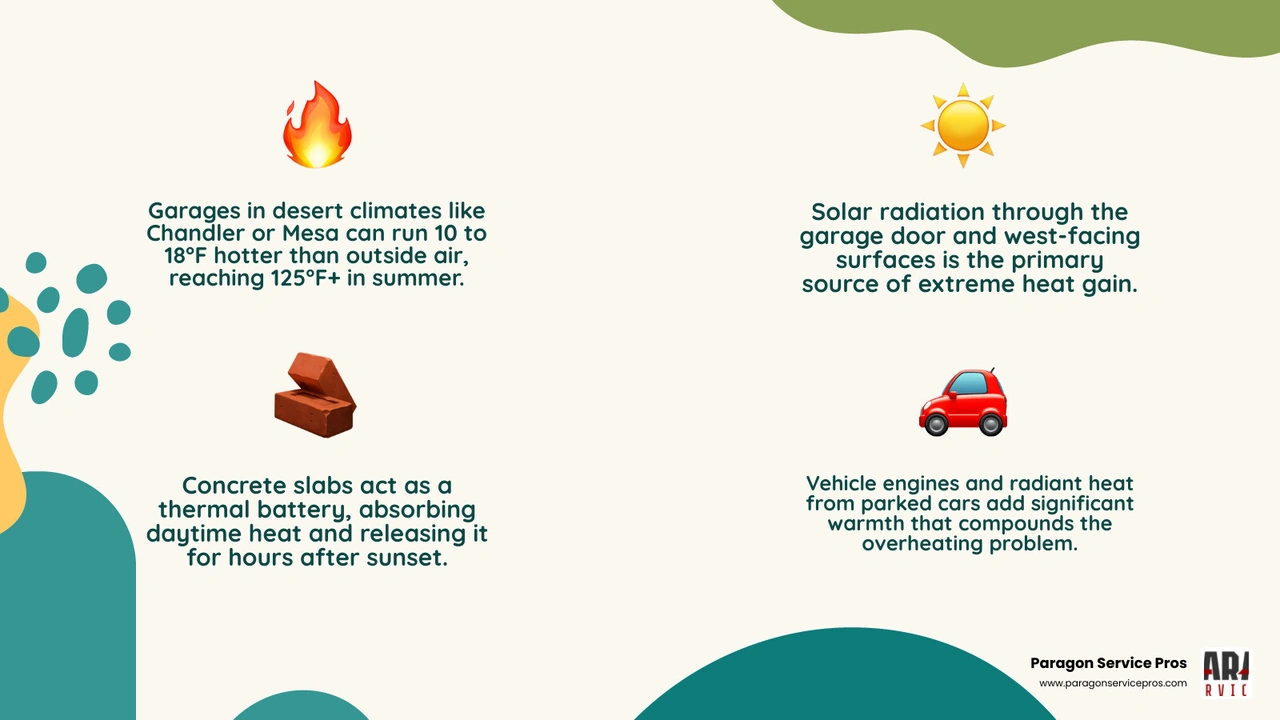
Basic how to cool your garage in extreme desert heat glossary:
Why Desert Garages Overheat: Main Sources of Heat Gain
To tackle the problem of a scorching garage, we first have to look at how that heat gets inside. In places like Gilbert, Queen Creek, and San Tan Valley, the desert sun is relentless. Your garage acts like a giant greenhouse, trapping heat with very few ways to let it escape.
The primary culprit is solar radiation. Direct sunlight beats down on your garage roof and door all day. If your garage door faces south or west, it receives the most intense afternoon sun. Because standard garage doors are typically made of thin sheet metal, they act like giant radiators, transferring that intense heat directly into the space.
Additionally, many homes have uninsulated attic spaces directly above the garage. During peak summer, attic temperatures in Arizona can easily soar to between 140°F and 160°F. Without a proper thermal barrier, this heat radiates downward through the garage ceiling, keeping the space incredibly hot. To understand how these extreme conditions affect your home's comfort systems, read more about How Arizona Desert Climate Affects Your HVAC.
The Role of the Concrete Slab and Vehicle Heat
One of the most overlooked heat sources in any garage is the concrete floor. Concrete has a high thermal mass, meaning it acts like a giant thermal battery. It slowly absorbs heat throughout the day and holds onto it. Long after the sun sets and the outside air begins to cool, that concrete slab will continue to radiate heat back up into your garage, keeping the space uncomfortably warm late into the evening.
Now, add a hot vehicle to the mix. When you drive home from work on a 115°F day, your car's engine, exhaust system, and brakes are radiating immense amounts of heat. Parking that hot vehicle inside a closed, uninsulated garage is the equivalent of turning on a large space heater. The car will dump heat into the enclosed space for one to two hours, driving temperatures up even further.
To combat this without spending a dime, develop a simple habit: park your recently driven vehicle in the driveway until the engine cools down before pulling it into the garage. This low-cost behavioral shift prevents hundreds of thousands of BTUs of heat from being trapped inside your home's shell.
How to Cool Your Garage in Extreme Desert Heat: The Core Strategy
When homeowners ask us how to cool a hot garage, their first instinct is often to buy a portable air conditioner or a fan. However, trying to cool an uninsulated, unsealed garage is like running your living room air conditioner with all the windows wide open. You will waste energy and get very disappointing results.
Our core recommendation is to focus on the building envelope first. By stopping the heat at the source and sealing air leaks, you make any future ventilation or active cooling systems incredibly efficient. For broader advice on keeping home comfort systems running smoothly, check out our Maximizing Energy Efficiency Tips for Your AC Unit.
Step-by-Step: How to Cool Your Garage in Extreme Desert Heat with Insulation
To build an effective barrier against the desert sun, you need to insulate the surfaces getting cooked.
- The Garage Door: This is your largest wall and your biggest source of heat gain. Installing a garage door insulation kit is a highly effective weekend DIY project. Look for kits utilizing high-quality polyurethane panels rather than simple polystyrene, as polyurethane offers superior thermal resistance in a thinner profile. Upgrading to a professional, pre-insulated garage door with an R-value of R-12 to R-15 or higher can dramatically reduce heat transfer into the space.
- The Ceiling: If the attic space above your garage is empty and uninsulated, adding fiberglass batts or blown-in insulation is crucial. Aim for an insulation level of R-30 to R-49 in the ceiling.
- Radiant Barriers: Installing a radiant barrier along the underside of your garage roof or on the garage ceiling can reflect up to 97% of radiant heat, preventing it from migrating downward.
- The Walls: If your garage walls are unfinished, installing fiberglass batt insulation before hanging drywall is highly recommended.
If you want to explore how these insulation upgrades prepare your space for dedicated climate control, take a look at our guide on Garage AC Options for Arizona Homeowners.
Sealing Air Leaks and Upgrading Weatherstripping
Once the insulation is in place, you must seal the gaps. Hot desert air is highly opportunistic; it will find any crack to seep into your garage, carrying dust and monsoonal moisture with it.
- Weatherstripping: Inspect the rubber seals along the top and sides of your garage door. If you can see daylight around the edges of the door when it is closed, hot air is constantly leaking inside. Replace old, brittle weatherstripping with high-quality, flexible vinyl seals.
- Bottom and Threshold Seals: The rubber seal at the bottom of your garage door takes a beating from the hot concrete. If it is cracked or flattened, replace it. You can also install a floor-mounted threshold seal to create a tight barrier against both hot drafts and blowing desert dust.
- Conduits and Penetrations: Use expanding foam or silicone caulk to seal gaps around electrical conduits, plumbing pipes, or outdoor vents that pass through your garage walls.
Ventilation Strategies for Extreme Desert Climates
Once you have insulated and sealed your garage, the next step is managing the air inside. Ventilation is all about removing trapped hot air and replacing it with cooler air from the outside (typically during the early morning or evening hours).
Passive Airflow vs. Powered Exhaust Fans
Passive ventilation relies on natural air movement. By installing low intake vents on one side of the garage and high exhaust vents (such as roof turbines or ridge vents) on the opposite side, you can create a natural chimney effect. As hot air rises and escapes through the top vents, it draws cooler air in through the lower vents.
However, passive ventilation often falls short when outdoor temperatures exceed 110°F and there is no natural breeze. This is where mechanical, powered exhaust fans become necessary.
A thermostatically controlled exhaust fan installed in the ceiling or an exterior wall can actively pull hot air out of the garage and dump it outside. To make this setup work, you must have a clear intake path, such as a wall vent, to allow fresh air to enter. For Arizona homes, we recommend sizing your exhaust fan to provide 10 to 15 air changes per hour.
That standard household fans do not lower the actual air temperature; they only move air across your skin to create a windchill effect. While high-velocity shop fans make you feel cooler while you are actively working in the garage, they will not protect your stored belongings from extreme heat when you leave the room.
Is Cracking the Garage Door Open an Effective Cooling Strategy?
It is a common sight in Arizona: homeowners leaving their garage doors cracked open a few inches at the bottom to let heat escape. While this might seem like a clever, free cooling hack, it is generally an ineffective and risky strategy in extreme desert heat.
First, cracking the door creates a major security vulnerability, inviting opportunistic intruders into your home. Second, it allows desert pests — including scorpions, spiders, mice, and snakes — to seek shelter in your shaded garage. Finally, when Phoenix-area dust storms or monsoons roll through, a cracked door allows blowing dust, debris, and moisture to coat everything inside.
Thermally, cracking the door without an active exhaust fan above simply allows a draft of superheated air to rise into the garage, often making the space hotter rather than cooler during peak sun hours.
Comparing Active Cooling Options for Desert Garages
If you plan to use your garage regularly as a gym, workshop, or home office, passive cooling and ventilation will not be enough. You will need an active cooling system. Let's compare the most common options available for desert homeowners:
| Cooling Option | Best Suited For | Pros | Cons |
|---|---|---|---|
| High-Velocity Fan | Spot cooling during quick projects | Low cost, easy to move, creates a windchill effect | Does not lower actual air temperature |
| Evaporative (Swamp) Cooler | Dry, low-humidity early summer days | Energy-efficient, portable options available | Completely loses effectiveness during monsoon season; adds humidity that can rust tools |
| Portable AC Unit | Small, lightly insulated spaces | No permanent installation required | Inefficient, requires venting a large hose outside, short lifespan |
| Window AC Unit | Garages with an existing window | Budget-friendly, reliable cooling | Requires a window, can be noisy, security risk if unsecured |
| Ductless Mini-Split | Daily use, full climate control | Extremely efficient, quiet, provides heating and cooling, perfect for desert heat | Requires professional installation and dedicated electrical work |
Active Systems: How to Cool Your Garage in Extreme Desert Heat Using AC
If you want reliable comfort in your garage, a dedicated air conditioning system is the ultimate solution. Among all options, a ductless mini-split system is the gold standard for desert garages.
Mini-splits consist of an outdoor compressor connected to a quiet, wall-mounted indoor air handler via a small conduit. Because they do not require ductwork, they eliminate the energy loss associated with traditional central AC systems. Modern mini-splits are incredibly efficient, boasting high SEER2 (Seasonal Energy Efficiency Ratio) ratings that keep energy consumption remarkably low.
To determine whether adding dedicated air conditioning to your garage aligns with your home improvement goals, read our detailed analysis: Is Garage Air Conditioning Worth the Investment.
The Impact of Monsoon Humidity on Cooling Choices
Arizona's summer is split into two distinct phases: the dry heat of June and the humid monsoon season of July and August. This shift has a massive impact on how you choose to cool your garage.
Evaporative coolers (or swamp coolers) work beautifully in dry desert air because they rely on the evaporation of water to lower temperatures. However, once the monsoon humidity spikes, the air becomes saturated. When the humidity rises, evaporative coolers can no longer evaporate water efficiently. Not only do they stop cooling, but they also pump sticky, humid air into your garage. This excess moisture can lead to mold growth, musty odors, and rust on your expensive tools and gym equipment.
Refrigerated air conditioning systems, like mini-splits or window units, are the only systems that remain fully effective during the monsoon season. They cool the air while simultaneously dehumidifying the space, protecting your belongings and keeping the air clean and comfortable.
DIY vs. Professional Installation: Safety and Code Compliance
Many garage cooling projects are perfect for handy homeowners. Installing weatherstripping, painting a dark garage door a lighter reflective color, or applying a DIY garage door insulation kit are excellent ways to save on labor.
However, when it comes to electrical upgrades, mechanical ventilation, and air conditioning installation, professional help is essential.
Installing a mini-split system, for example, requires handling refrigerants, running dedicated electrical lines, and ensuring proper condensate drainage. In attached garages, local building codes often require specific fire-rated drywall and fire dampers on ventilation systems to prevent a garage fire from quickly spreading to the main living areas of the house.
Why You Should Never Tie Your Garage to Your Home’s Central AC
We occasionally encounter homeowners who want to cut corners by extending their home's existing central AC ductwork into the garage. Never do this.
First, tying your garage into your home's central system is a major violation of building codes in Arizona. Second, it presents a severe safety hazard. Garages contain carbon monoxide from vehicle exhaust, paint fumes, gasoline, and other hazardous chemicals. If your garage is connected to your home's ductwork, these toxic fumes can easily be drawn into your home's return air system and distributed throughout your bedrooms and living spaces.
Additionally, your home's AC system was sized specifically for the square footage of your living spaces. Adding the heavy thermal load of a hot garage will overload your system, leading to premature compressor failure and uneven cooling throughout your house.
Maximizing Energy Efficiency and Solar Integration in 2026
As we navigate the hot summer of 2026, energy efficiency is more important than ever. If you have solar panels installed on your home, cooling your garage can actually improve your overall solar return on investment. By keeping the garage cool, you reduce the heat transfer through the shared walls of your home, allowing your main household AC unit to run less frequently.
Furthermore, there are several financial incentives available to help offset the cost of energy-efficient home upgrades. To see how you can save on high-efficiency cooling installations, explore our guides on Arizona Energy Rebates for HVAC Upgrades and SRP and APS Rebates for Phoenix Area Homeowners.
Frequently Asked Questions about Desert Garage Cooling
What is the most effective way to cool a garage in Arizona?
The absolute most effective method is a two-step approach: first, insulate and seal the garage envelope (especially the garage door and ceiling) to block the heat. Second, install a dedicated ductless mini-split AC system. This combination provides reliable, year-round temperature control regardless of how high the desert temperature climbs.
Will cooling my garage increase my electric bill significantly?
While adding any cooling system will increase electricity consumption, the impact can be minimized. By thoroughly insulating the garage first and choosing a high-efficiency mini-split with a high SEER2 rating, the system will run incredibly efficiently. Additionally, cooling the garage reduces the heat load on the shared walls of your home, which can actually help your main home AC system run more efficiently.
What is the most common mistake homeowners make when cooling a garage?
The most common mistake is buying cooling equipment (like a portable AC or a large fan) before addressing insulation and air sealing. Without a proper thermal barrier, any cooling system will be overwhelmed by the desert heat, resulting in high energy bills and a garage that remains uncomfortably hot.
Conclusion
Cooling your garage in the extreme desert heat of Arizona is entirely achievable when you follow the right steps. By starting with insulation and air sealing, managing daily habits like parking hot cars outside, and choosing a dedicated, high-efficiency cooling system like a ductless mini-split, you can transform your garage from a sweltering oven into a comfortable, functional extension of your home.
Whether you live in Chandler, Gilbert, Gold Canyon, Mesa, Queen Creek, or San Tan Valley, our team is here to help you design the perfect comfort solution for your home. Ready to take back your garage this summer? Explore our professional services at Paragon Service Pros HVAC Services and schedule your consultation today!
Keep reading: Air Conditioning
Browse every article in Air Conditioning or head back to the Learning Center .
Comfort you can count on, all year long.
Same-day service, honest diagnostics, and 24/7 emergency help with no overtime fees. A real Greater Phoenix team is standing by.