
Dust, Heat, and Heartbreak: Your HVAC in the Desert
Discover how Arizona desert climate affects your HVAC: beat dust, heat & monsoons with expert maintenance tips for longer life.

Why the Arizona Desert Is One of the Hardest Places on Earth to Own an HVAC System
How Arizona desert climate affects your HVAC is something every homeowner in Chandler, Gilbert, Mesa, Queen Creek, San Tan Valley, and Gold Canyon learns the hard way — usually in the middle of July, when the system stops keeping up and the thermostat reads 85°F inside despite running nonstop.
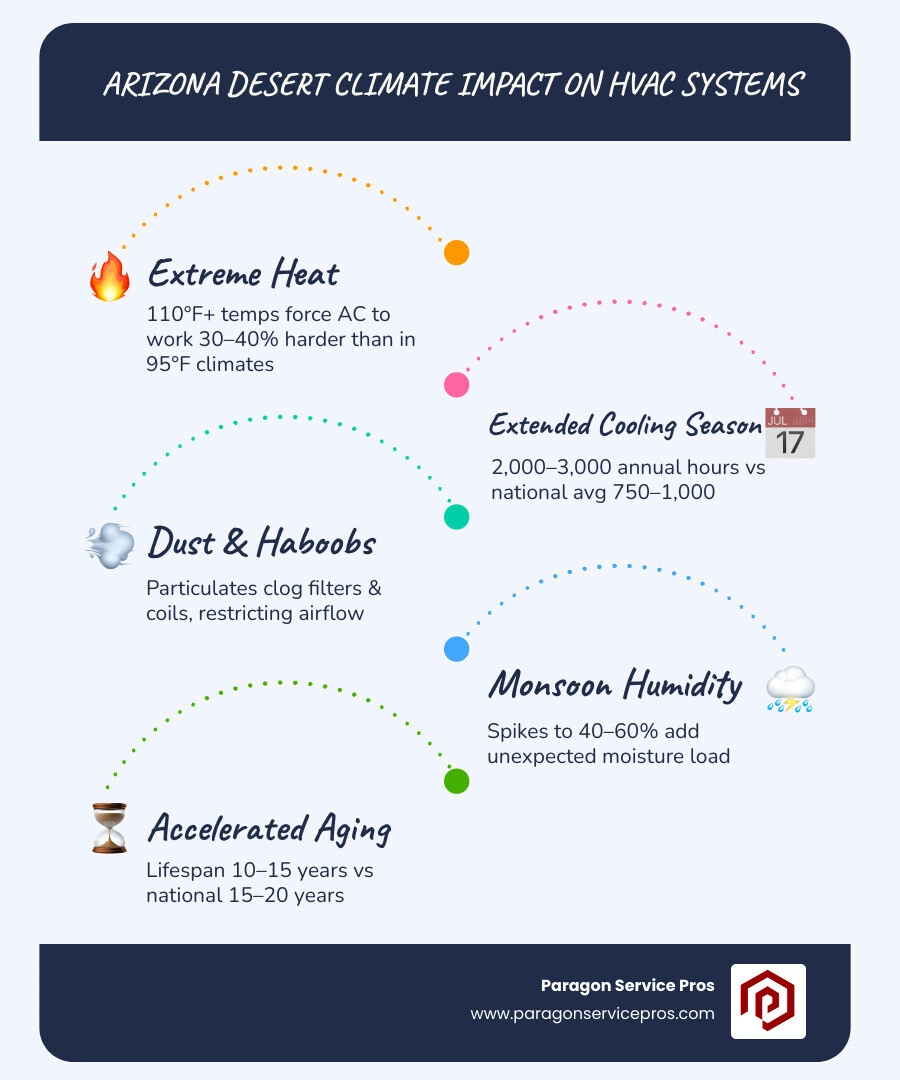
Arizona's desert climate is not just "hot." It is a year-round gauntlet of extreme temperatures, abrasive dust, monsoon humidity swings, and electrical surges that push HVAC equipment far beyond what it was designed to handle in most of the country. Here is a quick breakdown of the key ways the desert works against your system:
- Extreme heat — Temperatures regularly exceed 110°F, forcing your AC to work 30–40% harder than the same unit would in a 95°F climate
- Extended cooling season — Arizona systems run April through October, logging 2,000–3,000 cooling hours per year versus a national average of 750–1,000
- Desert dust and haboobs — Airborne particulate clogs filters fast, coats condenser coils, and chokes airflow
- Monsoon humidity spikes — From June 15 to September 30, outdoor humidity jumps from 10–20% to 40–60%+, adding moisture load the system was not managing before
- Landscaping heat effects — Decomposed granite and reflective rock can raise the ambient temperature around your outdoor unit by 5–8°F, increasing energy use by 15–20%
- Electrical surges — Monsoon storms bring power fluctuations that degrade capacitors and control boards over time
- Accelerated aging — The combination of all the above shortens the typical Arizona AC lifespan to 10–15 years, compared to the national average of 15–20 years
The result? Higher energy bills, more frequent repairs, and a system that hits its breaking point years earlier than it should — often right when you need it most.
This guide walks through exactly what the desert does to your HVAC, what warning signs to watch for, and what you can do to protect your investment and stay comfortable through every season.
How Arizona Desert Climate Affects Your HVAC
In the technical world of air conditioning, we talk a lot about "sensible cooling." This is the process of lowering the actual air temperature you see on the thermostat. In a place like Gilbert or Mesa, where summer afternoons routinely hit 115°F, your system is under massive thermal stress.
The physics of cooling relies on heat transfer. Your AC doesn't "create" cold; it removes heat from your home and dumps it outside. However, when it’s 115°F outside, the temperature difference between your boiling-hot condenser coils and the outdoor air narrows. This makes it incredibly difficult for the system to shed heat. To keep your home at a comfortable 78°F, the unit has to run longer and harder, which is why Maximizing AC Energy Efficiency is so critical for Arizona residents.
Understanding How Arizona Desert Climate Affects Your HVAC Efficiency
While we are famous for our "dry heat," the lack of humidity actually changes how your AC operates. In more humid climates, a large portion of the AC's energy goes toward "latent load"—removing moisture from the air. In the Arizona desert, almost all the energy is focused on sensible cooling.
While this sounds efficient, the sheer volume of heat means the compressor rarely gets a break. During peak summer, energy consumption spikes because the system may run 12 to 16 hours a day just to maintain a safe indoor temperature. If you find your AC Not Cooling effectively during a heatwave, it’s often because the system has reached its "design capacity"—it simply cannot move heat out of the house faster than the sun is pushing it in.
The Impact of Low Humidity on System Components
The extreme dryness of the Sonoran Desert is a silent killer for mechanical parts. Just as the dry air chaps your skin, it leaches moisture out of the rubber seals and belts inside your HVAC unit. Over time, these components become brittle and crack, leading to refrigerant leaks or mechanical failure.
Furthermore, dry air is a perfect conductor for static electricity. Within your ductwork, static can cause dust to cling to the walls of the ducts more aggressively. The intense heat also causes building materials to expand and contract. In attics that reach 160°F, ductwork expansion can cause seals to fail, leading to massive efficiency losses. For more on managing your home's air environment, check out our Indoor Air Quality Gilbert AZ Guide.
The Triple Threat: Dust, Haboobs, and Clogged Components
If heat is the weight on your HVAC’s shoulders, dust is the sand in its gears. Arizona is famous for haboobs—massive dust storms that can coat everything in a fine layer of silt in minutes. This particulate matter is an HVAC system's worst nightmare.
When dust coats your outdoor condenser coils, it acts as an insulator. Instead of the coils releasing heat into the air, the heat stays trapped. This "fouling" can reduce heat transfer efficiency by up to 30%. Indoors, the same dust clogs your air filters at an accelerated rate. While a manufacturer might say to change a filter every three months, the Benefits of Replacing HVAC Filters in Arizona are only realized if you do it every 30 to 45 days. If that dust makes it past the filter, it settles in your ducts, necessitating professional Duct Cleaning Services to restore airflow.
Landscaping and the Heat Island Effect
Many homeowners in San Tan Valley and Queen Creek prefer desert landscaping with decomposed granite or river rock. While beautiful and water-efficient, these materials create a "heat island" around your home. Light-colored rocks reflect solar radiation directly back onto your house and your outdoor AC unit.
Units surrounded by decomposed granite can experience ambient temperatures 5–8°F higher than those with strategic shade. This translates to a 15–20% increase in energy consumption. To mitigate this, we recommend maintaining at least two feet of clearance around the unit and using desert-hardy trees to provide afternoon shade, which can add years to your equipment's life. Regular AC Maintenance ensures that any debris from nearby plants, like mesquite pods or palo verde needles, doesn't choke the system.
Monsoon Madness: Humidity Spikes and Electrical Surges
From mid-June through September, the rules of the desert change. The humidity jumps from 10% to over 50%, and the dew point rises. Suddenly, your AC has to handle a massive latent load it wasn't dealing with in May.
This moisture can lead to an AC Freezing Up. When the air is humid, moisture condenses on the evaporator coil. If the airflow is restricted by a dirty filter or the refrigerant is low, that condensation turns to ice, effectively blocking all cooling. Additionally, monsoon thunderstorms bring lightning and power fluctuations. These surges are notorious for "fried" capacitors—the small components that help your motors start. Without a surge protector, a single storm can leave you without cooling in the middle of a humid night.
Managing Condensate and Drainage Issues
Because Arizona units aren't used to high humidity, their drainage systems are often the first thing to fail during monsoon season. The sudden increase in condensation means your drain lines are working overtime.
Dust from earlier in the season mixes with this water to create a "sludge" that promotes algae growth. This often leads to AC Drain Line Issues and clogs. If your primary drain line clogs, water can back up into your home or trigger a safety switch that shuts the whole system down. Keeping these lines clear is a vital part of desert homeownership.
Why Desert HVAC Systems Age Faster Than the National Average
It is a hard truth: an air conditioner in Arizona will likely die 5 to 10 years sooner than one in the Midwest. The sheer volume of work is the primary reason.
| Feature | Arizona Average | National Average |
|---|---|---|
| Typical Lifespan | 10–15 Years | 15–20 Years |
| Annual Cooling Hours | 2,000–3,000 | 750–1,000 |
| Workload at 115°F | 30–40% Harder | Baseline |
| Filter Change Frequency | 1 Month | 3 Months |
When a system runs for 3,000 hours a year in 110-degree heat, the compressor—the heart of the system—simply wears out. Eventually, the cost of keeping an old unit alive outweighs the benefits, making AC Replacement the smarter financial move. For those in the East Valley, we often provide Gold Canyon AC Replacement services to help families transition to modern, high-efficiency units that handle the heat better.
Signs That How Arizona Desert Climate Affects Your HVAC Is Leading to Failure
You don't want to wait for a total breakdown in July. Watch for these red flags:
- Rising Energy Bills: If your bill is 20% higher than the same month last year with no rate hike, your efficiency is tanking.
- Frequent Cycling: The unit turns on and off every few minutes (short-cycling), which destroys the compressor.
- Unusual Noises: Grinding, squealing, or heavy rattling usually indicates a failing motor or loose component.
If you notice these, it’s time for AC Repair. We specialize in San Tan Valley AC Repair and serve the surrounding areas to catch these issues before they become "heartbreak" failures.
Essential Maintenance for Arizona Homeowners
Maintenance in Arizona isn't a luxury; it’s a survival strategy. New federal SEER2 standards mean that modern units are more efficient than ever, but they are also more complex. Understanding SEER Ratings can help you choose the right replacement, but keeping your current unit running requires consistent HVAC Maintenance.
We recommend a two-visit approach: a spring tune-up to prep for the heat and a fall check-up to ensure your heating components (or heat pump) are ready for the chilly desert nights. Following a Seasonal HVAC Maintenance schedule is the best way to avoid the "July Emergency."
Proactive Steps for System Longevity
To keep your system alive as long as possible, follow these monthly and yearly steps:
- Change Filters Monthly: During the peak of summer or dust storm season, check them every 30 days.
- Clear the Perimeter: Keep plants, weeds, and rocks at least two feet away from your outdoor unit.
- Clean the Coils: Gently hose off your outdoor condenser (when the power is off) to remove dust buildup.
- Check Insulation: Ensure your attic has adequate insulation (R-38 or higher) to keep the heat from radiating through your ceiling.
- Professional Inspection: Have a technician check refrigerant levels and electrical connections annually.
If your system is over 12 years old and struggling, it might be time to look into a new AC Installation to take advantage of modern warranties and efficiency.
Frequently Asked Questions about Arizona HVAC
How often should I change my air filters in the desert?
In Arizona, the standard "three-month" rule does not apply. Because of the high volume of dust and the fact that the system runs almost constantly in the summer, you should check your filters every 30 days. If you have pets or live near a construction site or open desert, you may need to change them even more frequently.
Why does my AC struggle more during monsoon season?
The struggle is due to the "latent load." When humidity rises, your AC has to work to remove water from the air before it can effectively lower the temperature. This extra work strains the evaporator coil and can lead to higher energy bills and less effective cooling compared to the "dry" heat of June.
Is a 10-year-old AC unit considered "old" in Arizona?
Yes. While a 10-year-old unit in a cooler state might be considered "middle-aged," an Arizona unit at the 10-year mark has already logged as many hours as a 25-year-old unit elsewhere. This is the age where major components like the compressor or fan motors are most likely to fail.
Conclusion
At Paragon Service Pros, we live and work in the same desert heat you do. We understand that your air conditioner is the most important appliance in your home. Whether you are in Chandler, Mesa, or Queen Creek, our goal is to provide the reliability and expert service you need to navigate the harsh Arizona climate.
Don't let the desert heat break your heart (or your bank account). From routine tune-ups to emergency repairs and full system replacements, we are here to ensure your home remains a cool sanctuary. For all your cooling needs, explore our full range of HVAC Services today.
Keep reading: Home & Energy Savings
Browse every article in Home & Energy Savings or head back to the Learning Center .
Comfort you can count on, all year long.
Same-day service, honest diagnostics, and 24/7 emergency help with no overtime fees. A real Greater Phoenix team is standing by.