
In Depth Guide to How Your HVAC Affects Indoor Air Quality
Discover how your HVAC affects indoor air quality with expert filtration, ventilation, and maintenance tips for healthier Arizona homes.

Why How Your HVAC Affects Indoor Air Quality Matters More Than You Think
How your HVAC affects indoor air quality is one of the most important — and most overlooked — factors in your family's daily health and comfort. According to the EPA, Americans spend approximately 90% of their time indoors, and indoor air pollutant concentrations are typically 2 to 5 times higher than outdoor levels. In some cases, they can be more than 100 times higher.
Your HVAC system is not just a temperature machine. It is the primary mechanism that filters, circulates, and — when properly equipped — ventilates the air inside your home. Here is a quick look at how it works:
How Your HVAC System Affects Indoor Air Quality:
- Filtration — Your air filter captures dust, pollen, pet dander, mold spores, and other airborne particles every time air cycles through the system.
- Ventilation — A well-configured HVAC setup can bring in fresh outdoor air and exhaust stale, pollutant-laden indoor air.
- Humidity control — Your system removes excess moisture while cooling, which directly impacts mold growth and dust mite activity.
- Air circulation — The blower moves air through your home continuously, determining how often indoor air passes through the filter.
- Ductwork integrity — Clean, sealed ducts deliver filtered air where it belongs; leaky or dirty ducts can introduce contaminants and bypass your filter entirely.
A properly maintained HVAC system can reduce airborne particulate concentrations by 50 to 70% compared to homes with neglected filters and leaking ductwork. Research also shows that better air quality can improve cognitive performance by up to 61% — meaning the air in your home affects how you think and feel, not just how you breathe.
In this guide, we break down every major way your HVAC system shapes the air you breathe inside your Mesa, Gilbert, Chandler, Queen Creek, San Tan Valley, or Gold Canyon home — and what you can do about it.
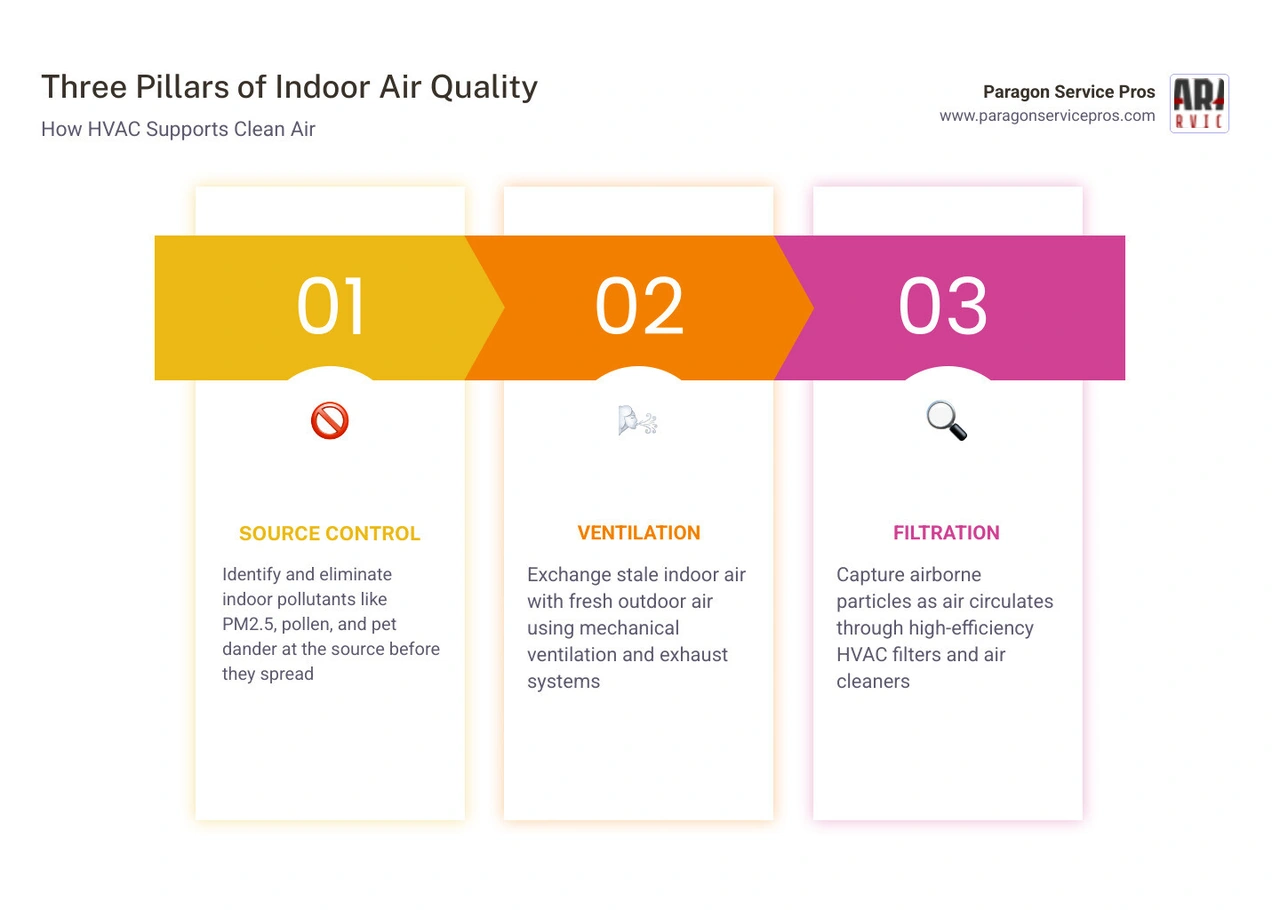
The Three Pillars of IAQ: How Your HVAC Affects Indoor Air Quality
To understand how to keep your home’s air clean, we have to look at the three foundational pillars of Indoor Air Quality (IAQ): source control, ventilation, and filtration. Your heating and cooling system plays a critical role in supporting and balancing each of these strategies.
When we evaluate a home's respiratory health, we look at how these three elements interact. For a detailed breakdown of how these principles apply directly to local homes, check out our Indoor Air Quality Gilbert AZ Guide.
Source Control and Pollutant Mitigation
The absolute most effective way to improve your air is to stop pollutants at their source. Source control means minimizing or eliminating the things that off-gas or shed particles into your living space. Common indoor air pollutants include volatile organic compounds (VOCs) from household cleaners, chemical fumes, pollen tracked in from the desert, and fine particulate matter (PM2.5) from cooking or candles.
For households with furry companions, dealing with pet hair and microscopic skin flakes is a constant battle. You can read more about managing these biological particles in our guide on Pet Dander Removal. Similarly, if you are struggling with stubborn, lingering scents from cooking, tobacco, or wildfire season, our resource on Smoke Odor Removal provides deep-dive solutions.
While your HVAC system cannot stop a dog from shedding or prevent a gas stove from emitting combustion byproducts, proper air circulation ensures these localized pollutants are quickly swept away to be filtered or exhausted rather than settling in your carpets and upholstery.
Mechanical Ventilation and Fresh Air Exchange
Historically, older homes were naturally "drafty," which meant fresh air leaked in through gaps around windows and doors. While terrible for your energy bills, this natural infiltration kept indoor air from becoming stale. Today, modern houses built in the East Valley are sealed tightly to maximize energy efficiency. Unfortunately, these airtight structures trap carbon dioxide ($CO_2$), moisture, and chemical vapors inside.
This is where mechanical ventilation comes in. The American Society of Heating, Refrigerating and Air-Conditioning Engineers (ASHRAE) sets the national standard for residential ventilation under ASHRAE 62.2. This standard outlines exactly how much fresh outdoor air must be introduced into a home to maintain healthy oxygen levels and dilute indoor contaminants.
Most standard residential split systems simply recirculate the same indoor air without mechanically bringing in fresh air. However, we can integrate fresh air intakes, mechanical dampers, or specialized ventilators into your existing system to draw in a controlled amount of outdoor air, filter it, and distribute it safely. If you suspect your home is trapping stale air, you can learn about professional diagnostic testing in our Indoor Air Quality Testing Chandler Guide.
Air Filtration and Particle Capture
Filtration is your home's active defense system. As your HVAC blower motor runs, it pulls air from your living spaces through return registers, pushes it through an air filter, conditions it (heats or cools it), and sends it back through your supply vents.
This continuous cycle of recirculating air is what allows high-quality air cleaners and media filters to scrub the air clean. Without effective filtration, your HVAC system acts as a giant fan that constantly stirs up dust and biological contaminants, keeping them suspended in the air you breathe. To find out how to establish a strong filtration baseline in your home, check out our Indoor Air Quality Testing Guide Mesa AZ.
Understanding HVAC Filtration and MERV Ratings

When it comes to filtration, not all filters are created equal. The standard flat, spun-fiberglass filters that have been used since the 1950s are only designed to do one thing: protect your HVAC equipment's internal components from large dust bunnies. They do almost nothing to clean the air you breathe.
To understand what a filter can actually capture, we look at its Minimum Efficiency Reporting Value (MERV) rating. Developed by ASHRAE, the MERV scale runs from 1 to 16 for residential and light commercial systems. The higher the MERV rating, the smaller the particles the filter can trap.
Upgrading to a high-quality pleated or deep-media filter can transform your heating and cooling system into a whole-home air purifier. There are incredible health and mechanical advantages to making this change, which we outline in our guide on the 15 Benefits of Regularly Replacing Your HVAC Filters.
| MERV Rating | Average Particle Size Captured | Common Contaminants Trapped | Recommended Use |
|---|---|---|---|
| MERV 1–4 | > 10.0 microns | Large dust, lint, carpet fibers, dust mites | Standard equipment protection only; not recommended for IAQ |
| MERV 5–8 | 3.0 to 10.0 microns | Mold spores, pollen, dust mite debris, pet dander | Good baseline residential filtration; suitable for standard homes |
| MERV 9–12 | 1.0 to 3.0 microns | Fine dust, lead dust, auto emissions, legionella | Excellent residential filtration; highly recommended for allergies |
| MERV 13–16 | 0.3 to 1.0 microns | Bacteria, virus carriers, smoke, microscopic allergens | Superior residential filtration; ideal for asthma and respiratory issues |
How Your HVAC Affects Indoor Air Quality Through Filter Selection
Choosing the right filter is a balancing act between particle capture and system airflow. As a filter's material becomes denser to catch smaller particles, it creates more resistance to airflow. This resistance is known in the HVAC industry as static pressure.
If you put a thick, highly restrictive MERV 13 filter into a system that was only designed for a flimsy fiberglass filter, your blower motor has to work twice as hard to pull air through. This increased static pressure causes significant blower motor strain, reduces your system's efficiency, and can even cause your cooling coils to freeze over.
- MERV 8: Captures large allergens like pollen and dust mites. It provides great airflow and is the safe baseline for almost every residential system.
- MERV 11: The sweet spot for most homes in our desert climate. It catches finer dust, pet dander, and mold spores without creating excessive airflow restriction.
- MERV 13: Excellent for severe allergy or asthma sufferers, as it traps bacteria and smoke particles. However, it requires a professional assessment to ensure your system's ductwork and blower motor can handle the static pressure.
Humidity Control, System Sizing, and Biological Growth
In our beautiful Arizona desert, we often think of humidity as something we only deal with during the summer monsoon season. However, maintaining balanced indoor relative humidity (RH) is critical for controlling biological growth year-round.
The EPA recommends keeping indoor relative humidity between 30% and 50%. If humidity drops below 30%, your skin, nasal passages, and respiratory tract dry out, making you more susceptible to viruses and infections. If indoor humidity rises above 50% to 60%, your home becomes a breeding ground for mold spores, dust mites, and bacteria.
If you are experiencing strange respiratory symptoms or suspect a moisture imbalance, our Gold Canyon Air Quality Testing Guide explains how we pinpoint these invisible environmental factors.
System Sizing and Short Cycling Impacts
Your air conditioner is naturally a dehumidifier. As warm, moist indoor air passes over the freezing cold evaporator coil, the moisture in the air condenses onto the metal coil and drains away. However, this dehumidification process only works efficiently if your system runs for long, steady cycles.
If an HVAC system is oversized for your home, it will cool the living space incredibly fast and shut off. This is called short cycling. While the air temperature drops quickly, the system does not run long enough to perform latent cooling — which is the removal of moisture from the air.
As a result, your home feels cold but damp and clammy. This high humidity level allows mold to grow in dark corners, inside closets, and directly on your supply vents, severely degrading your indoor comfort and air quality.
The Impact of Ductwork and Maintenance on Air Quality
Your ductwork is the hidden highway of your home's air supply. Unfortunately, because it is out of sight in the attic or crawlspace, it is often out of mind.
According to the U.S. Department of Energy, the average home loses 20% to 30% of its conditioned air through duct leaks. When your ductwork has cracks, unsealed joints, or disconnected sections, it creates a major air quality hazard.
During the cooling cycle, duct leaks in your attic create negative pressure inside the return ducts. This negative pressure pulls hot, unfiltered attic air — packed with fiberglass insulation fibers, dust, insect debris, and outdoor allergens — directly into the air stream, completely bypassing your HVAC filter and blowing it straight into your bedrooms.
If you want to keep your ductwork clean and sealed, explore our localized resources, including the Air Duct Cleaning Mesa AZ Guide and our Air Duct Cleaning Chandler AZ Guide.
Essential Maintenance Tasks for Cleaner Air
To prevent your heating and cooling system from working against your air quality, several routine maintenance tasks are absolutely essential:
- Regular Filter Replacements: A clogged filter restricts airflow, causes dirt to bypass the filter edges, and creates a "pollution loop" where trapped dust is continuously forced back into your air stream. To learn how to set a perfect schedule for your household, read our guide on How Often Should You Change Your HVAC Air Filter.
- Evaporator Coil Cleaning: Your indoor AC coil is dark, cold, and wet — the perfect environment for biological growth. Dust that slips past a low-quality filter sticks to the wet coil, creating a thick grime that breeds mold and bacteria. Regular AC Coil Cleaning is vital to stop this growth before it pollutes your entire home.
- Condensate Drain Line Maintenance: The moisture pulled from your air has to go somewhere. It collects in a drain pan and flows out through a PVC pipe. If this line gets clogged with algae or debris, water backs up and sits in the pan, creating standing water that breeds mold and bacteria. Keeping your AC Drain Line clear prevents water damage and mold issues.
- Eliminating "Dirty Sock Syndrome": Have you ever turned on your air conditioner and noticed a musty, dirty-sock odor? This is a common industry phenomenon caused by bacterial growth on the damp surface of your evaporator coil. Regular professional cleanings and coil treatments are the only way to neutralize this smell and keep your air smelling fresh.
Advanced IAQ Technologies to Integrate with Your HVAC
If standard filtration isn't quite enough — especially for families dealing with severe asthma, allergies, or compromised immune systems — there are several highly effective, whole-home IAQ technologies we can integrate directly into your existing HVAC system.
- UV-C Lights: These specialized germicidal lamps are installed inside your air handler, shining directly on your evaporator coil or in the main supply duct. UV-C light disrupts the DNA of microscopic organisms, neutralizing mold spores, bacteria, and viruses so they cannot reproduce or circulate.
- Energy Recovery Ventilators (ERVs) and Heat Recovery Ventilators (HRVs): These mechanical ventilation systems continuously exhaust stale indoor air while drawing in fresh outdoor air. An ERV transfers both heat and moisture between the two air streams, ensuring you get fresh, filtered air without sending your energy bills through the roof.
- Whole-Home Air Purifiers: Systems like the REME HALO use active purification technologies to send friendly oxidizers throughout your living space. These oxidizers cause microscopic dust and dander particles to clump together, making them large enough for your standard HVAC filter to easily capture.
How Your HVAC Affects Indoor Air Quality with UV-C and ERV Upgrades
Integrating these advanced upgrades transforms your HVAC system from a passive temperature controller into an active air purification machine. Instead of waiting for particles to float through a filter, active purification and UV-C systems neutralize biological growth directly at the coil and throughout the home.
Whether you are seeking testing insights locally or looking at broader regional standards, our Bluffdale UT Air Quality Testing Guide offers deep insights into how these advanced mechanical upgrades improve overall air health.
Frequently Asked Questions about HVAC and IAQ
Does running the HVAC fan continuously improve air quality?
Switching your thermostat fan setting from "Auto" to "On" keeps the blower motor running continuously, even when the system isn't actively heating or cooling.
- The Pros: Continuous filtration. Your air is constantly pulled through your filter, preventing dust and allergens from settling on your furniture and floors. It also keeps temperatures even throughout your home.
- The Cons: Running the fan continuously will increase your monthly electricity costs and cause your air filter to load up with dirt much faster, requiring more frequent replacements. During humid seasons, it can also blow moisture off your wet AC coil back into your home. We generally recommend using the "On" mode temporarily during high-pollen seasons, dusty desert windstorms, or when cleaning.
Can my HVAC system remove VOCs and gaseous pollutants?
Standard fiberglass and pleated HVAC filters are designed to capture solid particulate matter, not gases or chemical vapors.
To remove volatile organic compounds (VOCs), paint fumes, or cooking odors, you need a specialized filter containing activated carbon. Activated carbon works through adsorption, chemically trapping gas molecules inside its porous structure.
However, because these filters restrict airflow, the most effective residential solutions for VOCs are source control (using low-VOC products) and mechanical ventilation (introducing fresh outdoor air to dilute the chemical concentration).
Is professional duct cleaning necessary for improving air quality?
While the EPA does not recommend routine duct cleaning as a preventative measure, it is highly beneficial under specific circumstances.
You should consider professional duct cleaning if there is visible mold growth inside your hard-surfaced ducts or on your vents, if there is a known pest infestation, or if your registers are releasing visible dust and debris due to recent home renovations.
If you are noticing heavy dust buildup shortly after cleaning your home, explore our local resources on professional duct maintenance:
- Air Duct Cleaning Gilbert AZ Guide
- Air Duct Cleaning Gold Canyon AZ
Conclusion
At the end of the day, how your hvac affects indoor air quality comes down to how well your system is designed, sealed, and maintained. In our unique Arizona climate, our heating and cooling systems run almost constantly to keep us comfortable. If your system is neglected, it can easily turn into a distribution network for dust, pollen, mold, and allergens. But when it is properly maintained, it becomes your home's most powerful health asset.
At Paragon Service Pros, we believe that true home comfort goes far beyond just the temperature on your thermostat. It is about knowing that every breath your family takes is clean, fresh, and healthy. If you are ready to take control of your home's air, we are here to help.
Whether you need a comprehensive professional IAQ assessment, a system tune-up to prevent biological growth, or professional air duct cleaning services to eliminate years of accumulated desert dust, our friendly team is just a call away.
Schedule your professional duct cleaning and air quality assessment with Paragon Service Pros today!
Keep reading: Indoor Air Quality
Browse every article in Indoor Air Quality or head back to the Learning Center .
Comfort you can count on, all year long.
Same-day service, honest diagnostics, and 24/7 emergency help with no overtime fees. A real Greater Phoenix team is standing by.