
Spring AC Maintenance to Prevent Summer Breakdowns
Prepare for Arizona heat with spring ac and hvac maintenance. Boost efficiency, extend lifespan & prevent breakdowns. DIY tips + pro tune-up guide!

Why Spring AC and HVAC Maintenance Matters Before Arizona's Summer Heat
Spring AC and HVAC maintenance is one of the most important things you can do as a homeowner before Arizona's brutal summer arrives. In the East Valley — Mesa, Gilbert, Chandler, Queen Creek, San Tan Valley, and Gold Canyon — temperatures regularly climb past 110°F by June. Your AC isn't just a comfort item here. It's a necessity.
Here's the problem: most systems don't fail randomly. They fail because small, fixable issues went unnoticed. A clogged filter, a weak capacitor, dirty coils — these are cheap fixes in April. In July, when technicians are booked out two to four weeks and temps are at their peak, the same problem can mean days without cooling and a repair bill that's several times higher.
The numbers back this up. Heating and cooling account for roughly 50% of your home's electricity bill. Systems that skip annual maintenance run 15–25% less efficiently and have lifespans that are 5–10 years shorter. And according to HVAC contractors, 87% of emergency AC calls could have been prevented with a routine spring tune-up.
Here's a quick overview of what spring HVAC maintenance covers and why it matters:
Spring AC and HVAC Maintenance — Quick Overview:
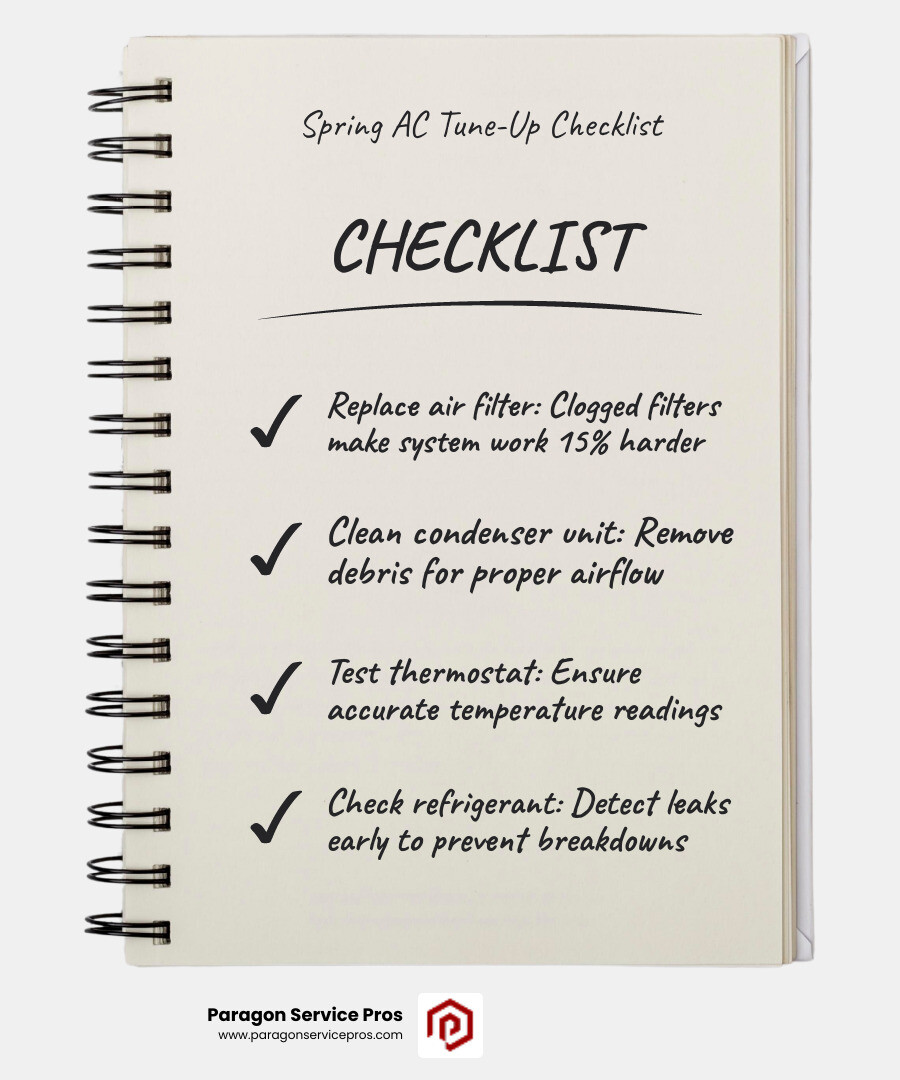
- Replace the air filter — A clogged filter forces your system to work 15% harder
- Clean the outdoor condenser unit — Remove debris and rinse coils for proper airflow
- Test the thermostat — Confirm it reads accurately and responds correctly
- Flush the condensate drain line — Prevents water damage and mold growth
- Check refrigerant levels — Low refrigerant often signals a leak that needs repair
- Inspect electrical connections — Loose wires cause 30% of AC failures
- Clean evaporator and condenser coils — Dirty coils reduce efficiency by up to 30%
- Lubricate moving parts — Reduces friction and lowers energy use
- Test capacitors and contactors — These are the most commonly replaced components
- Inspect ductwork — Leaky ducts waste 20–30% of the air your system produces
This guide walks you through exactly what to do yourself, what to leave to a licensed technician, and how to get your system ready before the heat arrives.
Why Spring AC and HVAC Maintenance is Essential in Arizona
Living in the East Valley means our air conditioners aren't just machines; they are the MVPs of our households. When April rolls around, we aren't just thinking about spring cleaning our closets; we are thinking about the 2,000+ hours of heavy lifting our cooling systems are about to perform.
Boosting Energy Efficiency
One of the most immediate impacts of spring ac and hvac maintenance is the boost to your system's efficiency. Research shows that airflow problems alone can reduce efficiency by up to 15%. When your system is bogged down by dust from our desert winds or restricted by a dirty filter, it has to run longer and work harder to reach the temperature set on your thermostat. By clearing those obstructions, you ensure that every bit of energy you pay for is actually cooling your home. For more details on this, check out 11 Reasons Annual HVAC Maintenance Saves You Money.
Extending System Lifespan
Think of your HVAC system like a vehicle. You wouldn't drive a car 100,000 miles without an oil change, right? An AC unit that receives annual care can last 15 to 20 years. Without it, that lifespan can drop by 5 to 10 years. In the heat of Mesa or Gilbert, a premature system replacement is a massive headache that is easily avoided with a little foresight.
Preventing High-Stakes Breakdowns
There is a direct correlation between maintenance and reliability. Statistics show that 87% of emergency calls are preventable. Most "sudden" failures are actually the result of a component like a capacitor or a fan motor wearing out over several months. Catching a weak part in the spring prevents it from failing during a 115-degree July afternoon.
Indoor Air Quality and Dust Control
Arizona is famous for its dust. If that dust settles on your evaporator coils or clogs your filters, it doesn't just hurt efficiency; it recirculates through your home. Maintenance helps keep your indoor air cleaner by ensuring your filtration system is optimized. We've put together some Seasonal Air Conditioning Preparation Tips for Optimal Performance to help you keep that desert dust where it belongs—outside.
Essential DIY Tasks for Your Spring HVAC Maintenance Checklist
While we always recommend a professional tune-up for the technical stuff, there are several tasks you can handle to give your system a head start. These simple chores can make a significant difference in how your home feels when the temperatures start to climb.
The Power of the Air Filter
If we could give only one piece of advice, it would be this: change your air filter. A dirty filter is the leading cause of system strain. In Arizona, we recommend checking your filter every 30 days. If you have pets or allergies, you might need to replace it monthly during the peak of summer. We suggest using high-efficiency pleated filters with a MERV rating between 8 and 11. Be careful with MERV 13 or higher; they can sometimes restrict airflow too much if your system isn't designed for them. You can find more on this in our guide on Maximizing Energy Efficiency: Tips for Your AC Unit.
The 2-Foot Rule for Outdoor Units
Your outdoor condenser unit needs to "breathe" to release the heat it pulls from your home. Over the winter, leaves, dead desert brush, and debris can pile up around the base. We recommend maintaining at least two feet of clear space on all sides of the unit. This ensures maximum airflow and prevents the system from overheating.
Thermostat Testing and Calibration
Before the first heatwave, switch your thermostat to "Cool" and set it five degrees below the current room temperature. Listen for the system to kick on and feel the air coming from the vents. If the air isn't cold within a few minutes, or if the thermostat screen is flickering, it might need new batteries or professional calibration. Proper AC Thermostat Calibration is key to ensuring your system doesn't run longer than necessary.
Simple Steps for Spring AC and HVAC Maintenance at Home
Beyond the basics, there are a few other "housekeeping" items for your HVAC system:
- Clear the Vents: Walk through your home and make sure no furniture, rugs, or curtains are blocking the supply or return vents.
- Rinse the Coils: With the power to the unit turned OFF, you can use a garden hose (never a pressure washer!) to gently rinse away dust and dirt from the outdoor coils.
- Check the Batteries: Spring is the perfect time to replace the batteries in your smoke detectors and carbon monoxide detectors. Since HVAC systems involve electrical and sometimes gas components, these safety devices are vital.
- Clean the Registers: Use a vacuum attachment to remove dust from the grilles of your vents to keep your indoor air fresh. For more localized advice, see our Best AC Maintenance Tips Tempe AZ.
Preparing Your Home for a Professional Visit
When you schedule a professional tune-up, a little preparation goes a long way. Make sure the technician has clear access to both the indoor air handler (usually in a closet or attic) and the outdoor unit. If you have pets, please secure them in a safe area. It's also helpful to have your system records or any warranty paperwork handy. If you've noticed any hot spots in the house or strange noises, jot them down so you don't forget to tell us! For a deeper dive into preparation, read Is Your AC Ready for Spring? Top Tips for a Successful Tune-Up.
What to Expect During a Professional Spring AC Tune-Up
While DIY tasks are great for maintenance, a professional tune-up is a "wellness check" that goes deep into the mechanical and electrical heart of your system. Here is a breakdown of what a professional visit typically includes:
| Task Category | What We Do | Why It Matters |
|---|---|---|
| Refrigerant | Check levels and look for leaks | Low refrigerant kills efficiency and can freeze the coils. |
| Electrical | Tighten connections and test voltage | Loose wires cause 30% of AC failures. |
| Capacitors | Test for proper "microfarad" output | Weak capacitors are the #1 cause of "AC won't start" calls. |
| Coils | Deep clean evaporator and condenser coils | Dirty coils can reduce cooling capacity by 30%. |
| Drain Line | Flush and treat the condensate line | Prevents clogs that cause water to leak into your ceiling. |
| Motors | Lubricate moving parts and check belts | Reduces friction, noise, and energy consumption. |
Precision Electrical and Refrigerant Checks
In cities like Mesa, the heat puts extreme stress on electrical components. We use specialized multimeters to test your capacitors and contactors. If a capacitor is supposed to put out 45 microfarads but is only putting out 38, we know it’s about to fail. Replacing it now is much easier than doing it during an emergency. We also check the refrigerant charge. A system that is even slightly low on refrigerant will struggle to cool, leading to higher bills and a frozen evaporator coil. If you’re in Mesa, our AC Maintenance Mesa AZ team specializes in these high-heat diagnostics.
Cleaning the "Lungs" of Your System
The evaporator and condenser coils are where the actual heat exchange happens. In Arizona, these coils get coated in fine dust, which acts like an insulating blanket, keeping the heat trapped inside. A professional cleaning restores the system's ability to move heat efficiently. We also pay close attention to the condensate drain line. An AC unit can pull gallons of water out of the air on a humid day; if that line is clogged with algae or dust, that water has nowhere to go but into your home. Residents in Chandler can learn more about our specific process at AC Maintenance Chandler AZ.
Advanced Spring AC and HVAC Maintenance for Heat Pumps and Mini-Splits
If you have a heat pump or a ductless mini-split system, your maintenance needs are slightly different. These systems run nearly year-round in Arizona, providing heat in the winter and cooling in the summer.
- Heat Pumps: We pay special attention to the reversing valve, which allows the system to switch between heating and cooling modes. We also check the defrost board and outdoor sensors. Because they work double-duty, spring maintenance is non-negotiable. Check out our tips for Heat Pump Maintenance Gilbert AZ and Heat Pump Maintenance San Tan Valley AZ.
- Mini-Splits: These require careful cleaning of the individual air handlers and the reusable filters inside. We also check the communication lines between the indoor and outdoor units. For more, see our guide on Mini-Split Maintenance.
The Value of Seasonal Maintenance Agreements
Many of our neighbors in Queen Creek and San Tan Valley find that the best way to stay on top of spring ac and hvac maintenance is through a maintenance agreement. These plans typically include two visits a year (spring and fall), priority scheduling, and discounts on any repairs found during the inspection. It’s the "set it and forget it" way to ensure your warranty remains valid and your home stays comfortable. Learn more about our AC Service Plans and how an AC Maintenance Agreement can save you money over time.
Warning Signs Your System Needs Immediate Service Before Summer
Sometimes, a simple tune-up isn't enough, and your system might be screaming for help. If you notice any of the following signs as you start to use your AC this spring, don't wait for a total breakdown.
1. Ice on the Refrigerant Lines
If you see ice on the copper lines leading to your outdoor unit or on the indoor evaporator coil, something is wrong. This is usually caused by restricted airflow (a very dirty filter) or a refrigerant leak. Turning the system off and calling us immediately is the best way to prevent compressor damage.
2. Weak or Warm Airflow
If the air coming out of your vents feels "lazy" or lukewarm, your system isn't cooling effectively. This could be a sign of a failing blower motor, a compressor issue, or even leaky ducts that are losing 20–30% of your conditioned air to the attic.
3. Strange Noises
Your AC should be relatively quiet. If you hear:
- Grinding: Likely a motor bearing issue.
- Screeching: Often a fan belt or motor problem.
- Banging: Could be a loose part or a compressor issue.These sounds are early warnings. For a full list of red flags, see 11 Signs Your AC Needs Professional Maintenance.
4. Frequent Cycling
If your AC turns on and off every few minutes (short-cycling), it’s putting massive strain on the compressor and using way too much electricity. This can be caused by anything from an oversized unit to a faulty thermostat. Our team provides expert AC Service Queen Creek AZ to diagnose these tricky issues.
When is the best time to schedule a tune-up in Arizona?
In Arizona, the "sweet spot" for scheduling is March or early April. By late May, the first 100-degree days hit, and every HVAC company in the state gets slammed with emergency calls. By booking early, you get faster service, and you ensure your system is ready before the heat becomes dangerous. For more insights, read How Often Should You Schedule an AC Tune-Up? Expert Tips and Insights.
How does maintenance improve indoor air quality?
During a tune-up, we don't just look at the mechanical parts; we look at the health of your air. By cleaning the coils and checking the filtration system, we reduce the amount of pollen, dust, and pet dander circulating in your home. We also check the condensate system to ensure humidity is being managed correctly, which prevents mold growth. Residents in San Tan Valley can find more tips here: AC Maintenance San Tan Valley Tips.
What are the consequences of skipping spring service?
Skipping maintenance is a gamble where the stakes are your comfort and your wallet. The consequences include:
- Higher Utility Bills: A dirty system can cost 15-25% more to run.
- Voided Warranties: Most manufacturers require proof of annual maintenance to honor warranty claims.
- Emergency Costs: Emergency repairs are always more expensive than planned maintenance.
- Early Replacement: You could end up buying a new system 5 years sooner than necessary.For those looking for budget-friendly options, check out Affordable AC Maintenance in Mesa AZ: Your Guide to Smart Savings.
Conclusion
At Paragon Service Pros, we know that your home is your sanctuary, and in Arizona, that sanctuary depends on a working HVAC system. Whether you are in Mesa, Gilbert, Chandler, Queen Creek, San Tan Valley, or Gold Canyon, our mission is to provide you with the peace of mind that comes from a well-maintained home.
Don't let the Arizona summer catch you off guard. A little bit of spring ac and hvac maintenance today can prevent a major headache tomorrow. From simple filter changes to comprehensive professional tune-ups, taking care of your system is the smartest investment you can make this season. If you're ready to ensure your home stays cool all summer long, we invite you to learn more about our HVAC Maintenance services. Let’s get your system ready for the heat!
Keep reading: Maintenance & Tune-Ups
Browse every article in Maintenance & Tune-Ups or head back to the Learning Center .
Comfort you can count on, all year long.
Same-day service, honest diagnostics, and 24/7 emergency help with no overtime fees. A real Greater Phoenix team is standing by.