
Don't Melt in Mesa with These Local HVAC Survival Tips
Beat the heat! Get essential hvac tips for queen creek and mesa homeowners to combat desert dust, boost efficiency, and avoid breakdowns.

Why HVAC Tips for Queen Creek and Mesa Homeowners Can Save You From a Brutal Summer
HVAC tips for queen creek and mesa homeowners aren't just nice to know — they're essential survival knowledge when summer temperatures regularly climb past 100°F and your AC is running 12 or more hours a day. With roughly 286 sunny days per year and desert dust constantly working against your system, the average HVAC unit in this area faces more stress than almost anywhere else in the country. A small maintenance miss — a clogged filter, dirty condenser coils, or a neglected tune-up — can snowball into a full breakdown during the worst possible week of August.
Here are the most important HVAC tips for Queen Creek and Mesa homeowners at a glance:
- Change air filters monthly — Arizona's dusty climate clogs filters far faster than the national average, and clean filters can lower energy costs by up to 15%
- Schedule two tune-ups per year — one in spring before cooling season, one in fall before heating season
- Set your thermostat to 78°F when home and around 85°F when away to balance comfort and efficiency
- Keep 2 to 3 feet of clearance around your outdoor unit and remove debris regularly
- Clean condenser coils annually — dirty coils can reduce system efficiency by up to 30%
- Seal leaky ductwork to stop losing up to 30% of your cooled air before it reaches your rooms
- Watch for warning signs like short cycling, strange noises, frozen coils, or rising energy bills — and call a pro before small issues become expensive repairs
Mesa and Queen Creek homes deal with a unique combination of extreme heat, monsoon dust storms, and temperature swings that can drop 40 degrees overnight. That's a lot to ask of any HVAC system. The good news is that most breakdowns are preventable with consistent, simple maintenance habits tailored to the desert environment.
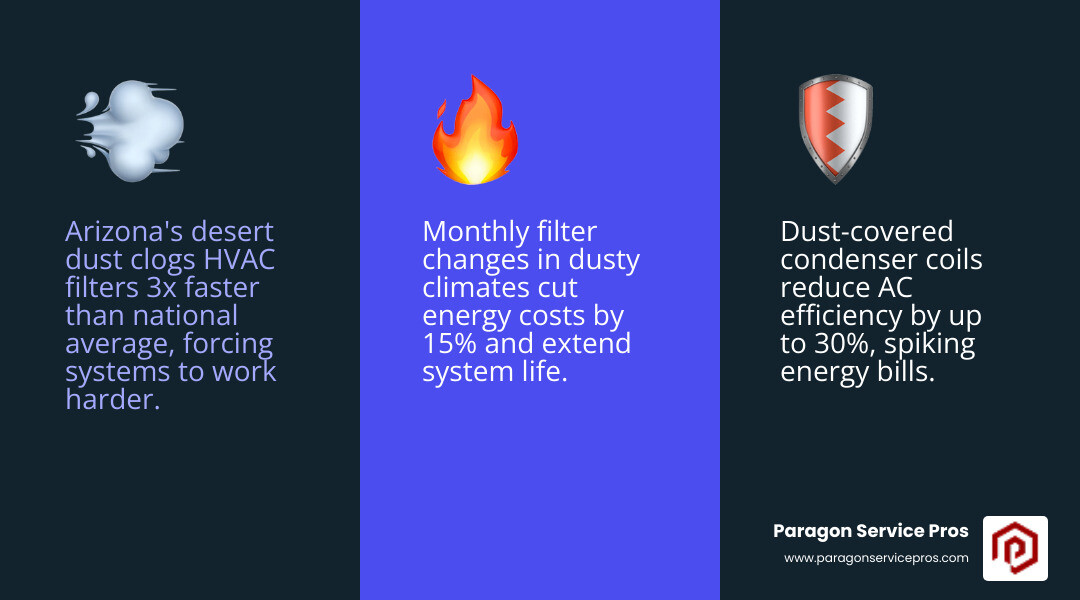
Essential HVAC Tips for Queen Creek and Mesa Homeowners to Combat Desert Dust
In the East Valley, dust isn't just a nuisance on your coffee table; it’s the primary enemy of your air conditioning system. Because Queen Creek and Mesa are surrounded by open desert and frequent construction, our air carries a high volume of particulate matter. When this dust enters your HVAC system, it acts like a blanket, insulating components that need to stay cool and friction-burning parts that need to move freely.
The Monthly Filter Rule
While manufacturers often suggest changing filters every three months, that advice doesn't account for a "Haboob" season in Arizona. For HVAC maintenance in Queen Creek, AZ, we recommend checking your filter every 30 days. A clogged filter restricts airflow, forcing your blower motor to work twice as hard to move half as much air. This doesn't just raise your bills; it can lead to a frozen evaporator coil or a premature motor failure.
When selecting filters, look at the MERV rating. For most residential homes in Mesa, a MERV rating between 8 and 11 provides the best balance of filtration and airflow. Avoid ultra-high MERV filters (13+) unless your system was specifically designed for them, as they can be too restrictive for older units.
Maintaining the Outdoor Unit
Your outdoor condenser unit is responsible for releasing the heat collected from inside your home. If it’s crowded by desert broom, bougainvillea, or accumulated "monsoon debris," it can’t breathe.
- Clearance: Maintain at least 2 to 3 feet of open space around the entire unit.
- Coil Cleaning: Arizona dust creates a fine layer of silt on condenser coils. This "dirt blanket" can reduce efficiency by up to 30%. While you can gently rinse the exterior with a garden hose, a professional HVAC maintenance in Mesa, AZ visit includes a deep chemical cleaning of these coils to ensure maximum heat transfer.
- Debris Removal: After any significant wind storm, check the base of your unit for rocks, leaves, or trash that may have blown in.
Following these essential maintenance tips for your heating and cooling system ensures that your unit doesn't suffocate when the temperature hits 115°F. seasonal HVAC maintenance is about preparing the system for the specific challenges of the upcoming quarter.
Maximizing Energy Efficiency During Scorching Arizona Summers
With cooling accounting for up to 50% of summer energy bills in the Phoenix Valley, efficiency isn't just about being "green"—it's about protecting your wallet. If your system is more than 10 to 15 years old, it likely uses significantly more energy than modern units.
Understanding SEER2 Ratings
In 2023, the industry moved to SEER2 standards, which more accurately reflect how systems perform in real-world conditions. When considering an AC installation in Queen Creek, AZ, opting for a unit with a higher SEER2 rating can lead to substantial monthly savings.
| System Type | Typical SEER2 Rating | Efficiency Impact |
|---|---|---|
| Older Standard Unit | 10 - 12 | High energy consumption; frequent cycling |
| Modern Entry-Level | 14.3 | Baseline efficiency for new installs |
| High-Efficiency | 16 - 20+ | Significant savings; better humidity control |
Understanding SEER ratings is the first step in deciding whether to repair or replace a struggling unit.
Addressing the "Hidden" Efficiency Killers
Even the most expensive AC unit will underperform if your home's "envelope" is leaky.
- Duct Sealing: The EPA estimates that the average home loses 20% to 30% of its conditioned air through leaky ducts. In an attic that reaches 150°F, those leaks are essentially cooling your roof instead of your living room.
- Insulation: Ensure your attic has adequate R-value insulation. This acts as the primary barrier between the scorching sun and your ceiling.
- Passive Cooling: Use blackout curtains and solar screens on west-facing windows. These simple additions are among the most effective tips for maximizing energy efficiency for your AC unit.
If you are planning an HVAC installation in Mesa, AZ, we always recommend a full duct inspection to ensure your new high-efficiency unit isn't being sabotaged by old, torn ductwork.
Smart Thermostat HVAC Tips for Queen Creek and Mesa Homeowners
A smart thermostat is one of the fastest-returning investments for Arizona homeowners. Using smart thermostat installation tips can help you shave 10% to 23% off your annual cooling costs.
- The 78-Degree Standard: The Department of Energy recommends 78°F when you are home. Every degree lower can increase your bill by 3% to 5%.
- Geofencing: This feature uses your phone’s GPS to tell the AC when you’re heading home, allowing it to stay at a conservative 85°F while you're at work and cooling down just in time for your arrival.
- System Readiness: Use your thermostat to run a "test" in early March. Checking if your AC is ready for spring allows you to catch issues before the first 100-degree day.
Recognizing When to Call for Professional AC Repair
In the desert, an AC failure isn't just an inconvenience; it can quickly become a safety issue. Knowing the early warning signs can save you from an emergency "no-cool" situation in the middle of July.
Warning Signs You Shouldn't Ignore
If you notice any of these 11 signs your AC needs professional maintenance, it’s time to pick up the phone:
- Short Cycling: The unit turns on and off every few minutes without reaching the set temperature.
- Strange Noises: Squealing, grinding, or banging sounds often indicate a failing belt, motor, or compressor.
- Frozen Coils: If you see ice on the copper lines or the indoor unit, stop! Turn the system off and call for Mesa AC repair immediately. An AC freezing up is usually caused by restricted airflow or low refrigerant.
- Weak Airflow: If air is coming out of the vents but feels "lazy," your blower motor or ductwork may be compromised.
Whether you need Queen Creek AC repair or are noticing signs your air conditioner needs to be replaced, early intervention is always the most cost-effective path.
Troubleshooting Common HVAC Tips for Queen Creek and Mesa Homeowners
Before calling for service, check these "simple fixes" that often mimic major HVAC system problems:
- Thermostat Batteries: If your screen is blank, start here.
- Tripped Breakers: Check your electrical panel. Extreme heat can sometimes cause a temporary surge that trips the AC breaker.
- Clogged Condensate Drain: Arizona ACs produce gallons of water daily. If the drain line clogs with algae, a safety switch will shut the system down to prevent flooding. If you see your AC is not cooling, check the drain pan for standing water.
For more complex issues, our team provides expert AC service in Queen Creek, AZ and specialized heating repair in Queen Creek for those chilly winter nights.
Frequently Asked Questions about Arizona HVAC Care
Reliable hvac tips for queen creek and mesa homeowners often come down to answering the most common questions we hear in the field. Understanding the "why" behind maintenance helps you stay committed to a schedule that protects your home.
How often should I change my air filter in Mesa?
In Mesa, the combination of desert dust and monsoon season means you should check your filter monthly. If you have pets or live near an open desert lot, you will likely need to change it every 30 days. During the winter, when the furnace maintenance in Mesa cycle is less intense, you might stretch this to every 60 days, but never go a full season without a fresh filter. This is the single best way to protect your indoor air quality.
Is it better to turn the AC off when I leave for work?
No. In the Arizona heat, turning your AC off entirely is a mistake. Your walls, furniture, and flooring all absorb heat. If the house reaches 95°F while you're away, the AC will have to run for hours at maximum capacity just to remove the "stored" heat in your home's structure. It is far more efficient to set the thermostat to 85°F. This prevents the home from becoming a "brick oven" and allows for a much faster, less stressful recovery time when you return.
When should I schedule my seasonal tune-up?
We recommend a two-visit approach. Schedule your AC tune-up in early spring (March or April) before the first heat wave hits. This ensures your refrigerant levels are correct and your capacitors are healthy. Similarly, follow a Queen Creek furnace maintenance guide and schedule a heating check in October. Preventive care is always better than a "furnace surprise" on a 35-degree night. There are at least 11 reasons annual HVAC maintenance saves you money, ranging from lower bills to maintaining your manufacturer's warranty.
Conclusion: Partner with Paragon Service Pros for Year-Round Comfort
Living in the East Valley means respecting the power of the Arizona sun. By following these hvac tips for queen creek and mesa homeowners, you can enjoy a cool, comfortable home without the constant fear of a system failure. At Paragon Service Pros, we are dedicated to providing our neighbors in Mesa, Queen Creek, Chandler, and San Tan Valley with transparent, high-quality service.
Whether you need a quick repair, a complex installation, or want the peace of mind that comes with a professional Maintenance Plan, we are here to help. Don't wait for the next heat wave to test your system's limits. Schedule your professional HVAC maintenance today and stay ahead of the desert heat!
Keep reading: Home & Energy Savings
Browse every article in Home & Energy Savings or head back to the Learning Center .
Comfort you can count on, all year long.
Same-day service, honest diagnostics, and 24/7 emergency help with no overtime fees. A real Greater Phoenix team is standing by.