
Keep Your Cool in the East Valley with These Spring Maintenance Tips
Discover spring ac and hvac maintenance for the Phoenix East Valley. Get checklists, DIY tips & pro tune-ups to beat the desert heat!

Why Spring AC and HVAC Maintenance in the Phoenix East Valley Matters Before Summer Hits
Spring ac and hvac maintenance for the phoenix east valley is one of the most important things you can do as a homeowner before summer temperatures climb past 110°F. If your system isn't ready, it won't just struggle — it could fail completely on the hottest day of the year, leaving your family without cooling when it's most dangerous.
Here's a quick overview of what spring HVAC maintenance covers in the East Valley:
- Replace air filters every 30-60 days (more often in dusty conditions)
- Clean the outdoor condenser unit and keep a 2-3 foot clearance around it
- Check thermostat settings and calibrate if needed
- Inspect electrical connections and test capacitors
- Flush the condensate drain line to prevent clogs and moisture damage
- Schedule a professional tune-up before temperatures exceed 90°F (March through early May is ideal)
- Test system performance and verify your AC is producing air 16-22°F cooler than the return air temperature
The East Valley — including Mesa, Gilbert, Chandler, Queen Creek, San Tan Valley, and Gold Canyon — faces some of the harshest HVAC conditions in the country. Dust storms (haboobs), rooftop heat exposure, and months of near-nonstop AC runtime put serious stress on every component in your system. According to a Thumbtack survey, 68% of homeowners already feel overwhelmed by home maintenance, and that number only grows when your AC is your first line of defense against life-threatening heat.
The good news? A little proactive care in spring goes a long way toward keeping your system reliable all summer long.
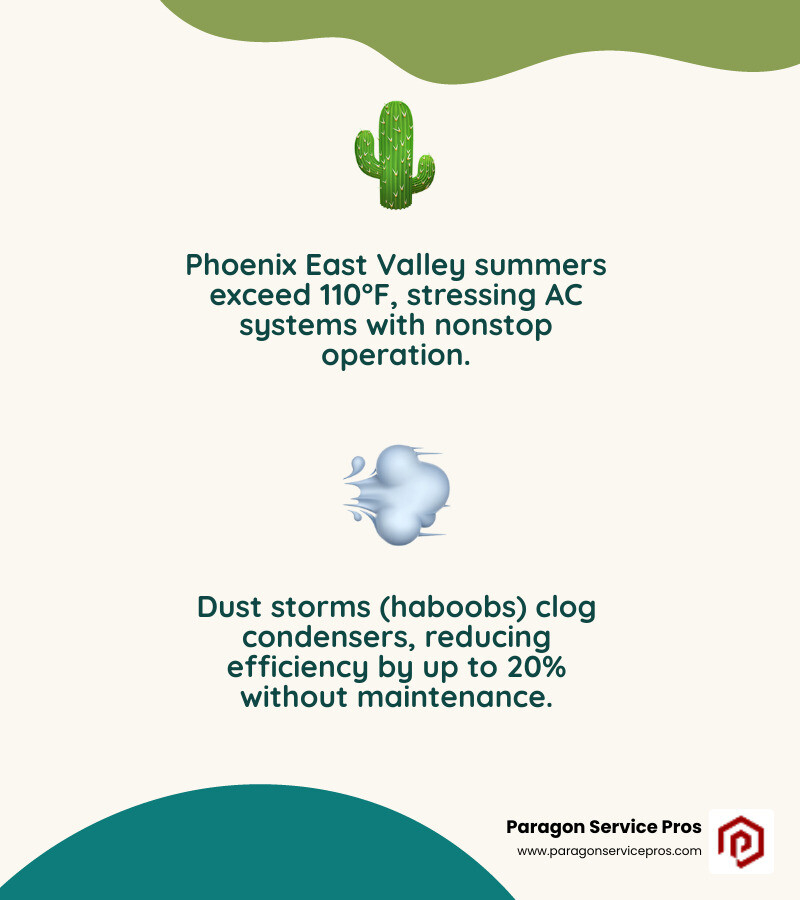
Why Spring AC and HVAC Maintenance for the Phoenix East Valley is Non-Negotiable
Living in the East Valley means your air conditioner isn't just a luxury appliance; it is a literal lifeline. When April 2026 rolls around, the countdown to triple-digit temperatures has already begun. In our neck of the woods, "average" summer days routinely push past 110°F, and the temperature on your roof or against your exterior walls can be significantly higher.
If you wait until the first 115°F day to see if your system works, you’re gambling with your family's comfort. This is why HVAC Service Mesa AZ and surrounding areas is so critical during the milder spring months. Systems here run nearly nonstop for months at a time. This high-cycle rate causes parts to wear out much faster than they would in cooler climates.
Furthermore, many HVAC manufacturers require proof of annual or semi-annual professional service to honor their parts warranties. If your compressor fails in July but you haven't had a spring tune-up, the manufacturer might deny your claim. Investing in More info about AC Maintenance now protects your equipment, your warranty, and your peace of mind.
The Impact of the Arizona Desert on Your System
The Arizona desert presents a unique set of challenges that most HVAC systems in other states never face. The most famous of these is the "haboob"—those massive dust storms that blanket everything in fine silt and sand. This dust acts like a thick wool blanket on your outdoor condenser coils, insulating them and preventing the system from releasing heat. When your coils are clogged with desert dust, your compressor has to work twice as hard to cool your home, leading to skyrocketing energy bills and premature motor failure.
We also deal with extreme thermal gain. Many homes in Gilbert or Queen Creek have rooftop units that sit in direct, punishing sunlight all day long. This heat adds immense stress to the electrical components, particularly the capacitors. Think of a capacitor as the "battery" that gives your motors the jolt they need to start. In the Phoenix heat, these are often the first things to pop. By following Essential Maintenance Tips for Your Heating and Cooling System, you can identify these weak points before they leave you sweating in the dark.
DIY Steps for Spring AC and HVAC Maintenance for the Phoenix East Valley
While complex electrical work should always be left to the pros, there are several vital steps you can take as a homeowner to prepare your system. These Seasonal Air Conditioning Preparation Tips for Optimal Performance can significantly boost your unit's efficiency:
- The 30-60 Day Filter Rule: In the dusty East Valley, the standard "change every three months" advice doesn't apply. If you have pets or live near new construction in San Tan Valley, check your filters every 30 days. A clogged filter restricts airflow, which is the leading cause of frozen coils and blower motor burnout.
- Clear the Perimeter: Your outdoor unit needs to "breathe" to release heat. Ensure there is a 2-3 foot clear perimeter around the condenser. Trim back desert broom, bougainvillea, or any debris that may have accumulated over the winter.
- Thermostat Check: Test your thermostat to ensure it is responsive. If you're still using an old manual slider, spring is the perfect time to upgrade to a smart thermostat that can help you manage the heavy summer load more efficiently.
- Visual Inspection: Look for any obvious signs of wear, such as frayed wiring or oil leaks around the base of the unit, which could indicate a refrigerant leak.
Your Essential Spring AC Maintenance Checklist for Desert Homes
When our technicians arrive for a professional visit, they perform a deep dive into the mechanical and electrical health of your system. This goes far beyond a simple "glance and go." For homeowners seeking AC Maintenance Gilbert AZ or AC Maintenance Chandler AZ, a comprehensive checklist is the gold standard for desert survival.
Professional Spring AC and HVAC Maintenance for the Phoenix East Valley
A professional tune-up is like a high-performance oil change for your home's most expensive appliance. We focus on technical calibrations that require specialized tools. For instance, we test capacitor "microfarads." Capacitors often lose their charge gradually; we can see if a part is about to fail and replace it then and there, preventing a midnight breakdown in July.
Other critical professional steps include:
- Coil Cleaning: We use specialized cleaners to dissolve the "baked-on" desert grime from your evaporator and condenser coils.
- Refrigerant Level Check: If your refrigerant is even slightly low, your system will run longer cycles and struggle to reach your set temperature.
- Condensate Drain Flushing: Algae and dust can clog your drain lines, leading to water damage inside your home. We flush these lines to ensure they are clear.
- Safety Control Testing: We verify that all safety switches are functional to protect your home from electrical surges or mechanical failures.
Is your system truly ready? Check out these Is Your AC Ready for Spring? Top Tips for a Successful Tune-Up for more details on what a professional inspection entails.
Recognizing the Signs Your System Needs Professional Attention
Sometimes, your AC tries to tell you it's struggling before it actually quits. Being aware of these 11 Signs Your AC Needs Professional Maintenance can save you from a costly emergency repair.
Watch for these red flags:
- Weak Airflow: If the air coming from your vents feels like a faint whisper, you likely have a blower issue or a major duct leak.
- Unusual Noises: Grinding, squealing, or banging sounds are never "normal." They often point to a failing motor bearing or a loose belt.
- Frequent Cycling: If your AC turns on and off every few minutes, it’s "short-cycling," which places immense strain on the compressor.
- Warm Air: If the air blowing out isn't significantly cooler than the air going in, you may have a refrigerant or compressor problem.
- Moisture or Leaks: Standing water around your indoor furnace or air handler is a sign of a clogged drain or a freezing coil.
Professional Tune-Ups vs. Routine Maintenance: What Your System Needs
It’s helpful to understand the difference between a one-time tune-up and an ongoing maintenance plan. A tune-up is a seasonal "reset" for your system, usually done in the spring. An AC Maintenance Agreement is a proactive strategy to protect your home year-round. For residents needing HVAC Maintenance Queen Creek AZ, having a plan in place ensures you never forget this critical task.
| Feature | Seasonal Tune-Up | Maintenance Plan (Membership) |
|---|---|---|
| Frequency | Once per season | Bi-annual (Spring & Fall) |
| Goal | Prepare for immediate heat/cold | Long-term health & longevity |
| Scheduling | Standard | Priority "Front of the Line" |
| Discounts | None | Discounts on repairs & service fees |
| Warranty | Covers current service | Maintains manufacturer compliance |
| Perks | Basic inspection | No-breakdown guarantees & credits |
Protecting Your Investment and Manufacturer Warranty
Your HVAC system is likely the most expensive piece of equipment in your home. Neglecting it is like buying a luxury car and never changing the oil. Regular service extends the lifespan of your unit by years. While a neglected system in the East Valley might only last 8-10 years, a well-maintained one can easily reach 15 years or more.
Consistency is key. Following 11 Reasons Annual HVAC Maintenance Saves You Money shows that the cost of a tune-up is dwarfed by the savings in energy and avoided repairs. We also look for the "Ideal Temperature Split." A healthy system should produce air that is 16–22°F cooler than the air entering the return vent. If your split is only 10°F, your system is working overtime for half the results.
Maximizing Energy Efficiency Before the Summer Peak
In April 2026, as electricity rates continue to be a concern for many, efficiency is your best friend. A dirty or uncalibrated system can consume up to 15% more energy than a clean one. By ensuring your coils are spotless and your motors are lubricated, you keep the utility company’s hand out of your pocket.
Beyond the bills, proper maintenance improves your indoor air quality. Since we spend about 90% of our time indoors during the peak of summer, breathing air that hasn't been filtered through layers of dust and mold is vital for your family's health. If you are looking for HVAC Maintenance San Tan Valley AZ, a clean system means a clean home.
Frequently Asked Questions about Spring HVAC Care
How often should I replace my AC filters in the East Valley?
Due to the dusty desert conditions and high pollen counts, we recommend checking your filters every 30 days. At a minimum, they should be replaced every 60 days. If you have pets, a high-occupancy home, or live near a dusty area like North Mesa or Queen Creek, you may need to change them even more frequently. Neglecting this leads to restricted airflow and higher energy costs. You can find more specific advice for your area at AC Maintenance Mesa AZ.
What is the ideal temperature split for a healthy AC system?
The "temperature split" is the difference between the air entering your return vent and the air coming out of your supply vents. A properly functioning AC system in the Phoenix East Valley should maintain a split of 16–22°F. If your home is 78°F, the air coming out of the vents should be between 56°F and 62°F. If the difference is less than 16°F, your system is likely undercharged or has dirty coils.
When is the best time to schedule my spring tune-up?
The "sweet spot" for spring maintenance is between March and early May. You want to beat the "90-degree rush." Once the temperatures hit 100°F, HVAC companies become flooded with emergency repair calls, and wait times can increase. Scheduling early ensures you get a convenient appointment and that any potential issues are fixed before the brutal heat arrives. For more timing tips, see How Often Should You Schedule an AC Tune-Up? Expert Tips and Insights.
Conclusion
Preparing your home for an Arizona summer is a big job, but you don't have to do it alone. At Paragon Service Pros, we understand that your AC is a lifeline, and we treat every service call as if we were working on our own family’s home. Whether you are in Mesa, Gilbert, Chandler, Queen Creek, San Tan Valley, or Gold Canyon, our goal is to provide unmatched comfort and transparency.
Don't wait for the first heatwave to find out your system is struggling. Invest in your home’s efficiency and your family's safety by securing a professional Maintenance Plan today. We are here to help you stay chilly all summer long with expert care and quality workmanship you can trust. Reach out to us today to schedule your spring tune-up!
Keep reading: Maintenance & Tune-Ups
Browse every article in Maintenance & Tune-Ups or head back to the Learning Center .
Comfort you can count on, all year long.
Same-day service, honest diagnostics, and 24/7 emergency help with no overtime fees. A real Greater Phoenix team is standing by.