
How to Keep Your AC Sane During Arizona's Wild Weather Swings
Learn how desert temperature swings affect your HVAC. Protect your AC from Arizona's extreme heat & cold swings with expert maintenance tips.

Why Desert Temperature Swings Are So Hard on Arizona HVAC Systems
How desert temperature swings affect your HVAC is one of the most important things to understand as an Arizona homeowner. In the Sonoran Desert — including cities like Chandler, Mesa, Gilbert, and Queen Creek — temperatures can swing 40 to 50 degrees between dawn and afternoon in a single day. That kind of thermal whiplash puts constant stress on your heating and cooling equipment, season after season.
Here's a quick look at the main ways desert temperature swings damage HVAC systems:
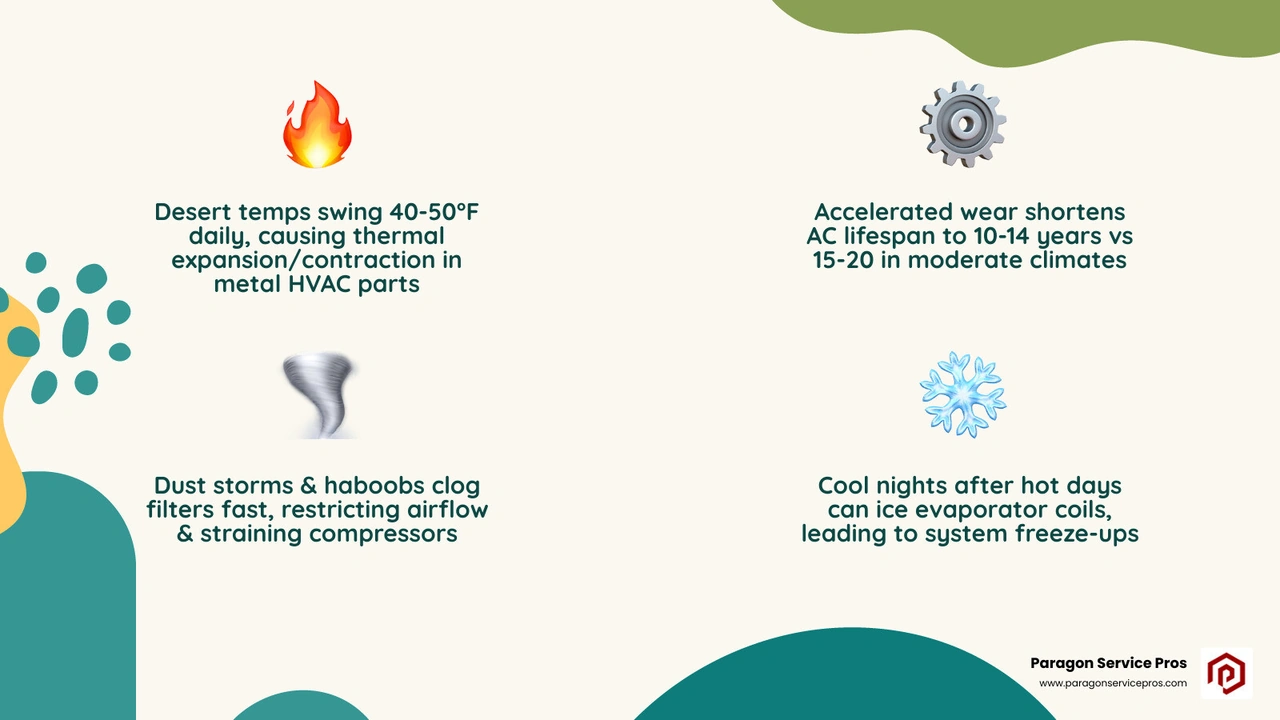
- Thermal expansion and contraction - Metal components expand in extreme heat and contract in cool nights, causing cracks, refrigerant leaks, and loosened electrical connections over time
- Accelerated wear - Systems in desert climates like Arizona may last only 10-14 years, compared to 15-20 years in moderate climates
- Longer run cycles - When outdoor temps hit 100°F+, heat transfer efficiency drops, forcing your AC to run longer to reach your set temperature
- Filter clogging - Desert dust and haboobs clog filters far faster than in other regions, restricting airflow and straining the entire system
- Freeze-ups - Even in Arizona, AC coils can ice over during cooler nights after the system runs hard all day
- UV damage - Intense year-round sun degrades insulation, wiring coatings, and plastic components on outdoor units
Most Arizona homeowners don't realize how much this daily temperature rollercoaster quietly wears down their HVAC equipment — until something breaks on the hottest day of the year. This guide walks you through exactly what's happening inside your system and what you can do to stay ahead of it.
Understanding How Desert Temperature Swings Affect Your HVAC System
When we talk about the desert climate in April 2026, we aren't just talking about the heat. We are talking about the sheer physics of change. In the East Valley, your outdoor unit sits in 110°F sun all afternoon, then faces a rapid drop to 65°F once the sun dips behind the Superstition Mountains.
This creates a phenomenon called thermal expansion and contraction. Think of your HVAC system like a living thing that has to stretch and shrink every single day. The copper refrigerant lines, aluminum fins, and steel casings all expand when they are hot and contract when they cool down. Over thousands of cycles, this movement leads to "mechanical fatigue."
This fatigue is the root cause of many HVAC System Problems we see in the field. Specifically, it can lead to:
- Refrigerant Leaks: The joints where copper pipes meet can develop microscopic cracks from constant shifting.
- Electrical Failures: Wire connections can wiggle loose, leading to arcing or shorts.
- Vibration Damage: As components loosen, the natural vibration of the compressor causes even more wear.
If you notice your system making a new rattling sound or struggling to keep up after a particularly swingy week of weather, it might be time for a professional HVAC Repair to tighten things up before a minor loose connection becomes a major blowout.
Why High Heat and Freezing Nights Shorten Equipment Lifespan
It’s a tough pill to swallow, but the industry average lifespan for an HVAC system drops significantly here in Arizona. While a unit in a moderate climate like the Pacific Northwest might hum along for 20 years, a system in Mesa or San Tan Valley is often considered "senior" by year 12.
The primary culprit is the heavy duty cycle. In our desert environment, your AC doesn't just run; it labors. High ambient temperatures make it much harder for your outdoor unit to "dump" the heat it gathered from inside your home. When the outdoor air is nearly as hot as the refrigerant inside the coils, the laws of thermodynamics make the heat transfer process incredibly inefficient.
This results in:
- Compressor Strain: The heart of your AC has to work at much higher pressures to move heat.
- Lubrication Breakdown: Extreme heat can cause the oil inside the compressor to lose its viscosity, leading to friction and eventual motor failure.
- No "Rest" Periods: During peak summer, the nighttime lows stay so high (often in the 90s) that the system never truly gets a chance to cool down and recover.
This is why we emphasize that HVAC Maintenance isn't just a luxury—it’s a survival tactic for your equipment. When you look at the 11 Reasons Annual HVAC Maintenance Saves You Money, the number one reason in Arizona is simply delaying a five-figure replacement bill by keeping the current system healthy.
How desert temperature swings affect your HVAC components in Gilbert, AZ
In Gilbert, we see specific components fail more often due to the "yo-yo" effect of our weather. The most common victim is the capacitor. This small, cylindrical part provides the "kick" needed to start your motors. High heat is a capacitor's natural enemy, and the constant on-off cycling caused by shifting temperatures can cause them to bulge and pop.
We also see significant contactor pitting. Contactors are electrical switches that close to send power to the compressor. Every time the temperature swings and your thermostat calls for cooling, these switches snap shut. In our dusty, hot environment, they can develop "pits" or carbon buildup, eventually welding themselves shut or failing to make a connection.
Don't forget the sun itself. Intense UV radiation in the San Tan Valley area can bake the insulation off your suction lines and turn plastic fan blades brittle. Regular AC Maintenance allows us to catch these brittle parts and worn electrical bits before they leave you sweating in July.
Using smart controls to manage how desert temperature swings affect your HVAC
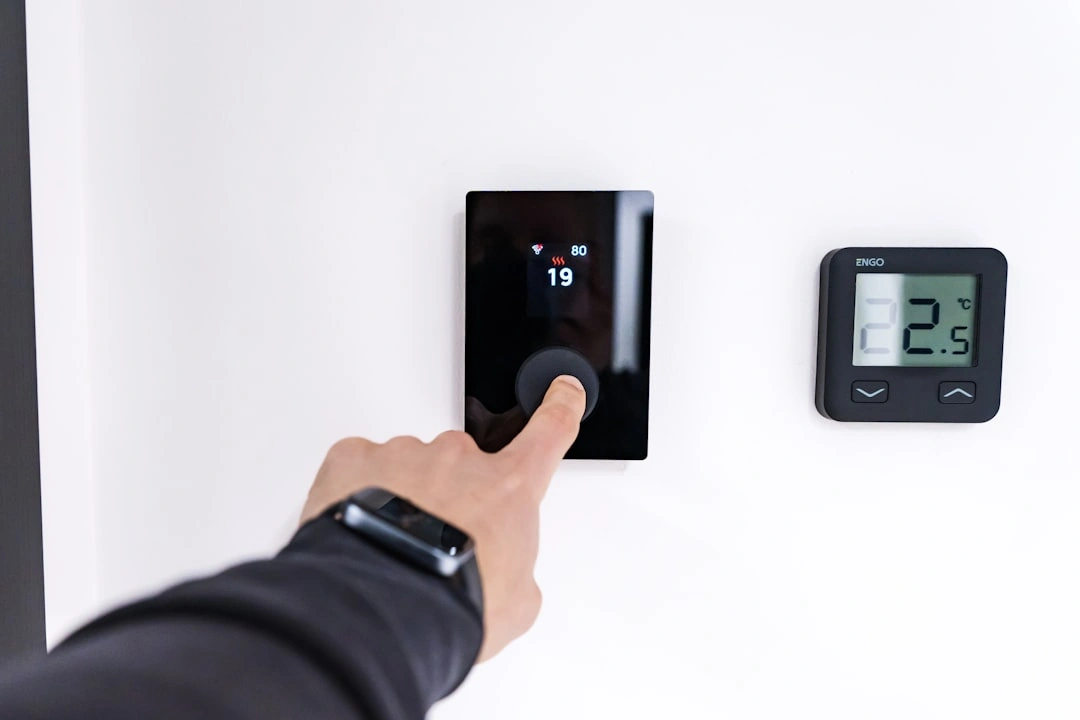
One of the best ways to fight back against how desert temperature swings affect your HVAC is to get smarter about how you control it. A basic thermostat is a "dumb" switch—it only knows if it's hot or cold right now.
Smart thermostats, however, can be programmed to handle "recovery time" more efficiently. Instead of letting your house bake at 85°F all day and then forcing the AC to run for six hours straight to hit 75°F (which puts massive strain on the compressor), you can use gradual staging.
By Maximizing Energy Efficiency: Tips for Your AC Unit, you can set your system to maintain a more consistent temperature, reducing the extreme expansion and contraction cycles. Smart controls also help with humidity balancing. Even though we live in a "dry" heat, managing the internal moisture levels can make 78°F feel like 74°F, allowing your system to take a much-needed break.
Essential Steps to Manage Weather-Driven HVAC Stress
You don't have to be an HVAC expert to help your system survive the Sonoran Desert. There are several "how-to" steps every homeowner in Queen Creek and Chandler should follow.
- The 30-Day Filter Rule: In most parts of the country, you can change a filter every 90 days. In Arizona, that's a recipe for a broken blower motor. Between our natural dust, construction in growing areas like San Tan Valley, and seasonal haboobs, your filters get "carpeted" in dirt very quickly. We recommend checking them every 30 days. If it looks gray, swap it out.
- Clear the Perimeter: Ensure your outdoor unit has at least two feet of "breathing room." Trim back desert broom, bougainvillea, or any other landscaping that might restrict airflow.
- Shade (But Don't Smother): If you can provide shade to your outdoor unit during the hottest part of the day without blocking the top (where the hot air blows out), you can significantly improve efficiency.
Following Essential Maintenance Tips for Your Heating and Cooling System is your first line of defense. Additionally, making sure your coils are clean is vital. A thin layer of desert dust on your outdoor coils acts like a thermal blanket, trapping heat inside the system.
Before the heat truly arrives, asking yourself, "Is Your AC Ready for Spring? Top Tips for a Successful Tune-Up," can save you from a mid-summer emergency.
Upgrading technology to handle how desert temperature swings affect your HVAC
If your current system is reaching that 10-to-12-year mark, you might want to consider modern technology designed specifically for extreme climates.
- Two-Stage Compressors: These units can run at a lower, more efficient speed on "mild" 90°F days and only kick into high gear when it hits 115°F. This reduces the "all-or-nothing" stress on the motor.
- Variable-Speed Blowers: These blowers adjust their speed precisely to maintain comfort, which helps manage the dry air and dust levels in your home more effectively.
- High SEER Ratings: Understanding SEER Ratings: What They Mean for Your AC and Heating System is crucial. In Arizona, a higher SEER rating isn't just about the environment; it’s about a system designed to handle the load of a desert summer without skyrocketing your utility bill.
For many of our neighbors in Gold Canyon and Mesa, heat pumps are an excellent choice. They are incredibly versatile, providing efficient cooling in the summer and handling those freezing desert nights with ease.
Preparing Your Home for Extreme Seasonal Transitions
Your HVAC system is only half of the comfort equation; your home's "thermal envelope" is the other half. When the temperature swings 50 degrees outside, your home's insulation and sealing act as the buffer that keeps your AC from panicking.
- Duct Sealing: In Arizona, many ducts run through the attic. If your attic is 150°F and your ducts have leaks, you are literally sucking in superheated air and trying to cool it. This forces the system to run longer cycles.
- Insulation: Ensure your attic has adequate R-value (insulation thickness). This keeps the "cool" in and the "heat" out, reducing the workload on your unit.
- Weatherstripping: Seal the gaps around doors and windows. In the desert, if air can get in, dust can get in—and both are enemies of your HVAC system.
By following a Seasonal HVAC Maintenance: Preparing Your System for Year-Round Comfort plan, you ensure that the transition from the heater to the AC (which often happens in the same 24-hour period in March!) goes smoothly.
Don't forget the winter side of things. Our Winter Prep Checklist: AC Repair and Maintenance and dedicated Heating Maintenance are just as important. Even though we are famous for our heat, those freezing January nights in Queen Creek can crack a neglected heat exchanger, posing a safety risk to your family.
Frequently Asked Questions about Arizona HVAC Performance
Why does my AC run longer in Mesa, AZ than in other regions?
It’s not your imagination—systems in Mesa and surrounding desert cities do run longer. This is due to the "high ambient temperature" effect. When it’s 115°F outside, the temperature difference between the outdoor air and your AC's refrigerant is very small. This makes it much harder for the system to release heat. Additionally, the low humidity in Arizona means the air doesn't hold "coolness" as well as humid air, and the high "building heat load" (the sun beating on your roof and walls) means your house is constantly gaining heat as fast as the AC can remove it.
How often should I replace my air filters in a dusty desert environment?
While the package might say "lasts 90 days," that doesn't apply to the Sonoran Desert. During the peak of summer or during haboob season, you should replace your filters every 30 to 45 days. If you live near open desert or new construction in areas like San Tan Valley, you might even need to check them every three weeks. A clogged filter increases "static pressure," which can burn out your blower motor and cause your evaporator coil to freeze up.
Can extreme temperature swings cause my HVAC system to freeze up?
Yes, and it’s a very common HVAC Service call we receive. It seems counter-intuitive that an AC would freeze in 100°F weather, but it happens. If the system runs all day in extreme heat and then the temperature drops rapidly at night while the AC is still running, the evaporator coil can drop below freezing. If your airflow is even slightly restricted by a dirty filter or low refrigerant, moisture on the coil turns to ice. Once a thin layer of ice forms, it blocks all airflow, and soon you have a solid block of ice inside your unit.
Conclusion
Living in the Arizona desert is a unique experience, and owning a home here requires a specialized approach to maintenance. How desert temperature swings affect your HVAC is a challenge that every resident in Chandler, Mesa, Gilbert, Queen Creek, San Tan Valley, and Gold Canyon faces.
At Paragon Service Pros, we understand the local "thermal whiplash" better than anyone. Our goal is to ensure your home remains a sanctuary of comfort, regardless of what the outdoor thermometer says. By staying proactive with your filter changes, investing in smart technology, and keeping up with professional HVAC Service, you can extend the life of your equipment and keep your energy bills under control.
Don't wait for the next record-breaking heatwave to find out if your system is struggling. Whether you need a quick tune-up, a complex repair, or a full system replacement, our team is here to provide the quality workmanship and transparency you deserve. Keep your AC sane, keep your home cool, and let us handle the desert's wild weather swings for you.
Keep reading: Air Conditioning
Browse every article in Air Conditioning or head back to the Learning Center .
Comfort you can count on, all year long.
Same-day service, honest diagnostics, and 24/7 emergency help with no overtime fees. A real Greater Phoenix team is standing by.