
Ductless vs Ducted Cooling: The Ultimate Pros and Cons List
Discover central ac vs ductless mini split comparison: efficiency, comfort & costs for Arizona homes. Find pros, cons & choose your best cooling system now!

Central AC vs. Ductless Mini Split Comparison: Which Cooling System Is Right for Your Arizona Home?
The central ac vs ductless mini split comparison comes down to one key question: does your home already have ductwork, and how well is it actually working?
Here's a quick breakdown to help you decide:
| Factor | Central AC | Ductless Mini Split |
|---|---|---|
| Requires ductwork | Yes | No |
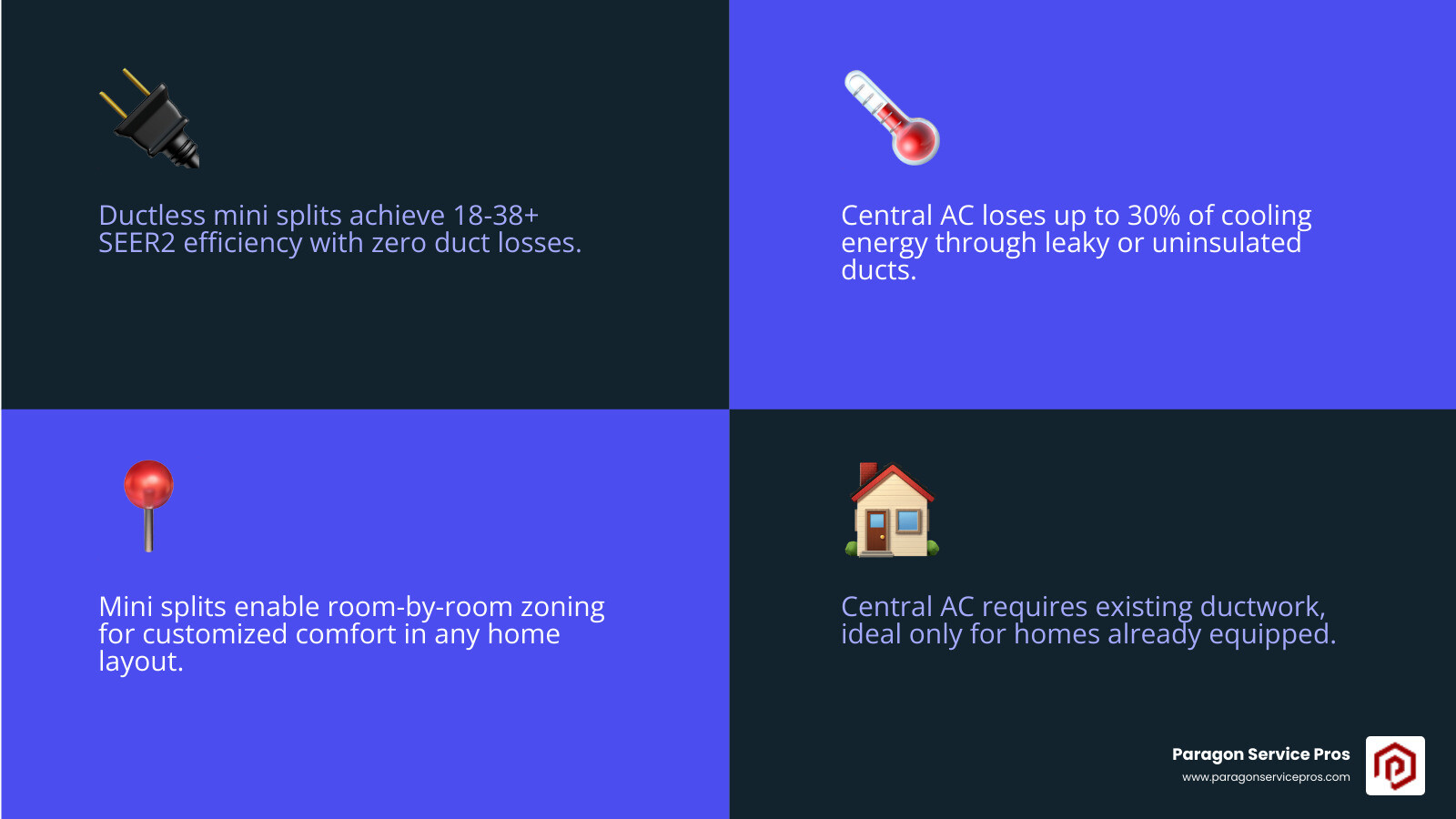
| SEER2 efficiency range | 13-21+ (up to 26) | 18-38+ (up to 42) |
| Energy loss | Up to 30% via ducts | None |
| Zoning | Limited (one thermostat) | Yes (room-by-room) |
| Best for | Homes with existing ducts | Older homes, additions, garages |
| Heating capability | Needs separate furnace | Built-in heat pump |
| Lifespan | 15-20 years | 15-20+ years |
Both systems use refrigerant to pull heat out of your home and push it outside. The big difference is how that cooled air gets delivered to you. Central AC sends it through a network of ducts. Ductless mini splits deliver it directly from a wall-mounted unit in each room.
For Arizona homeowners in Chandler, Gilbert, Mesa, Queen Creek, San Tan Valley, and Gold Canyon, this choice matters more than it might elsewhere. Summers here are relentless, and an inefficient system doesn't just cost you comfort — it costs you real money every month. According to the Department of Energy, typical duct systems lose 25% to 30% of their cooling energy through leaks, poor insulation, or what's known as thermal bypass. In a Phoenix-area summer, that waste adds up fast.
There's no single right answer for every home. But understanding the real differences between these two systems will help you make a confident, informed decision.
How They Work: Central AC vs. Ductless Mini Split Comparison
To make an informed choice, it helps to understand the "under the hood" mechanics of these two popular options. While both rely on the same basic laws of physics to move heat, their delivery methods couldn't be more different.
When we talk about Air Conditioning, we are generally looking at a system that uses a closed loop of refrigerant. This refrigerant absorbs heat from your indoor air and releases it outside. In a Mini Split system, this process happens right in the room you are standing in. In a central system, it happens in a central location (usually the attic or a closet) and then the cold air has to travel to reach you.
Understanding these differences is the first step in Picking the Suitable Cooling System: Ductless vs. Ducted Air Conditioning for your specific lifestyle and home layout.
Operational Mechanics of Central Systems
A central HVAC system is a "forced air" system. It uses a large fan called an air handler to push conditioned air through a sprawling network of metal or flexible ductwork hidden behind your walls and ceilings.
The air is pulled from your rooms through "return vents," cooled at the central evaporator coil, and then redistributed through "supply vents." Most central systems are controlled by a single thermostat, meaning the system is either "on" for the whole house or "off." While this provides a uniform feel, it means you are often cooling empty bedrooms during the day or an empty living room at night.
The Technology Behind Ductless Units
Ductless systems, as the name implies, skip the ducts entirely. A Mini Split Install involves an outdoor compressor connected to one or more indoor air handlers via a small bundle of cables and refrigerant lines. These lines only require a tiny three-inch hole in your exterior wall.
The secret weapon of the mini split is inverter technology. While most central units are either 100% on or 100% off (like a light switch), inverter-driven variable-speed compressors can ramp up or down like a dimmer switch. They provide exactly the amount of cooling needed to maintain a steady temperature, which is far more efficient than the constant stop-and-start of traditional units.
Energy Efficiency and Performance in the Arizona Heat
In April 2026, efficiency standards have become stricter than ever. When performing a central ac vs ductless mini split comparison, efficiency is usually the most significant factor for our neighbors in Mesa and Queen Creek.
| Metric | Central AC | Ductless Mini Split |
|---|---|---|
| Max SEER2 | ~26 SEER2 | ~42 SEER2 |
| Duct Energy Loss | 25% - 30% | 0% |
| Compressor Type | Single/Two-Stage | Variable-Speed Inverter |
Understanding SEER Ratings: What They Mean for Your AC and Heating System is vital here. SEER2 measures how much cooling a system provides per watt of electricity used. While high-end central systems can reach impressive ratings, they are often no match for the ultra-efficient mini split models that frequently soar into the 30s and 40s.
Eliminating Energy Waste from Leaky Ducts
Think of your ductwork like a straw. If that straw has tiny pinpricks in it, you have to suck much harder to get your drink. In many Arizona homes, the ductwork is located in a scorching hot attic. If those ducts have leaks or poor insulation, you are losing up to 30% of your paid-for cooling before it ever reaches your living room.
This "thermal bypass" is a major reason why many homeowners eventually opt for AC Replacement with a ductless option. By delivering air directly into the room, mini splits eliminate this waste entirely. However, if you prefer central air, regular AC Maintenance and professional duct sealing can help recoup some of that lost efficiency.
High-Efficiency Ratings of Modern Mini-Splits
Modern mini-splits are designed for part-load operation. Since they spend most of their time running at a low, steady speed, they consume significantly less power. For those considering a Mini Split Replacement in San Tan Valley, the jump in efficiency from an old 10-SEER unit to a 30+ SEER2 mini split can result in cooling costs dropping by 30% to 40%.
Comfort and Customization: Whole-Home vs. Zoned Cooling
Comfort is subjective. Some people want every square inch of their home to be exactly 74 degrees. Others want a frigid 68-degree bedroom but don't care if the kitchen is 78. This is where the central ac vs ductless mini split comparison gets personal.
When you schedule an AC Installation, you have to decide if you want the "raw power" of central air or the "surgical precision" of a Mini Split.
Achieving Uniform Temperatures with Central Air
Central systems excel at maintaining a consistent temperature across large, open floor plans. If your home is over 2,000 square feet and has a layout where air flows freely between rooms, central air is often the most practical choice.
However, central systems can struggle with "hot spots." If you have a sunroom in Gold Canyon that faces the afternoon sun, a central system might not be able to keep up without making the rest of the house feel like a walk-in freezer. In these cases, you might need AC Repair to balance your dampers or consider a hybrid approach.
Targeted Comfort with Zoned Mini-Split Heads
Mini splits offer built-in zoning. Each indoor "head" has its own thermostat and remote. This allows you to:
- Cool only the home office during the day.
- Keep the master bedroom at a different temperature than the guest rooms.
- Turn off the air in the guest wing when nobody is visiting.
If you find yourself calling for Mini Split Repair because one room isn't cooling, it's usually a simple fix localized to that specific unit, rather than a failure that leaves the entire house sweltering.
Aesthetics, Noise, and Indoor Air Quality Considerations
How a system looks and sounds matters. After all, you have to live with it every day.
Visual Impact and Noise Levels
Central AC is virtually invisible inside the home, appearing only as small, discreet vents in the ceiling or floor. For many homeowners, this "clean" look is a major selling point. However, the outdoor condenser can be quite loud when it kicks on.
Ductless units require a visible indoor air handler. While modern designs are sleek and slim, they are still a presence on your wall. The trade-off? They are incredibly quiet. Most mini split indoor units operate at 19 to 26 decibels—that's quieter than a whisper or a rustling leaf. Even the outdoor units are significantly quieter than traditional HVAC condensers.
Air Filtration and Humidity Control
Central systems are the heavy hitters of indoor air quality. Because they move a massive volume of air through a central filter, they are better at removing dust, pet dander, and pollen from the entire home. They also integrate easily with whole-home purifiers and dehumidifiers—a big plus during the Arizona monsoon season.
Mini splits have filters in every head, but they are smaller and require more frequent Mini Split Maintenance. While they are excellent at dehumidifying the specific room they are in, they don't provide the same "scrubbing" effect for the whole house that a central Air Conditioning system provides.
Maintenance, Lifespan, and Year-Round Heating Capabilities
Both systems are a long-term investment. With proper AC Maintenance, you can expect 15 to 20 years of service from either a central unit or a mini split. Some premium mini split brands can even push past the 25-year mark if they are well-cared for.
Heating Solutions for Arizona Winters
Don't let the "AC" name fool you; most mini splits are actually heat pumps. They use a "reverse cycle" to pull heat from the outside air and move it indoors. Even when it dips into the 40s in Chandler, these systems are incredibly efficient heaters.
Central systems typically pair an AC condenser with a gas furnace or a central heat pump. If you already have a gas line, a central furnace is a powerful way to handle our brief winters. However, if you are looking for a "two-for-one" solution that handles both seasons with high efficiency, the mini split is hard to beat.
Long-Term Durability and Care
The maintenance needs differ slightly.
- Central AC: You need to change your central filter every 1–3 months and have an annual professional checkup for the HVAC system. Duct cleaning is also recommended every few years.
- Mini Split: You should rinse the mesh filters in your indoor heads every 2–4 weeks. Because they don't have ducts, they are prone to mold if the "deep cleaning" of the indoor coils is neglected. Annual professional Mini Split Maintenance is essential to check refrigerant levels and electrical connections.
Frequently Asked Questions about Central AC vs. Ductless Mini Split Comparison
Can a central ac vs ductless mini split comparison help me choose a system for my Mesa, AZ garage?
Absolutely. For garage conversions or workshops, a Mini Split is almost always the winner. Extending ductwork into a garage is often expensive and can actually violate local building codes if not done carefully to prevent carbon monoxide from entering the main house. A ductless unit provides powerful, independent cooling without the construction headache.
Is a central ac vs ductless mini split comparison relevant for heating in Gilbert, AZ?
Yes! While we focus on cooling, our winter nights can get chilly. Mini splits are world-class heaters. Because they use electricity to move heat rather than create it, they are often much cheaper to run than electric baseboard heaters or even some older gas furnaces.
Which system provides better air quality in a central ac vs ductless mini split comparison?
Central Air Conditioning generally wins on air quality for the whole home because it can accommodate high-MERV filters and HEPA systems that "scrub" the air as it circulates. However, for a single room (like a nursery or a home office), a mini split provides excellent localized filtration.
Conclusion: Making the Final Call for Your Home
Choosing between these two technologies isn't about finding the "best" system; it's about finding the best system for you.
If your home in Chandler or Gilbert has existing ductwork in good condition, a high-efficiency central AC replacement is often the most cost-effective path. But if you're dealing with a historic home in Mesa, a new addition in Queen Creek, or a "hot room" that never seems to get cool, a ductless mini split offers a level of comfort and efficiency that traditional systems just can't match.
Before you make a decision, it’s worth reading How to Choose the Best HVAC Service Provider: Key Questions to Ask. At Paragon Service Pros, we pride ourselves on transparency. We don't push one system over the other; we look at your home’s layout, your energy goals, and your comfort needs to provide a recommendation that makes sense for your wallet and your family.
Whether you need a brand-new Mini Split or a robust central system, our team is here to ensure your Arizona home remains a sanctuary from the heat. Reach out to us today in Chandler, Gilbert, Mesa, Queen Creek, San Tan Valley, or Gold Canyon to find your perfect cooling match.
Keep reading: Heat Pumps & Ductless
Browse every article in Heat Pumps & Ductless or head back to the Learning Center .
Comfort you can count on, all year long.
Same-day service, honest diagnostics, and 24/7 emergency help with no overtime fees. A real Greater Phoenix team is standing by.