
Signs You Need Emergency HVAC Service: Red Flags to Watch For
Don't guess when an hvac failure is a true emergency. Learn red flags like gas leaks, electrical hazards, & extreme heat to stay safe.

When an HVAC Failure Is a True Emergency: Know Before It's Too Late
When an HVAC failure is a true emergency comes down to one core question: does the problem put your family's health, your home's safety, or your property at immediate risk right now?
Here is a quick reference to help you decide:
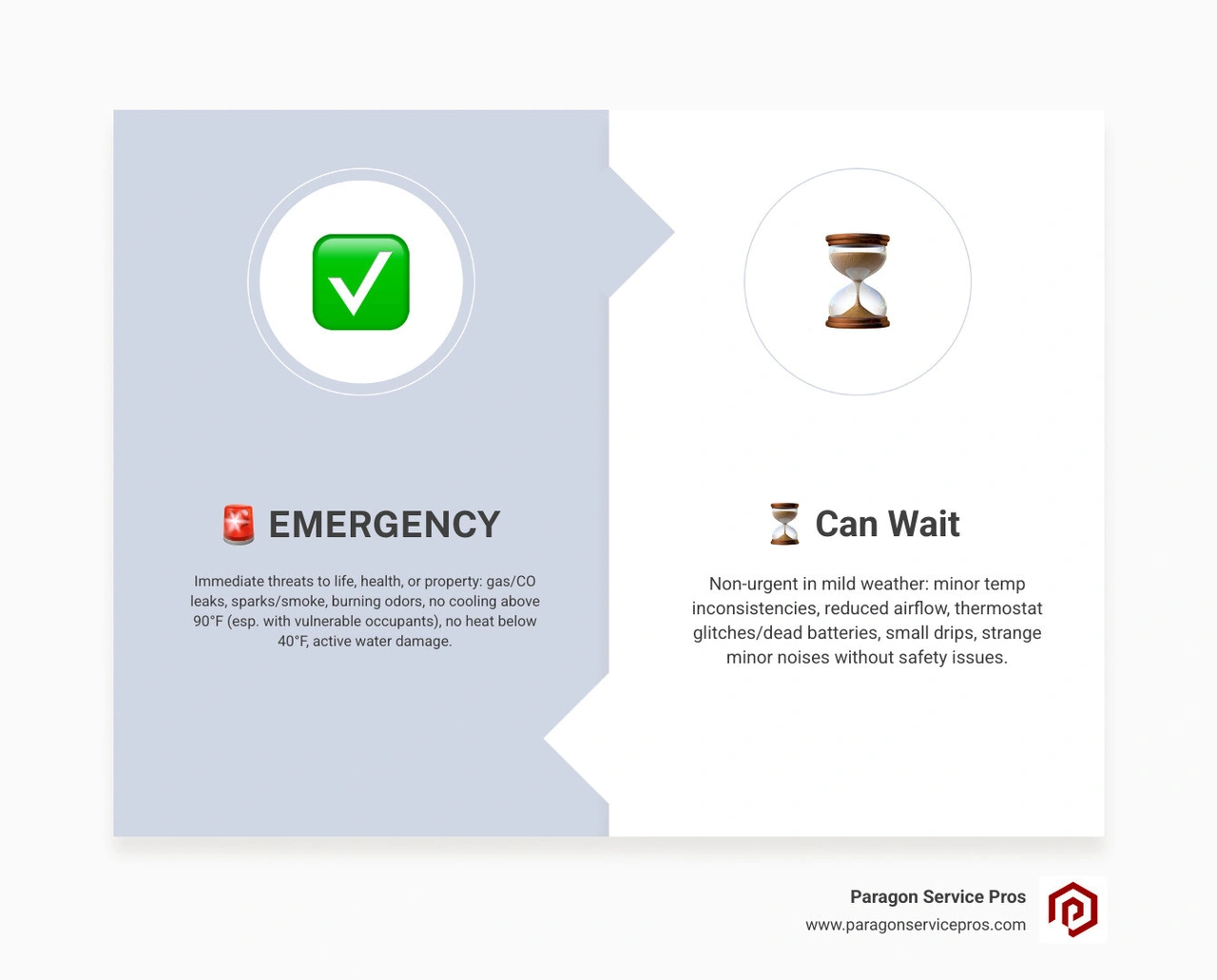
Call for emergency service immediately if you have:
- A gas smell or rotten egg odor near your furnace
- A carbon monoxide detector going off
- Sparks, smoke, or burning smells from your system
- No cooling when outdoor temps are above 90°F, especially with children, elderly, or anyone with a health condition in the home
- No heat when outdoor temps drop below 40°F
- Active water leaking from your indoor unit causing structural damage
These issues can typically wait until business hours:
- Minor temperature inconsistencies in mild weather
- Slightly reduced airflow with no other symptoms
- Thermostat display glitches or dead batteries
- Small, slow drips from the AC unit with no property damage
- Strange but minor noises without any burning smell or safety concern
For homeowners in Chandler, Gilbert, Mesa, Queen Creek, and San Tan Valley, AZ, the stakes are especially high. Arizona summers are brutal. When outdoor temperatures climb past 100°F, an uncooled home can become dangerous within just a few hours. And yet, not every HVAC problem is a crisis. Research shows that roughly 40% of emergency calls actually trace back to simple issues like a tripped breaker or a thermostat with dead batteries.
Knowing the difference can protect your family and save you from an unnecessary after-hours call. This guide walks you through exactly how to tell the two apart.
Defining When an HVAC Failure is a True Emergency
In the industry, we define a true emergency as any situation that poses an immediate threat to life, health, or the structural integrity of your property. While a broken air conditioner is always an inconvenience, it doesn't always qualify as a crisis. However, as of April 2026, we are seeing more extreme weather patterns in the East Valley, making the distinction even more critical for residents in San Tan Valley and Queen Creek.
A HVAC system problem shifts from "annoying" to "emergency" based on three main factors:
- Health Hazards: If the lack of climate control could lead to heatstroke, dehydration, or respiratory distress.
- Safety Risks: If the system is at risk of causing a fire, explosion, or poisoning the air with carbon monoxide.
- Property Damage: If the failure results in water flooding through your ceiling or pipes potentially freezing during a rare Arizona cold snap.
The presence of vulnerable residents—such as infants, the elderly, or those with chronic medical conditions—lowers the threshold for what we consider an emergency. A healthy adult might tolerate an 85-degree indoor temperature for a night, but for a senior citizen in Mesa, that same temperature can be life-threatening.
Critical Red Flags: When to Call for Immediate Help
When your system starts acting up, it often gives off warning signs. Some are subtle, but others are the equivalent of a loud siren. If you notice any of the following, don't wait for regular business hours.
One of the most visual "red flags" is a frozen evaporator coil. If you see ice forming on your indoor unit or the copper lines outside, your system is under extreme stress. Running a frozen unit can destroy the compressor—the most expensive part of your AC. Similarly, if your furnace pilot light is behaving strangely or you notice warning signs your air conditioner needs repair like grinding or banging, it’s time to call for emergency furnace service.
Identifying a Gas or Carbon Monoxide Leak as a True HVAC Emergency
Safety is our absolute priority. Natural gas is naturally odorless, but utility companies add a chemical called mercaptan to give it a distinct sulfur or "rotten egg" smell. If you catch this scent near your furnace or vents, do not flip any light switches or start your car. Evacuate immediately and call your gas provider from a safe distance.
Even more dangerous is carbon monoxide (CO), known as the "silent killer" because it is colorless, odorless, and tasteless. According to the CDC, unintentional carbon monoxide poisoning sends over 100,000 Americans to emergency departments every year. If your CO detector alarms, or if family members experience sudden headaches, nausea, or dizziness, follow the steps in our Mesa emergency furnace repair guide: get everyone out into the fresh air and call 911.
Electrical Hazards and Burning Smells
Your HVAC system pulls more electricity than almost any other appliance in your home. If you notice a persistent acrid, ozone, or burning plastic smell, it usually indicates fried wiring or a failing motor. If your system is not turning on and is repeatedly tripping the circuit breaker, do not keep resetting it. This is a safety mechanism designed to prevent a fire.
Frayed wiring or loose electrical connections are major fire risks. If you are in Gilbert and notice sparks or smoke, shut the power off at the main breaker if it is safe to do so and refer to our Gilbert emergency furnace repair guide for immediate professional assistance.
The Impact of Arizona Heat on System Urgency
In many parts of the country, an AC failure is just a discomfort. In Chandler and Mesa, it’s a different story. We often use the "90-degree rule": if the outdoor temperature is 90°F or higher and your AC is not cooling, the situation becomes an emergency quickly.
Indoor temperatures can rise to dangerous levels in a matter of hours. When the indoor thermometer hits the 85-degree threshold, the body begins to struggle to cool itself, especially if indoor humidity is high. This can lead to dehydration and heatstroke. If your system fails during a heatwave, you can find help through our emergency AC repair in Chandler.
Why Extreme Temperatures Make an HVAC Failure a True Emergency
The urgency of a repair is often dictated by who lives in the home. Infants and the elderly are much less efficient at regulating their body temperatures. Furthermore, individuals with certain medical conditions or those who rely on home medical equipment are at high risk when the cooling fails.
A home’s "thermal mass"—its ability to hold onto cool air—usually only provides an 8 to 12-hour window of protection once the AC stops. After that, the indoor temperature will rapidly equalize with the blistering Arizona sun. For residents in more remote areas, check out Gold Canyon's AC SOS guide to understand how to get rapid help when you need it most.
When Your HVAC Issue Can Wait for Business Hours
Not every bump in the night requires an emergency dispatch fee. If the weather is mild (between 65°F and 80°F) and everyone in the house is healthy, most issues can wait until the next morning.
| Issue | Urgency Level | Action |
|---|---|---|
| Gas/Burning Smell | Emergency | Evacuate & Call Now |
| No Cooling (>90°F) | Emergency | Call for Same-Day Service |
| AC Leaking Water | Urgent | Turn off system; call business hours |
| AC Freezing Up | Urgent | Turn off to thaw; call business hours |
| Minor Rattling | Non-Urgent | Schedule maintenance |
| Uneven Room Temps | Non-Urgent | Schedule a diagnostic |
If you notice a small drip or your system is freezing up, the best thing to do is turn the system off to prevent further damage and call us during regular hours. This saves you money and ensures we can get the necessary parts from our suppliers who may be closed after hours.
Simple Troubleshooting Before You Call
Before you pick up the phone for an emergency call, perform a "30-second triage." About 40% of HVAC emergencies are actually caused by simple thermostat malfunctions or maintenance oversights.
- Check the Thermostat: Are the batteries dead? Is it set to "Cool" and "Auto"?
- Inspect the Breaker: Did a power surge trip the HVAC circuit?
- Look at the Filter: A clogged filter can cause the system to overheat and shut down. If your furnace isn't turning on in Chandler, a dirty filter is a very common culprit.
- Clear Debris: Ensure your outdoor unit isn't buried under monsoon debris or overgrown weeds, which chokes airflow.
Preventing Future Breakdowns with Proactive Care
The best way to handle an HVAC emergency is to prevent it from ever happening. Statistics show that homeowners who invest in regular maintenance are 50% less likely to experience a total system breakdown. Conversely, skipping maintenance makes you twice as likely to face a crisis at the worst possible time.
We recommend seasonal tune-ups: an AC check in the spring and a heater check in the fall. For those in the East Valley, our Queen Creek furnace maintenance tips and Mesa furnace maintenance guide provide great starting points for keeping your system in top shape.
Regular care ensures your system runs efficiently, maintains its warranty, and reaches its full 15-20 year lifespan. For more information on what a professional looks for, see our 24-hour AC repair guide for Chandler.
Frequently Asked Questions about HVAC Emergencies
What should I do if my carbon monoxide detector goes off?
If your CO detector alarms, evacuate everyone—including pets—immediately. Call 911 or your local fire department from outside the home. Do not re-enter until emergency responders have cleared the building. Once it is safe, have a professional inspect your heat exchanger and flue pipes to find the source of the leak.
Is a complete loss of cooling always an emergency in Arizona?
Not always, but often. It depends on the outdoor temperature and the health of your household. If it’s 75°F outside, it’s a comfort issue. If it’s 105°F and you have an infant or an elderly family member, it is a high-priority emergency. We prioritize calls based on the heat index and the vulnerability of the occupants.
How quickly can a technician arrive for an emergency call?
During peak summer months like July and August, demand is incredibly high. However, we offer rapid dispatch for true emergencies. Our goal is to get a technician to your door as quickly as possible, often the same day, to diagnose the problem and restore your comfort.
Conclusion
At Paragon Service Pros, we understand that "when an hvac failure is a true emergency," you need a team you can trust. Serving Chandler, Gilbert, Mesa, Queen Creek, and San Tan Valley, we pride ourselves on transparency and quality workmanship. Whether you need a simple tune-up or an urgent HVAC repair, we are here to ensure your Arizona home remains a safe haven of comfort. Don't wait until a small sound becomes a major breakdown—give us a call today.
Keep reading: Home & Energy Savings
Browse every article in Home & Energy Savings or head back to the Learning Center .
Comfort you can count on, all year long.
Same-day service, honest diagnostics, and 24/7 emergency help with no overtime fees. A real Greater Phoenix team is standing by.