
A–Z Guide to Ductless vs Central HVAC
Compare ductless vs central HVAC for home additions in Arizona to find the best comfort solution for your new space.

What's the Best HVAC Option for Your Home Addition in Arizona?
When it comes to ductless vs central HVAC for home additions, most Arizona homeowners have two realistic options: install a ductless mini-split system or extend their existing central HVAC. Here's a quick breakdown to help you decide:
| Factor | Ductless Mini-Split | Central HVAC Extension |
|---|---|---|
| Best for | Detached spaces, sunrooms, garages, ADUs | Additions adjacent to existing ductwork |
| Installation disruption | Minimal (3-inch wall hole) | Moderate to significant |
| Energy efficiency | Up to 35 SEER2 | Up to 26 SEER2 |
| Duct energy loss | None | Up to 30% |
| Independent temperature control | Yes, per zone | Limited |
| Requires existing system capacity | No | Yes |
| Installation time | 1-2 days | 3-7 days |
You just finished building that new home office, Arizona room, or master suite addition. Now the Arizona heat is hitting — and you need to keep that space comfortable without turning it into an oven or jacking up your energy bill.
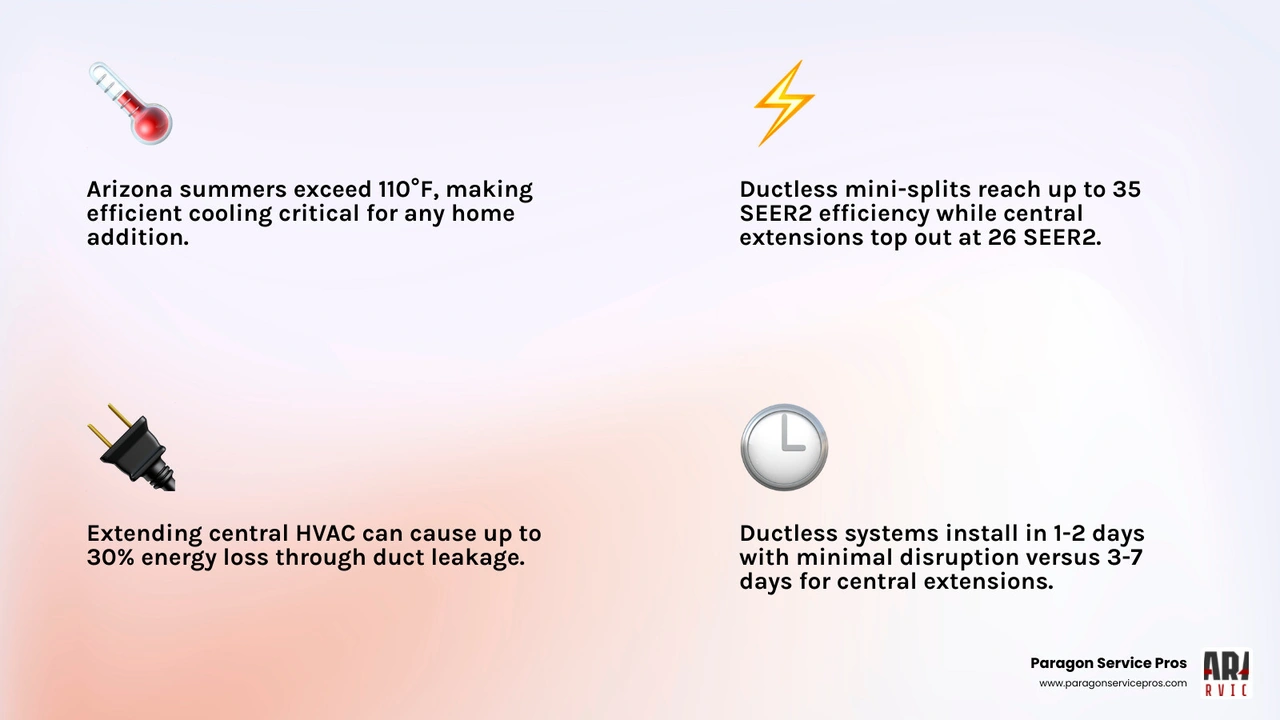
The challenge is real. Arizona summers push outdoor temperatures past 110°F, and adding square footage to your home means your existing HVAC system may already be stretched thin. Choosing the wrong approach can leave your new space uncomfortable, overload your current equipment, or cost you significantly more on monthly energy bills.
For most home additions in the Chandler, Gilbert, Mesa, Queen Creek, and San Tan Valley areas, a ductless mini-split is the more practical and energy-efficient solution — but extending central air can still make sense under the right conditions. This guide walks you through everything you need to know to make the right call.
Ductless vs central hvac for home additions definitions:
- ductless mini split benefits for arizona homeowners
- how ductless systems work for heating and cooling
Core Differences: Ductless vs Central HVAC for Home Additions
To make an informed decision, it helps to understand the fundamental mechanical and functional differences between these two systems.
At its core, a central HVAC system relies on a single, large outdoor compressor and a centralized indoor air handler to distribute conditioned air throughout your entire home. It accomplishes this via a complex network of hidden sheet metal or flexible ductwork.
In contrast, a ductless mini-split system bypasses ducts completely. It uses a smaller outdoor condenser connected directly to one or more indoor air-handling units mounted on the wall or ceiling. Instead of pushing air through massive ducts, a mini-split delivers conditioned air directly into the specific room where the indoor unit is installed.

Understanding these structural differences is crucial when evaluating Central AC vs Ductless Mini Split Comparison details. For a broader look at how these systems compare financially and operationally over their lifespans, checking out a Mini Split vs Central AC Cost Comparison can shed light on the long-term value of each setup.
| Feature | Ductless Mini-Split | Central HVAC Extension |
|---|---|---|
| Aesthetics | Visible wall or ceiling-mounted indoor unit | Hidden vents and registers flush with walls/ceilings |
| Zoned Climate Control | Standard; adjust temperature independently in the addition | Tied to the main home thermostat (unless complex zoning is added) |
| Structural Invasiveness | Requires only a small 3-inch wall penetration | Requires cutting drywall, framing, and routing large ducts |
| Air Filtration | Individual washable filters per indoor unit | Centralized media filter (MERV ratings vary) |
| Acoustics | Whisper-quiet indoor fan (19–26 dB) | Moderate airflow noise through vents |
How Ductless Systems Work for Home Additions
A ductless mini-split is beautifully simple. The system consists of an outdoor condenser unit and a sleek indoor blower unit. These two components are connected by a small conduit housing the power cable, communication lines, and copper refrigerant tubing.
During the blistering summer months, the refrigerant absorbs heat from inside your room addition and carries it to the outdoor unit, where it is released into the desert air. Because the indoor unit is positioned directly inside the room, it cools the space instantly without having to force air through hot, dusty attic spaces. This direct-delivery method is highly reliable and ensures that no cooling power is lost along the way. You can dive deeper into the mechanics of this process by reading How Ductless Systems Work for Heating and Cooling.
How Central HVAC Extensions Work for Home Additions
Extending your existing central HVAC system to a new home addition requires tapping into your home’s current trunk line. This involves running new supply and return ducts from your main air handler, through the attic or crawl space, and into the new room.
While this sounds straightforward, it is a complex engineering task. Your existing HVAC blower motor is designed to push a specific volume of air against a set amount of resistance, known as static pressure. When you add more ductwork and a new room to the loop, you change that balance.
If your blower motor is not powerful enough, extending the ducts will reduce airflow to the rest of your home, making your existing bedrooms warmer and leaving the new addition under-conditioned. To prevent this, a professional must calculate the static pressure and ensure your current air handler has the spare capacity to support the extra load. For a step-by-step look at this process, check out our guide on How to Extend Your HVAC to an Arizona Room.
Choosing the Right System: Ductless Mini-Split vs. Central Extension
Selecting the best system for your new space depends heavily on your lifestyle goals, the layout of your home, and how you plan to use the addition.
If you are building an "Arizona room" (a enclosed patio or sunroom), a guest suite, or a detached home office, the climate control needs of that space will differ dramatically from your main living room. For instance, a guest suite might sit empty for weeks before hosting family, while a sunroom with floor-to-ceiling windows will experience massive heat spikes during the day.
For many homeowners, choosing a mini-split is a great way to avoid the limitations of cheaper, noisier alternatives. You can read more about this in our comparison of a Mini Split vs Window Unit for Arizona Rooms. If you live in the East Valley and are ready to explore your options, our Ductless AC Installation Gilbert Guide offers practical local advice.
Why Ductless vs Central HVAC for Home Additions Wins for Sunrooms and Garages
Sunrooms and converted garages are notorious thermal weak points. Sunrooms suffer from high solar heat gain because of their extensive glass surfaces. Converted garages, even when insulated, often lack the thermal barrier integrity of the rest of the home because of concrete slabs and thin exterior walls.
If you try to cool these spaces by extending your central HVAC, you will likely face a frustrating dilemma: either the addition remains too hot, or you have to freeze out the rest of your house to make the new room livable.
A ductless mini-split solves this problem completely. It acts as an independent climate zone, running only when needed and adjusting its cooling output precisely to combat the solar heat load of a sunroom or the heavy heat retention of a garage. It keeps the space comfortable without placing any extra burden on your main home system. For more specialized strategies on handling these unique additions, read about Arizona Room Heating and Cooling Solutions.
Eliminating Energy Loss with Ductless vs Central HVAC for Home Additions
One of the most compelling arguments for choosing a ductless system is energy efficiency. According to the U.S. Department of Energy, duct leakage can account for more than 30% of a home's total energy consumption for space conditioning.
When cool air travels through ductwork routed across a blistering Arizona attic—which can easily reach 150°F in July—it naturally absorbs heat. By the time that air reaches your new room, it is no longer as cold as it was when it left the air handler.
Ductless mini-splits eliminate this energy loss entirely because they do not use ducts. Additionally, modern mini-splits utilize advanced inverter technology. Traditional central AC units turn on at 100% capacity and shut off when they reach the set temperature, consuming a massive amount of electricity during start-up. Inverter-driven mini-splits operate more like cruise control, adjusting their speed incrementally to maintain a constant temperature.
This technology allows modern mini-splits to achieve efficiency ratings up to 35 SEER2, compared to high-efficiency central systems that generally top out around 26 SEER2. If you want to compare how ductless systems stack up against other non-ducted options, take a look at our article Adding Cooling Without Ductwork Options Compared.
When Extending Central Air Makes More Sense
Despite the efficiency benefits of mini-splits, extending your existing central HVAC system can still be a smart choice under specific circumstances:
- The addition is a seamless, open extension: If you are knocking down a wall to expand your living room or kitchen, the new space is structurally integrated with the rest of your home, meaning a single, unified climate zone is ideal.
- Your existing system has verified extra capacity: If your central AC unit was recently replaced and is slightly oversized for your home, it may easily handle the extra square footage. A professional Manual J load calculation will confirm this.
- You prefer a hidden look: If you dislike the visual presence of a wall-mounted mini-split blower, central HVAC allows you to maintain clean walls with hidden, flush-mounted ceiling vents.
To ensure your extended system performs optimally without driving up your utility bills, read our guide on How to Heat and Cool Your Arizona Room Efficiently.
Installation, Maintenance, and Air Quality Considerations
The installation process for these two systems looks very different. Installing a ductless mini-split is remarkably clean and non-invasive, typically taking only one to two days. The technician simply mounts the indoor unit, drills a small 3-inch hole through the exterior wall to route the refrigerant lines, and connects it to the outdoor pad.
Extending central ductwork, however, is a major construction project that can take anywhere from three to seven days. It involves cutting into your drywall, framing, running bulky 12-inch ducts through tight attic spaces, and patching and painting the affected walls.
Whether you are leaning toward a ductless setup or extending your existing system, working with experienced professionals is key to ensuring a flawless installation. Homeowners in the Gold Canyon area can find localized tips and guidance in our Ductless Mini Split Installation Gold Canyon Guide.
Maintenance Requirements for Both Systems
To keep either system running efficiently in our dusty desert environment, regular maintenance is essential:
- Ductless Mini-Splits: These units feature small, washable air filters located right behind the front panel. Because they pull air directly from the room, they should be popped out and rinsed under warm water every 2 to 4 weeks during the peak summer cooling season.
- Central HVAC Extensions: Central systems utilize larger media filters (often MERV-rated) that need to be replaced every 1 to 3 months. Additionally, because dust can accumulate inside ductwork over time, professional duct cleanings are recommended every few years to keep your indoor air clean.
- Outdoor Units: For both systems, you must keep the outdoor condenser coils clear of desert debris, weeds, and windblown dirt. Maintaining at least 24 inches of clear space around the outdoor unit ensures proper airflow and prevents the compressor from overheating.
Indoor Air Quality and Dehumidification
Indoor air quality is a major concern for Arizona homeowners, especially during dust storms (haboobs) and seasonal wildfire events.
Central HVAC systems generally provide superior whole-home air filtration because they can accommodate thick, high-MERV pleated filters that capture ultra-fine dust and airborne allergens. They also excel at whole-home dehumidification, pulling moisture out of the air consistently as it circulates through the central return vents.
Ductless mini-splits provide excellent localized filtration for the specific room they serve, but they do not filter the air in the rest of your home. They do, however, prevent dust from migrating between rooms because they do not share ductwork. If you want to keep dust from your home addition from spreading to your bedrooms, a mini-split acts as an effective thermal and physical barrier.
Frequently Asked Questions about HVAC for Additions
Can a mini-split provide both heating and cooling for year-round comfort in Arizona?
Yes, absolutely. Modern ductless mini-splits are heat pumps, meaning they utilize a reversing valve to change the flow of refrigerant. During our chilly desert winter nights, the system extracts heat from the outdoor air and pumps it indoors, providing highly efficient electric heating without the need for energy-hogging space heaters or baseboards.
Will extending my ductwork reduce airflow in the rest of my home?
It can. If your existing air handler and compressor are already sized exactly to your home's original square footage, adding more ductwork will split the available airflow. This drop in static pressure will leave your existing rooms warmer and strain your blower motor, potentially leading to premature system failure. A professional load calculation is always recommended before extending ducts.
Is a hybrid HVAC approach possible for large home additions?
Yes, and it is often the most comfortable solution. Many homeowners keep their central HVAC system to cool the core living areas of the home, but install a supplemental ductless mini-split to handle a new master suite, a home office, or a converted attic space. This hybrid setup gives you the best of both worlds: uniform whole-home cooling and precise, zoned comfort where you need it most.
Conclusion
Choosing between a ductless mini-split and extending your central HVAC is a decision that affects your home's comfort, energy efficiency, and utility bills for years to come. While extending your central air offers a seamless, hidden aesthetic, a ductless mini-split provides unmatched efficiency, easy installation, and independent temperature control that is perfect for the extreme Arizona climate.
At Paragon Service Pros, we are committed to helping homeowners in Chandler, Gilbert, Mesa, Queen Creek, and San Tan Valley find the perfect heating and cooling solutions for their homes. Our team of experienced, local HVAC professionals can perform a detailed home assessment and help you design a system that keeps your new addition comfortable all year long.
Ready to make your new room the most comfortable spot in the house? Schedule a mini-split consultation today with our friendly team.
Keep reading: Heat Pumps & Ductless
Browse every article in Heat Pumps & Ductless or head back to the Learning Center .
Comfort you can count on, all year long.
Same-day service, honest diagnostics, and 24/7 emergency help with no overtime fees. A real Greater Phoenix team is standing by.