
Don't Let the Rain Drain Your AC: Monsoon Maintenance Tips
Discover how Arizona monsoon season affects your HVAC system. Protect against haboobs, humidity & surges with expert maintenance tips!

Why Arizona Monsoon Season Is One of the Biggest Threats to Your HVAC System
How Arizona monsoon season affects your HVAC system is something every homeowner in the Valley needs to understand before June 15 rolls around. Arizona's monsoon season runs officially from June 15 to September 30 — and during those months, your AC is fighting battles it was never fully designed for.
Here's a quick look at the main ways monsoon season stresses your HVAC:
- Humidity spikes from 10-20% up to 40-60% or higher, forcing your AC to work harder to remove moisture
- Haboobs (dust storms) coat condenser coils with fine particles, restricting airflow and reducing cooling efficiency
- Lightning and power surges — Phoenix alone averages 500,000 lightning strikes per monsoon season — can fry circuit boards, capacitors, and compressors
- Clogged condensate drains back up with the sudden increase in moisture, risking water damage and mold
- Wind and debris block outdoor units and can cause physical damage to coils and fins
- Energy bills rise 15-30% as your system runs longer and less efficiently under these combined stresses
Most Arizona AC systems are built and sized for dry desert heat. When the monsoon flips the script — bringing heavy moisture, dust, and electrical storms all at once — the strain on your system compounds fast. A unit that was running fine in May can start struggling by mid-July if it hasn't been prepped properly.
In this guide, we'll walk through exactly what's happening inside your HVAC during monsoon season, what you can do to protect it, and when it's time to call in a professional.
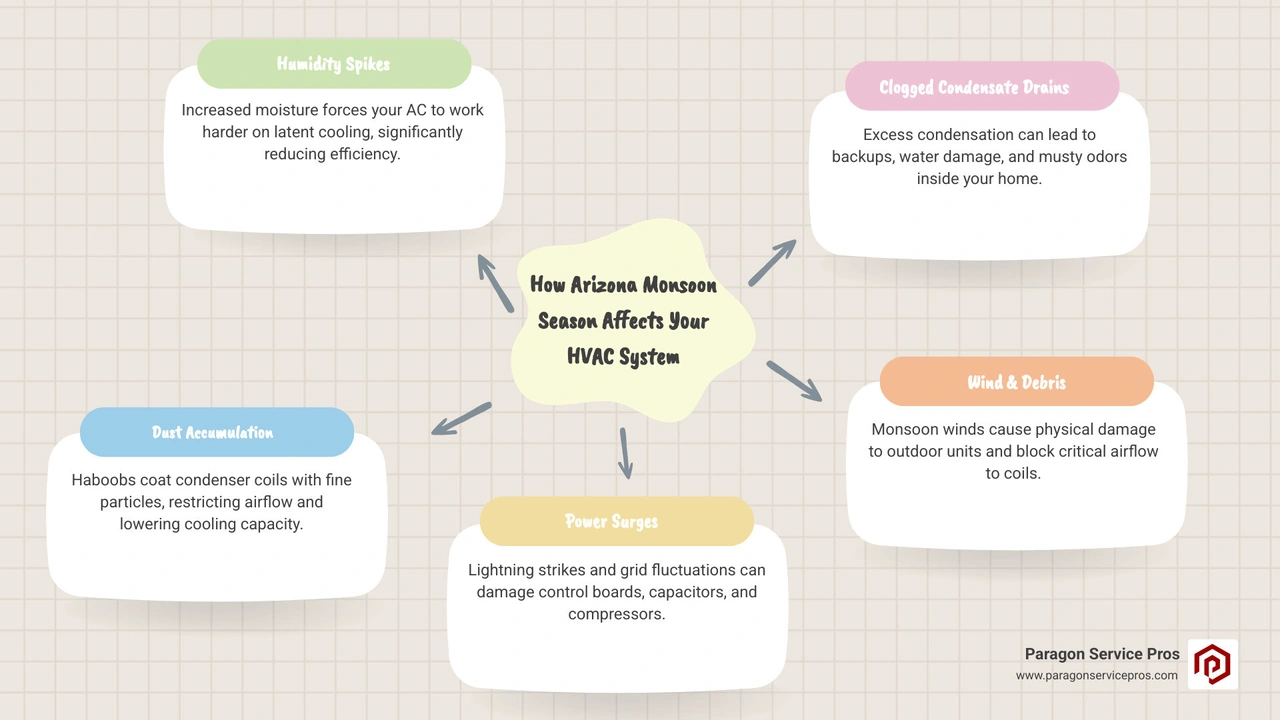
How Arizona Monsoon Season Affects Your HVAC System

When we talk about how Arizona monsoon season affects your HVAC system, we have to talk about the shift from "sensible" cooling to "latent" cooling. In the dry months of April and May, your AC focuses almost entirely on lowering the temperature of the air (sensible heat). However, once the monsoon moisture arrives, your system has to spend a massive amount of energy pulling water out of the air (latent heat).
This shift causes a noticeable efficiency drop. When the humidity jumps, your cooling capacity can decrease by 10% to 20%. Because the system is struggling to keep up with both the 110-degree heat and the 50% humidity, it runs for much longer cycles. This leads to common HVAC System Problems like overheating compressors and worn-out capacitors. If your system is already over a decade old, this seasonal stress is often the "final straw" that leads to a mid-summer breakdown.
Humidity and How Arizona Monsoon Season Affects Your HVAC System
Your air conditioner is actually a giant dehumidifier. As warm, moist air passes over the cold evaporator coils, the moisture condenses into liquid water. During the dry season, this is a minor task. But when humidity levels spike to 40-60% during a storm, your AC produces gallons upon gallons of water.
If your system isn't prepared, you might notice your AC Leaking Water inside the house. This happens when the condensate drain line—the pipe that carries that water outside—becomes overwhelmed or clogged. High humidity also makes your home feel "sticky" or "heavy," even if the thermostat says it's 75 degrees. This is because the AC is so busy fighting the heat that it can’t keep up with the moisture removal, leaving your indoor air quality less than ideal.
Dust Accumulation and How Arizona Monsoon Season Affects Your HVAC System
Haboobs are a spectacular sight, but they are a nightmare for mechanical equipment. These dust storms carry fine particulate matter (specifically PM10 particles) that act like a blanket for your outdoor condenser unit.
When dust coats the metal fins of your condenser coils, it creates an insulation layer that prevents heat from escaping. Your system then has to work twice as hard to dump heat outside, which skyrockets your utility bills. Furthermore, that dust doesn't stay outside; it finds its way into your return vents. Understanding the 15 Benefits of Regularly Replacing Your HVAC Filters is crucial during this time. We recommend checking your filters every two weeks during the height of the haboob season, as a clogged filter can restrict airflow enough to cause your evaporator coils to freeze up—yes, even in the Arizona summer!
Protecting Your System from Lightning and Power Surges
With over 500,000 lightning strikes occurring across the region each season, electrical safety is a top priority. A single nearby strike can send a massive voltage spike through the power lines and into your home’s electrical system.
The sensitive electronics in modern HVAC units—like control boards, sensors, and variable-speed motors—are highly vulnerable. These surges can fry a circuit board instantly or cause "invisible" damage to capacitors that leads to a failure weeks later. If you find yourself needing HVAC Repair Mesa AZ after a particularly nasty thunderstorm, an electrical surge is often the culprit.
The Essential Role of Surge Protectors in Arizona
Many homeowners think a standard power strip is enough, but your HVAC system requires a dedicated surge protector. These devices are installed at the electrical disconnect box near your outdoor unit and are rated to UL 1449 standards.
They work by sensing excess voltage and instantly routing it into the ground wire before it can reach your compressor or fan motor. Given that thousands of systems fail every year in Arizona due to grid fluctuations during storms, this is one of the smartest investments you can make. If you haven't had one installed yet, it's a common request for HVAC Repair Chandler AZ technicians during pre-monsoon tune-ups.
What to Do During a Power Outage
If the power flickers or goes out completely during a storm, your first instinct might be to restart the AC as soon as the lights come back on. Don't do it.
When power is restored, the electrical grid is often unstable, and "brownouts" (low voltage) can be just as damaging as surges. Additionally, your AC's compressor needs time for the refrigerant pressures to equalize. If you find your AC Not Turning On after a storm, you may have tripped a breaker or blown a fuse. We recommend turning your thermostat to "Off" during an outage and waiting at least 15 minutes after the power is stable before switching the cooling back on.
Preventing Water Damage and Clogged Condensate Drains
As we mentioned, your AC creates a lot of water when it's humid. This water collects in a drain pan and flows through a condensate line. However, monsoon dust and high humidity create the perfect environment for algae and "slime" to grow inside those lines.
If the line clogs, the water has nowhere to go but back into your home. This can lead to ruined drywall, warped flooring, and musty odors that linger for months. Regular HVAC Maintenance Gilbert AZ includes flushing these lines to ensure they stay clear, preventing a small clog from becoming a major indoor flood.
Managing Indoor Air Quality and Humidity Levels
If your home consistently feels sticky during the monsoon, your AC might be oversized or simply unable to handle the latent load. Upgrading to a smart thermostat can help; many modern versions can be set to "Dehumidification Mode," which slows down the blower fan to allow more moisture to condense on the coils.
For the ultimate comfort, some homeowners in HVAC Maintenance Queen Creek AZ service areas opt for whole-home dehumidifiers. These systems work alongside your AC to pull moisture out of the air without over-cooling your home, which is a major win for mold prevention and overall comfort.
Sealing Your Home Against Monsoon Moisture
Your HVAC system can only do so much if your home is "leaking" air. Monsoon winds can push humid air through tiny cracks around windows, doors, and even through your ductwork.
If you have duct leaks in your attic, your system might be sucking in 130-degree, humid attic air and trying to cool it. This is incredibly wasteful and puts immense strain on the unit. Ensuring you have proper attic insulation and weather stripping is a key part of HVAC Service San Tan Valley AZ that many people overlook. Sealing these gaps keeps the "monsoon" outside where it belongs.
Essential Monsoon Maintenance for Arizona Homeowners
Staying ahead of the weather is the best way to avoid a Saturday night breakdown in July. We've put together a simple comparison to help you track your maintenance tasks:
| Maintenance Task | Pre-Monsoon (April–June) | Post-Monsoon (October) |
|---|---|---|
| Filter Changes | Replace with fresh MERV 8-11 filter | Replace after final dust storms |
| Coil Cleaning | Professional deep clean | Rinse off haboob silt |
| Drain Line | Flush with vinegar or cleaner | Inspect for algae growth |
| Surge Protection | Test and verify installation | Check for "tripped" indicators |
| Debris Clearance | Trim bushes back 3 feet | Clear dead leaves and twigs |
Routine HVAC Maintenance Mesa AZ should always be scheduled before the first storm hits to ensure your system is mechanically sound.
Professional Tune-Ups to Prevent Seasonal Breakdowns
While DIY steps are great, there are things only a pro can catch. During a pre-monsoon tune-up, a technician will check your refrigerant levels. If your refrigerant is even slightly low, your system will struggle significantly more once the humidity hits, often leading to a frozen evaporator coil.
We also inspect the blower motor and electrical contactors for signs of pitting or seasonal wear. Catching these 11 Signs Your AC Needs Professional Maintenance early can save you from the "emergency call" list when it's 115 degrees outside.
Cleaning Your Outdoor Unit After a Haboob
After a major dust storm, your outdoor unit likely looks like it was dipped in chocolate. That silt needs to go. You can do this yourself with a standard garden hose—just make sure the power is off first.
Use a low-pressure setting; never use a pressure washer, as it will bend the delicate aluminum fins and permanently restrict airflow. Spray from the inside out if possible, or gently rinse the exterior from the top down. This simple act of airflow optimization can improve your cooling efficiency immediately. For a deeper, chemical clean that removes the minerals stuck deep in the coils, our HVAC Service Chandler AZ team is always ready to help.
Post-Storm Inspection: What to Check After the Clouds Clear
Once the rain stops and the dust settles, it’s a good idea to do a quick "walk-around" of your property. Check your outdoor unit for any large branches or debris that might have been blown against the fan grille.
If you notice your AC Not Cooling as well as it did before the storm, or if you hear new, unusual noises like rattling or buzzing, something may have been damaged. Standing water around the base of the unit is also a red flag, as it can lead to rust or electrical shorts if the unit's pad has shifted.
Identifying Hidden Storm Damage
Not all damage is as obvious as a fallen tree. Hail can "comb" over the fins on your unit, flattening them and blocking air. Wind-blown debris can also dent the cabinet or loosen electrical connections.
In some cases, a nearby lightning strike doesn't kill the system immediately but weakens the capacitor. This causes the motor to run hotter than usual, leading to a slow failure over the next few weeks. If you’re in an area prone to heavy storms, HVAC Repair Gilbert AZ experts can perform a quick diagnostic to ensure everything is still within factory specifications.
When to Call for Professional HVAC Repair
Some signs are clear indicators that it's time to stop DIYing and call in the experts. If your system is "short-cycling" (turning on and off every few minutes), it’s often a sign of an electrical issue or an overwhelmed compressor.
Weak airflow, burning smells, or a sudden spike in your energy bill are all reasons to seek HVAC Repair San Tan Valley AZ immediately. The sooner you address these issues, the less likely they are to turn into a total system replacement.
Frequently Asked Questions about Arizona Monsoons and HVAC
How often should I change my air filter during monsoon season?
During the monsoon (June–September), we recommend checking your filter every 2 weeks. If you've had a recent haboob or if you have pets, you’ll likely need to change it every 30 days. This is much more frequent than the standard 90-day recommendation for other times of the year.
Is it safe to run my AC during a lightning storm?
Yes, it is generally safe, provided you have a high-quality surge protector installed. However, if the power is flickering or "surging" (lights getting very bright and then dim), it is best to turn the system off at the thermostat to protect the compressor until the storm passes.
Why does my house feel humid even when the AC is running?
This usually happens because the AC is "short-cycling"—meaning it's cooling the air so fast that it doesn't run long enough to remove the moisture. It can also be caused by leaving your thermostat fan setting to "On" instead of "Auto," which blows the moisture sitting on the coils back into the house.
Conclusion
The Arizona monsoon is a force of nature that demands respect—especially when it comes to your home's comfort. By understanding how Arizona monsoon season affects your HVAC system, you can take the proactive steps needed to keep your family cool and your energy bills manageable. From installing surge protectors to keeping those coils clean after a haboob, a little bit of maintenance goes a long way in the desert.
At Paragon Service Pros, we live and work in the same storms you do. Whether you are in Mesa, Gilbert, Chandler, Queen Creek, San Tan Valley, or Gold Canyon, our team is here to ensure your system is "monsoon-proof." We pride ourselves on transparency, quality workmanship, and making sure our neighbors never have to suffer through a humid Arizona night without air conditioning.
Don't wait for the first haboob to hit. Schedule your monsoon-ready HVAC service in Mesa, AZ today! and breathe easy all summer long.
Keep reading: Maintenance & Tune-Ups
Browse every article in Maintenance & Tune-Ups or head back to the Learning Center .
Comfort you can count on, all year long.
Same-day service, honest diagnostics, and 24/7 emergency help with no overtime fees. A real Greater Phoenix team is standing by.