
How to Extend AC Lifespan in Extreme Heat
Learn how to extend the life of your AC in extreme heat with proven maintenance tips and smart habits for Arizona desert homes.

Why Arizona Homeowners Need a Plan to Survive Summer Without an AC Breakdown
Knowing how to extend the life of your AC in extreme heat can be the difference between staying cool all summer and facing a costly breakdown when temperatures hit 110°F. In Arizona cities like Chandler, Mesa, and Gilbert, AC units don't just run hard — they run almost constantly, logging 18 to 20 hours of runtime per day during peak summer months. That kind of workload chews through components faster than most homeowners realize.
Here's a quick overview of the most effective ways to extend your AC's lifespan in extreme heat:
- Change air filters every 30 days during summer to prevent airflow restriction and overheating.
- Set your thermostat to 78°F when home and 82°F when away to reduce compressor strain.
- Schedule professional maintenance twice a year — spring and fall — to catch failing components early.
- Keep 2 feet of clearance around your outdoor condenser unit at all times.
- Seal duct leaks and improve attic insulation to cut the cooling load your system has to fight.
- Shade your outdoor unit from direct sun to improve efficiency by up to 10%.
- Watch for warning signs like short cycling, warm air, or ice buildup so you can act before a full breakdown.
The average AC lasts 10 to 15 years nationally, but in desert climates like Arizona, neglected systems can fail in as few as 8 years. With the right habits and maintenance routine, that same system can push well past 15 years — and sometimes even reach 20.
This guide breaks down exactly what extreme heat does to your AC, what you can do about it, and when it's smarter to replace than repair.
The Reality of Desert Heat: How Long Does an AC Last in the Desert?
When you live in the East Valley — whether that’s Chandler, Gilbert, Mesa, Queen Creek, or San Tan Valley — your air conditioner is the undisputed MVP of your home. However, our scorching summers subject cooling systems to some of the most hostile environmental conditions on the planet.
While the national average air conditioner lifespan is estimated to be between 10 to 15 years, the reality in the Arizona desert is much harsher. A system that is neglected can easily fail in as little as 8 to 10 years. Constant operation in triple-digit weather subjects the equipment to an immense thermal load. Think of your AC like a car engine: if you drove your car at maximum speed for 18 hours a day through a dusty desert, it would accumulate wear and tear far faster than a car driven occasionally in a mild climate.
With proper care, high-quality systems can defy the desert odds and extend their operational life up to 20 years. To make that happen, you have to understand the specific environmental challenges your system faces. For a deeper look at how our local weather shapes your system's needs, check out our guide on How Arizona Desert Climate Affects Your HVAC.
How Extreme Heat Physically Stresses Critical Components
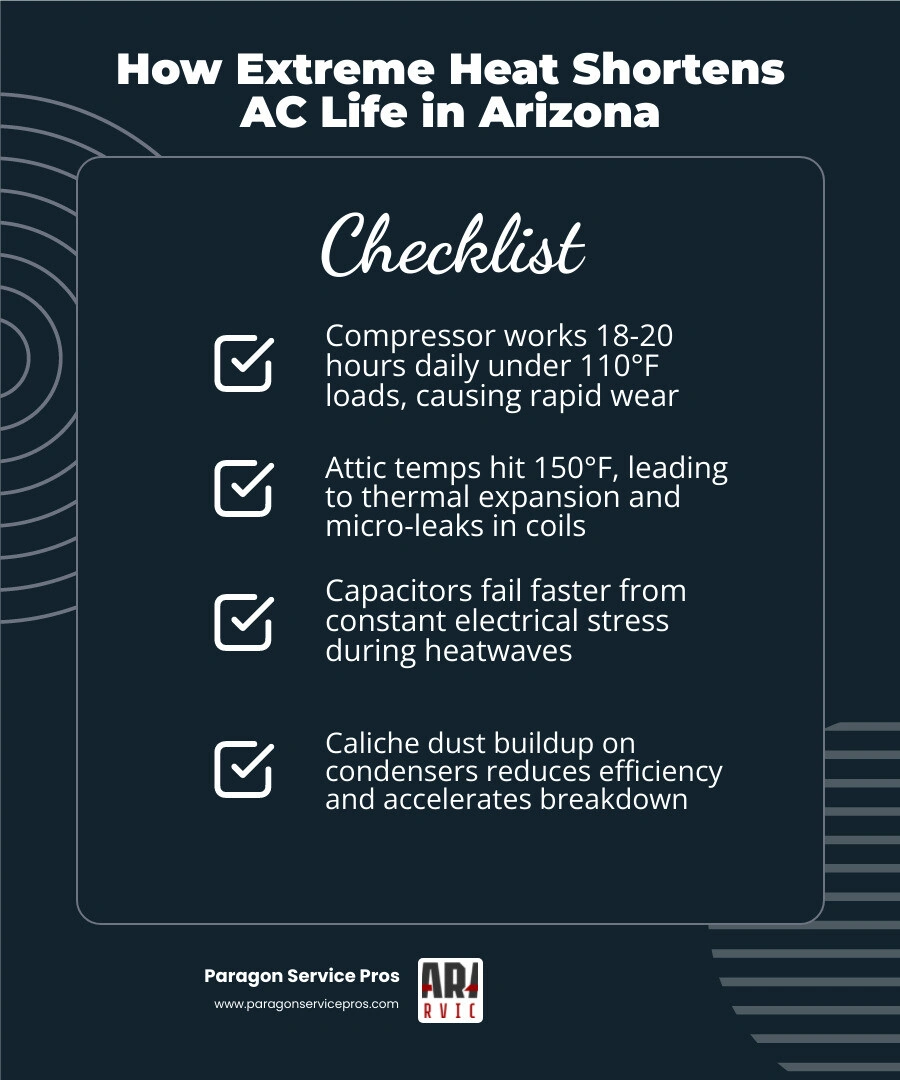
When ambient temperatures soar past 95°F, and routinely top 110°F in communities like Gold Canyon and San Tan Valley, your AC must work overtime. This extreme heat physically taxes several vital parts:
- The Compressor: This is the heart of your AC. Its job is to pump refrigerant through the system. In extreme heat, the compressor must work against incredibly high pressures. The lubricating oil inside the compressor can thin out under extreme thermal stress, and if it begins to burn, it turns acidic, causing catastrophic compressor failure.
- Condenser Coils: Located in the outdoor unit, these coils release the heat pulled from inside your home. When the outdoor air is already blistering hot, heat transfer slows down. To make matters worse, desert dust carried by summer winds can mix with outdoor moisture to form a baked-on paste on the coils. This "caliche" layer acts as an insulating blanket, forcing the compressor to work up to 20% harder just to dump heat.
- The Capacitor: This small, cylindrical component acts like a temporary battery, providing the electrical boost needed to start the compressor and fan motors. Capacitors are highly sensitive to heat. When temperatures inside the metal cabinet of your outdoor unit exceed 150°F, capacitors can physically bulge, leak oil, and pop, immediately shutting down your cooling system.
- Ductwork and Refrigerant Lines: Extreme heat causes the materials in your home to expand and contract. In a hot attic space, temperatures can easily reach 140°F to 150°F. This daily thermal expansion and contraction cycle degrades joint sealants, creating duct leaks and micro-leaks in copper refrigerant lines.
Common Heatwave AC Problems and Early Warning Signs
During an intense Arizona heatwave, minor system inefficiencies quickly escalate into major failures. Recognizing the early warning signs of component stress can save you from a late-afternoon cooling emergency.
- Short Cycling: If your AC turns on and off rapidly every few minutes, it is short cycling. This is often caused by an overheating compressor, a failing thermostat, or restricted airflow. It places immense strain on the starter components and wastes energy.
- Warm Air blowing from Vents: If the air coming out of your registers feels lukewarm, your system is struggling to complete the refrigeration cycle. This could point to a refrigerant leak, a failed capacitor, or a completely blocked condenser coil.
- Ice Accumulation on the Unit: It sounds counterintuitive, but your AC can freeze into a solid block of ice in 100-degree weather. This usually happens when airflow is severely restricted (such as from a clogged filter) or when refrigerant levels are too low, causing the indoor evaporator coil to drop below freezing.
- Strange Noises: A buzzing sound often indicates an electrical issue, such as a capacitor on its deathbed or a contactor chatter. Squealing or grinding noises point to failing bearings in the condenser fan motor or blower motor. Clanking or rattling suggests loose components or compressor damage.
How to Extend the Life of Your AC in Extreme Heat by Spotting Trouble Early
The key to preventing an expensive system replacement is addressing minor performance drops immediately. Airflow restriction is the number-one silent killer of air conditioners. When dust and debris block your system, you will notice weak airflow coming from your vents. Your system will have to run longer and harder to cool your home, leading to unexpectedly high energy bills.
If you notice your system running continuously without reaching your target temperature, do not simply lower the thermostat setting. This will not make the air any colder; it only forces the system to run indefinitely, accelerating wear. Instead, turn off the system if you suspect ice has formed, let it thaw, and call a professional to inspect it. Catching these issues early is essential, and you can learn more about preventing major system failures by reading about How to Prevent HVAC Emergencies with Maintenance.
Daily Habits and Thermostat Settings to Reduce System Strain
Adjusting how you interact with your cooling system on a daily basis can dramatically reduce the stress placed on its mechanical components.
| Condition | Recommended Thermostat Setting | Mechanical Benefit |
|---|---|---|
| Occupied (Home) | 78°F | Lowers runtime, prevents compressor overheating, keeps system within safe design limits. |
| Unoccupied (Away) | 82°F – 85°F | Gives the system a rest period; prevents "heat soak" without forcing a massive recovery load later. |
| Sleeping | 75°F – 78°F | Utilizes cooler nighttime outdoor temperatures to shed heat more efficiently. |
To understand why these settings are so critical, you need to understand the 20-degree rule. Most residential air conditioning systems are engineered to create a maximum 20-degree temperature differential between the outdoor air and the indoor air. If it is 110°F outside in Chandler, your AC is physically designed to maintain an indoor temperature of around 90°F under peak load. Expecting your system to pull your home down to 70°F when it is blistering hot outside forces the compressor to run continuously without a break, which is a recipe for a heatwave breakdown.
You can help your AC bridge this gap by adopting a few simple daily habits:
- Use Ceiling Fans: Run your ceiling fans counterclockwise while you are in the room. This creates a wind-chill effect that makes the air feel up to 4 degrees cooler, allowing you to set your thermostat higher without sacrificing comfort. Remember to turn fans off when you leave the room, as they cool people, not empty spaces.
- Manage Solar Heat Gain: Windows account for up to 30% of unwanted heat entering your home. Close your blinds, drapes, or thermal curtains on the south- and west-facing sides of your house during the afternoon to block intense solar radiation.
- Shift Heat-Generating Chores: Avoid running your oven, clothes dryer, or dishwasher during the hottest parts of the day (typically between 2 PM and 8 PM). These appliances dump additional heat and humidity into your living space, forcing your AC to work harder to remove it.
For more practical ways to optimize your system's daily operation, explore our Maximizing Energy Efficiency Tips for Your AC Unit.
Smart Thermostat Strategies to Protect Your System
Using a programmable or smart thermostat is an excellent way to automate your energy-saving habits. However, avoid the temptation to turn your AC completely off when you leave for work. Doing so allows the walls, furniture, and air inside your home to thoroughly heat up — a phenomenon known as "heat soak."
When you return and drop the thermostat back down, your AC will have to run continuously for hours to remove that deeply embedded heat, putting extreme stress on the compressor. Instead, use a gradual "stair-step" approach. Raise the temperature to 82°F or 85°F when you leave, and program it to lower the temperature by just a couple of degrees per hour starting shortly before you return home.
How to Extend the Life of Your AC in Extreme Heat Through Regular Maintenance
In the mild climates of the northern states, an annual AC tune-up is a solid recommendation. In the unforgiving desert of Arizona, twice-yearly professional maintenance is an absolute survival tactic. Scheduling a professional tune-up in the spring before the intense heat arrives, and a follow-up inspection in the fall, ensures that your system is fully prepared to handle the thermal stress.
During a professional maintenance visit, a qualified technician will perform critical tasks that go far beyond what a homeowner can safely do:
- Deep Coil Cleaning: Technicians use specialized, self-rinsing chemical cleaners to dissolve baked-on desert dust, pollen, and caliche from the condenser and evaporator coils, restoring optimal heat transfer.
- Electrical Inspections: We test the capacitance of your start and run capacitors, tighten loose wiring connections, and inspect contactor points for pitting or burn marks. Replacing a weak capacitor before it fails can save your compressor from taking damage.
- Refrigerant Charge Calibration: We check refrigerant levels and monitor operating pressures. Too little refrigerant causes the system to freeze up, while too much refrigerant can destroy the compressor.
- Blower Motor and Fan Lubrication: Ensuring all moving parts are lubricated reduces friction, lowers electricity consumption, and prevents motor overheating.
By investing in regular maintenance, you ensure your system remains highly efficient and reliable. To prepare your home for the changing seasons, take a look at our Seasonal Air Conditioning Preparation Tips for Optimal Performance.
Safe DIY Maintenance Tasks That Protect Your Warranty
While complex electrical and refrigerant work must always be left to licensed professionals, there are several simple, safe maintenance tasks you can perform to protect your system and keep your manufacturer's warranty fully intact.
- Change the Air Filter Every 30 Days: During the peak of summer, your AC processes an enormous volume of air. If you have pets or live in a dusty area of San Tan Valley or Queen Creek, check your filter every 3 to 4 weeks. A dirty filter chokes off airflow, forcing the blower motor to draw more electricity and potentially causing the evaporator coil to freeze. Understanding the impact of this simple task is easy when you read about the 15 Benefits of Regularly Replacing Your HVAC Filters.
- Maintain Clear Clearance Around the Outdoor Unit: Your outdoor condenser needs to breathe. Keep trees, shrubs, weeds, and patio furniture at least 2 feet away from the unit on all sides, and keep at least 4 feet of clear space above it. This ensures that the hot air being blown out of the top of the unit can disperse instead of being recirculated.
- Gentle Coil Rinsing: Between professional visits, you can gently rinse your outdoor condenser coils with a garden hose. Turn off the power to the unit at the outdoor disconnect box first. Use a gentle spray setting to wash away loose dust and leaves from the outside of the metal cabinet. Never use a high-pressure power washer, as this will bend the delicate aluminum fins and permanently restrict airflow.
For more helpful local tips on keeping your system running smoothly, check out our guide on AC Maintenance Tips Tempe AZ.
Home Improvements That Shield Your AC from Intense Solar Heat
Sometimes, the best way to help your air conditioner is to make your home easier to cool. By reducing the overall thermal load on your house, your AC won't have to run as long or as hard to keep you comfortable.
- Upgrade Attic Insulation: Your attic can act like a giant oven sitting directly above your living space. If your attic lacks proper insulation, that heat radiates down through your ceilings. Upgrading your attic insulation to recommended levels (R-38 to R-60) can reduce your home's cooling energy consumption by up to 40% and cut solar heat absorption by as much as 60% during peak hours.
- Seal Leaky Ductwork: Your ductwork carries the cold air your AC worked so hard to create. If your ducts are leaky, you can lose up to 30% of your total airflow into wall cavities and your blistering hot attic. This forces your system to run longer to cool your living areas. Sealing duct joints with mastic or professional foil tape keeps the cold air going where it belongs.
- Shade the Outdoor Condenser: If your outdoor unit sits in direct, blazing afternoon sunlight, it has to work much harder to release heat. Installing a shade screen, awning, or planting a shade-providing tree can improve the unit's efficiency by up to 10%. Just make sure the shade structure does not block the unit's airflow or restrict access for technicians.
To see how these home improvements fit into a complete maintenance strategy, read our comprehensive list of the Best AC Maintenance Tips Tempe AZ.
Sealing and Insulating to Lower the Cooling Load
To make your home as energy-efficient as possible, you want to create a tight "thermal envelope."
- Duct Leaks: You can use the "smoke trick" (holding a lit incense stick near duct joints while the system is running) to identify where air is escaping.
- Reflective Window Film: Applying reflective solar film to east- and west-facing windows can reject up to 70% of incoming solar heat without completely blocking your view.
- Weatherstripping and Caulking: Seal gaps around exterior doors and windows to prevent hot, dusty desert air from infiltrating your home and driving up indoor humidity.
Repair vs. Replacement: When to Say Goodbye to an Aging AC
No matter how well you maintain your air conditioner, there comes a time when repairs are no longer cost-effective. When you are faced with a major repair bill during a summer heatwave, you can use the 5,000 Rule to help make your decision.
Multiply the age of your air conditioning unit by the cost of the repair. If the resulting number is greater than $5,000, it is generally smarter to invest that money into a new, energy-efficient system. For example, if a 12-year-old system needs a $600 repair ($12 times 600 = 7,200$), replacement is likely the better financial choice.
Other factors that point toward system replacement include:
- The R-22 Refrigerant Phase-Out: Older units manufactured before 2010 use R-22 (Freon), which has been phased out due to environmental regulations. Sourcing R-22 is incredibly expensive, making refrigerant leak repairs on these older systems highly impractical.
- Frequent Breakdowns: If you find yourself calling for repairs multiple times a summer, the system's overall reliability has degraded, and a breakdown during a major heatwave is highly likely.
- Declining SEER Ratings: Older systems typically have a SEER (Seasonal Energy Efficiency Ratio) rating of 10 to 13. Modern baseline systems start at SEER2 14.3, with high-efficiency models reaching SEER 18 or higher.
How to Extend the Life of Your AC in Extreme Heat vs. Upgrading to a New System
If your system is relatively young and has been well-maintained, continuing to invest in preventative care is the best way to maximize your return on investment. Regular maintenance keeps your system running as close to its original efficiency rating as possible, which saves you money month after month. You can read more about how regular care pays off by exploring 11 Reasons Annual HVAC Maintenance Saves You Money.
However, if you choose to upgrade, modern high-efficiency systems offer incredible technological benefits designed to survive desert summers. Systems equipped with variable-speed compressors and inverter technology do not simply blast on at 100% capacity and then shut off. Instead, they run continuously at lower, highly efficient speeds, adjusting their output incrementally to match the cooling load. This drastically reduces wear and tear on the compressor, keeps indoor temperatures incredibly consistent, and can cut your summer cooling bills by up to 50%.
Frequently Asked Questions about AC Longevity in Arizona
Why won't my AC cool my home below 75 degrees when it is 110 degrees outside?
This is due to the physical limits of standard residential AC design and the 20-degree rule. Air conditioners are designed to cool the air by about 20 degrees compared to the outdoor temperature. When outdoor temperatures reach 110°F or higher, your system is working at its absolute design limit just to keep your home at 75°F to 80°F. If your system is blowing cool air and running continuously, it is likely performing as designed under extreme conditions.
How often should I change my air filter during a hot Arizona summer?
You should check your air filter every 30 days during the peak summer months. Our dusty desert environment, combined with high winds and household factors like pets or dander, can cause filters to clog much faster than they would in other parts of the country. If the filter looks gray or is covered in a layer of dust, replace it immediately to prevent airflow restriction.
Is it better to turn my AC off or leave it at a higher temperature when I am at work?
It is much better to leave your AC on at a higher temperature, such as 82°F or 85°F, rather than turning it completely off. Turning the system off allows "heat soak" to warm the physical structure of your home, forcing the AC to run continuously for hours to cool it back down when you return. Leaving it at a moderate, higher temperature keeps the heat load manageable and reduces overall system strain.
Conclusion
Extending the life of your air conditioner during our punishing Arizona summers isn't just about saving money — it's about protecting your comfort and peace of mind. By combining smart daily habits, temperature management, and simple DIY tasks with professional care, you can keep your system running reliably for years to come.
At Paragon Service Pros, we are proud to serve homeowners throughout Chandler, Gilbert, Gold Canyon, Mesa, Queen Creek, and San Tan Valley. As of June 2026, our team continues to provide the East Valley with unmatched AC maintenance, repair, and replacement services built on complete transparency and quality workmanship.
Whether you need a seasonal tune-up to prepare for the summer heat or want to learn more about our Air Conditioning Maintenance Mesa AZ services, we are here to help. To take the guesswork out of your home comfort, consider signing up for our AC Maintenance Agreement to ensure your system gets the twice-yearly care it needs to survive the desert heat.
Don't wait for your system to struggle in the middle of a triple-digit afternoon. Take action today to protect your home. Schedule Professional AC Maintenance with Paragon Service Pros and keep your cooling system running strong all summer long!
Keep reading: Air Conditioning
Browse every article in Air Conditioning or head back to the Learning Center .
Comfort you can count on, all year long.
Same-day service, honest diagnostics, and 24/7 emergency help with no overtime fees. A real Greater Phoenix team is standing by.