
The Average Lifespan of Air Conditioners in Extreme Heat
Discover how long does an AC last in the desert: 10-15 years avg. Learn factors, maintenance tips & replacement signs for Arizona heat.

Why Desert Homeowners Are Asking How Long Does an AC Last in the Desert
How long does an AC last in the desert is one of the most important questions you can ask as an Arizona homeowner — and the answer is different from what most national guides will tell you.
Here's the short version:
| Climate | Typical AC Lifespan |
|---|---|
| National average (moderate climates) | 15-20 years |
| Arizona / desert climates | 10-15 years |
| Harsh desert areas (e.g., Yuma) | 8-12 years |
| Well-maintained premium units in AZ | Up to 18 years |
| Neglected units in AZ | As few as 8-10 years |
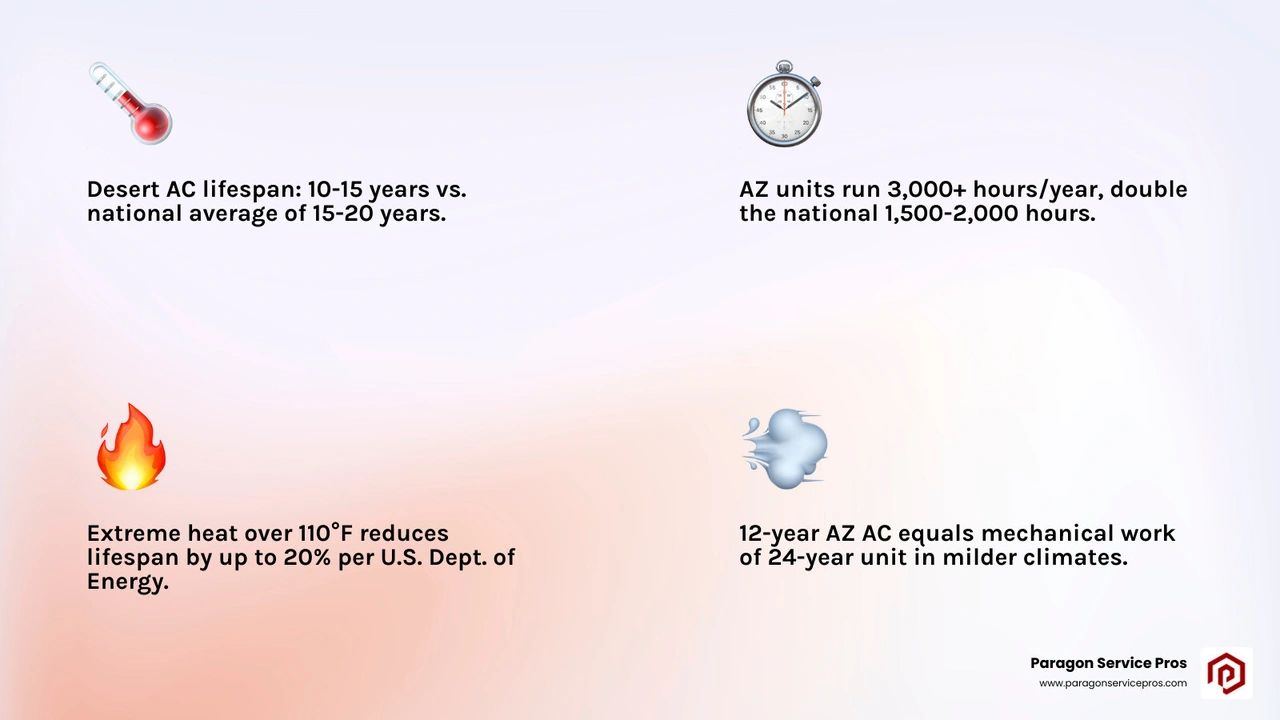
In places like Mesa, Gilbert, Queen Creek, and San Tan Valley, your AC doesn't get a break. It runs through scorching summers, monsoon humidity, and relentless dust — often logging more than 3,000 operating hours per year. That's more than double the national average of 1,500 to 2,000 hours. According to the U.S. Department of Energy, Arizona's extreme climate can reduce AC lifespan by as much as 20% compared to the national standard.
In short: the desert is hard on cooling equipment. What lasts 18 years in Minnesota might give out by year 10 in Chandler. Understanding why — and what you can do about it — is how you protect your investment and stay comfortable when temperatures push past 110°F.
How long does an AC last in the desert?
While the national average for a central air conditioning system is often cited as 15 to 20 years, the reality for those of us living in the Sonoran Desert is quite different. In our service areas like Mesa and Chandler, we typically see units reach the end of their functional life between 10 and 15 years.
This discrepancy exists because "average" lifespans are calculated using moderate climates where the AC might only run for four or five months a year. In Arizona, our cooling season can stretch for eight or nine months, sometimes even longer. When we discuss Residential AC Replacement, we often explain that a 12-year-old unit in Arizona has essentially performed the same amount of mechanical work as a 24-year-old unit in a milder state.
By the time a system hits its 10th birthday in the desert, it is often delivering only about 80-85% of its original cooling power. This is why many homeowners begin looking into AC Replacement Mesa AZ around the decade mark, especially when the cost of maintaining an older, struggling unit begins to outweigh the benefits of a new, high-efficiency system.
Climate factors affecting how long an AC lasts in the desert
The desert environment is a triple threat to mechanical equipment: extreme heat, intense sunlight, and seasonal humidity.
- 110°F+ Stress: When it is 115°F outside, your compressor has to work 30-40% harder than it would in 95°F weather just to move heat out of your home. This constant high-pressure operation accelerates the wear on internal valves and seals.
- 3,000+ Annual Operating Hours: Most systems across the country run for 800 to 1,000 hours a year. Arizona units regularly exceed 3,000 hours. This is the equivalent of driving a car 50,000 miles a year versus 12,000; the parts simply wear out faster.
- Thermal Cycling: The desert is famous for its temperature swings. A unit might sit in 70°F air at night and then suddenly have to contend with 115°F by mid-afternoon. This rapid expansion and contraction of metal components can lead to HVAC System Problems like refrigerant leaks.
- UV Radiation and Monsoon Humidity: Our intense sun degrades plastic components and wire insulation on the outdoor unit. Then, the monsoon season introduces sudden humidity, which forces the AC to work even harder to dehumidify the air while cooling it.
Factors That Shorten HVAC Longevity in Arizona
Beyond the heat itself, the desert environment introduces physical contaminants that act like sandpaper on your system's internal parts.
One of the biggest culprits is alkaline dust. The dust in the Phoenix Valley is uniquely abrasive and chemically reactive. During haboobs or even just windy days in San Tan Valley, this dust gets sucked into the condenser coils. If left uncleaned, it forms a "blanket" that traps heat, forcing the compressor to run hotter and longer. This is why we emphasize AC Maintenance Chandler AZ as a non-negotiable part of homeownership.
Other factors that lead to premature failure include:
- Component Strain: The extreme heat is particularly brutal on capacitors. These parts are often rated for temperatures up to 149°F, but inside a sun-baked metal AC cabinet, temperatures can easily exceed that, leading to an AC Not Turning On right when you need it most.
- Electrical Wear: Constant starting and stopping in the heat puts immense strain on the contactors and fan motors.
- Improper Sizing: An undersized unit will run 24/7 and burn out its compressor, while an oversized unit will "short cycle," turning on and off so frequently that it never removes humidity and wears out the starter components.
Maintenance impact on how long an AC lasts in the desert
The single most effective way to fight back against the desert climate is through consistent, professional care. Research shows that neglected systems in Arizona lose 20-30% of their expected lifespan, while those on a bi-annual maintenance plan can last 25-35% longer.
When we perform AC Maintenance Queen Creek AZ, we aren't just looking for broken parts. We are cleaning the coils to ensure proper heat transfer, checking refrigerant levels to prevent the compressor from overheating, and testing capacitors before they fail in July.
There are 11 Reasons Annual HVAC Maintenance Saves You Money, but in the desert, the most important one is reliability. A well-maintained system can push past the 15-year mark, whereas a neglected one might suffer a terminal compressor failure by year eight.
Maximizing System Life with Smart Usage and Installation
How you use your system is just as important as how you maintain it. We recommend a "smart usage" strategy to reduce the workload on your equipment.
- The 78°F Rule: The Department of Energy and local utilities recommend setting your thermostat to 78°F when you are home. Every degree you drop below that significantly increases the strain on your system. If you try to keep your home at 70°F when it's 115°F outside, your AC may never turn off, leading to a much shorter lifespan.
- Smart Thermostats: These devices help by preventing extreme temperature swings and managing "recovery time" more efficiently. You can find more Maximizing Energy Efficiency Tips for Your AC Unit to help lower your bills and save your system.
- Home Efficiency: Your AC is only as good as the "envelope" it's cooling. Improving attic insulation (aim for R-38 or higher) and sealing duct leaks ensures your AC doesn't have to work overtime to compensate for lost air.
- Professional Installation: Longevity starts on day one. A shoddy installation can reduce a system's lifespan by five years or more. When performing AC Replacement San Tan Valley AZ, we ensure the system is perfectly sized using a Manual J load calculation and that the airflow is balanced to prevent pressure issues that kill compressors.
Signs Your Air Conditioner Is Nearing Failure
In Arizona, most AC units show age-related warning signs between years 8 and 12. Recognizing these early can save you from an emergency replacement in the middle of a 110-degree afternoon.
Common red flags include:
- Rising Energy Bills: If your utility costs have spiked by 15-25% year-over-year without a rate increase, your system is likely losing efficiency.
- Frequent Repairs: If you've had to replace a capacitor, a fan motor, and a contactor in the last two seasons, you are "playing whack-a-mole" with a dying system.
- Strange Noises: Grinding, squealing, or banging sounds often indicate that the compressor or blower motor is on its last legs.
- Uneven Cooling: If some rooms are ice cold while others stay warm, the system is struggling to move air effectively.
- Refrigerant Issues: If your unit still uses R-22 (Freon), it is effectively obsolete. R-22 has been phased out and is incredibly expensive to source.
There are 7 Signs Your Air Conditioner Needs to Be Replaced that every homeowner should know. Additionally, staying informed on What You Need to Know About the 2025 Shift in HVAC Refrigerants and Efficiency Standards will help you understand why newer models are more reliable and environmentally friendly.
Deciding Between AC Repair and Replacement
When your system acts up, the "Repair vs. Replace" debate begins. In the industry, we often use the "5,000 Rule" as a starting framework. You multiply the age of the unit by the cost of the repair. If the result is more than $5,000, it is usually time to replace.
- Example: A $600 repair on a 10-year-old unit equals 6,000. It might be time for HVAC Replacement Mesa AZ.
- Example: A $300 repair on an 8-year-old unit equals 2,400. Repairing is likely the smarter financial move.
Beyond the math, consider the efficiency. Newer systems are required to meet SEER2 standards, which are significantly higher than the units installed a decade ago. Understanding SEER Ratings What They Mean for Your AC and Heating System is key to seeing how a new unit can pay for itself in energy savings over 5-7 years. For a comprehensive look at the process, check out our AC Replacement Gilbert AZ Guide.
Frequently Asked Questions about Desert AC Longevity
Is it normal for my AC to run constantly during Arizona summers?
Yes, when temperatures exceed 105°F, it is perfectly normal for an AC to run nearly all day to maintain your set temperature. However, if it runs constantly and the indoor temperature is still rising, you may have a mechanical issue or a significant insulation problem.
Can an air conditioner last 20 years in the desert?
While it is technically possible with premium brands and obsessive maintenance, it is very rare. Most units in the Phoenix Valley are considered "on borrowed time" after year 15. The internal components simply aren't designed for the 40,000+ hours of runtime that 20 years in the desert would require.
How often should I change my air filters in a dusty climate?
In places like Gilbert and Queen Creek, the standard "90-day" filter advice does not apply. We recommend checking your filters every 30 days. If you have pets or live near active construction or open desert, you may need to change them every 20 days during the peak of summer to prevent airflow restriction.
Conclusion
Living in Arizona means your air conditioner is your most important appliance. While the desert climate is undeniably tough on cooling systems, you aren't powerless. By prioritizing AC Maintenance, choosing the right installation partner, and using smart thermostat settings, you can ensure your unit lasts as long as possible.
At Paragon Service Pros, we understand the unique demands of the East Valley. Whether you are in Mesa, Chandler, Gilbert, Gold Canyon, Queen Creek, or San Tan Valley, we are here to provide the transparency and quality workmanship you need to stay cool. Don't wait for a mid-summer breakdown — let's make sure your system is ready for the marathon ahead.
Keep reading: Air Conditioning
Browse every article in Air Conditioning or head back to the Learning Center .
Comfort you can count on, all year long.
Same-day service, honest diagnostics, and 24/7 emergency help with no overtime fees. A real Greater Phoenix team is standing by.