
Choosing the Best AC Unit for Your Arizona Room
Beat the heat in your Arizona room! Compare mini split vs window unit for arizona rooms for efficient, comfortable cooling in desert heat.

Why Cooling an Arizona Room Is One of the Hardest HVAC Decisions You'll Make
mini split vs window unit for Arizona rooms is a question every homeowner in Mesa, Gilbert, Chandler, and the greater Phoenix area eventually faces — especially after adding a sunroom, enclosed patio, or bonus space to their home.
And it's not a simple answer. Arizona rooms sit at the intersection of two brutal realities: extreme desert heat that regularly pushes past 110°F, and a space that wasn't built with your main HVAC system in mind. That combination means your cooling choice matters more here than almost anywhere else in the country.
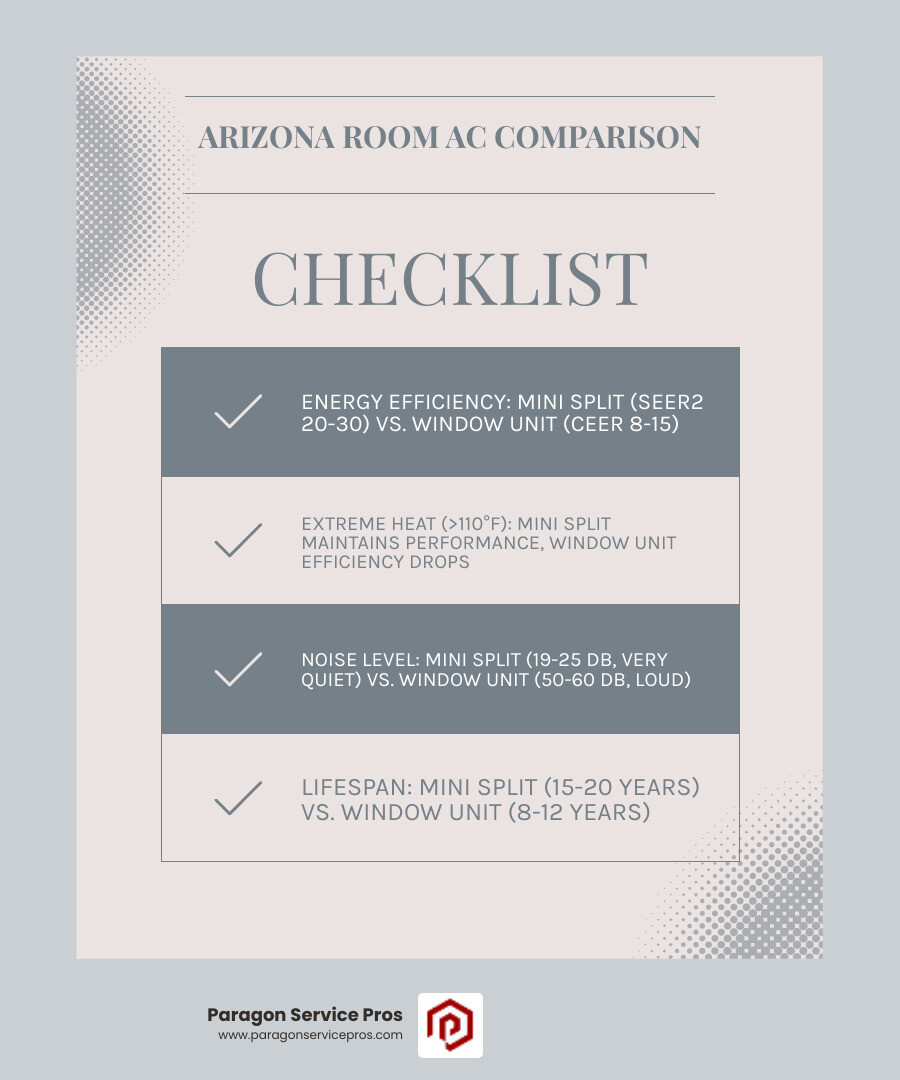
Here's a quick comparison to help you decide:
| Factor | Mini Split | Window Unit |
|---|---|---|
| Energy efficiency | SEER2 ratings of 20–30 | CEER ratings of 8–15 |
| Performance in 110°F+ heat | Maintains efficiency well | Efficiency drops significantly |
| Installation | Professional, wall-mounted, permanent | DIY-friendly, fits window frame |
| Noise level | 19–25 dB (very quiet) | 50–60 dB (noticeably loud) |
| Heating capability | Yes, year-round heat pump | Cooling only (most models) |
| Lifespan | 15–20 years | 8–12 years |
| Best for | Long-term homeowners | Tight budgets, temporary use |
The short answer: For most Arizona homeowners who plan to stay in their home and use the space regularly, a mini split is the stronger long-term investment. It handles extreme heat better, runs quieter, lasts longer, and saves more on electricity bills over time. A window unit makes sense if you're on a tight budget, cooling the space occasionally, or need a short-term fix.
The rest of this guide breaks down exactly why — with real performance data, installation considerations, and Arizona-specific factors that should shape your decision.
Comparing Efficiency: Mini Split vs Window Unit for Arizona Rooms
When we talk about efficiency in the East Valley, we aren't just talking about being "green." We’re talking about survival for your wallet during a July billing cycle. To understand the mini split vs window unit for Arizona rooms debate, we have to look at how these units are rated.
For decades, the industry used SEER (Seasonal Energy Efficiency Ratio). However, as of 2023, we moved to SEER2, which better reflects real-world conditions with higher external static pressure. Most mini splits we install today carry SEER2 ratings between 20 and 30. In contrast, window units use CEER (Combined Energy Efficiency Ratio), which usually hovers between 8 and 15.
Why the massive gap? It comes down to inverter technology.
Traditional window units are "all or nothing" machines. The compressor kicks on at 100% power, blasts cold air until the thermostat is satisfied, and then abruptly shuts off. This constant cycling is incredibly wasteful. Imagine driving your car by flooring the gas pedal and then slamming on the brakes every block — that’s a window unit.
Mini splits utilize variable-speed compressors. They adjust their speed to maintain a steady temperature, often using up to 40% less electricity than window units. In fact, real-world testing in Phoenix has shown that mini splits can save homeowners nearly 50% on their annual cooling costs for a single room compared to a standard window AC.
To dive deeper into these metrics, you can read our guide on Understanding SEER Ratings for AC and Heating. Understanding these numbers is the first step in Maximizing AC Energy Efficiency in your Arizona home.
Performance in Extreme Desert Heat
Phoenix summers are the ultimate stress test for any mechanical system. When it’s 115°F in Gilbert or Queen Creek, the "physics" of cooling changes. This is where the mini split vs window unit for Arizona rooms comparison gets real.
Window units suffer from three major flaws in extreme heat:
- Air Leakage: No matter how much foam or duct tape you use, a window unit is never perfectly sealed. Hot Arizona air is constantly pushing its way in through the gaps around the unit.
- Thermal Bridging: The chassis of a window unit is made of thin metal and plastic. When the sun beats down on that exterior box, heat transfers directly into your room, forcing the unit to work even harder.
- Efficiency Drop-off: Standard window units are rarely designed to operate efficiently when ambient temperatures exceed 100°F. In Phoenix testing, while a mini split maintained a SEER2 of 18.2 at peak heat, window units often saw their real-world CEER drop to a dismal 8.5.
Why a mini split vs window unit for Arizona rooms handles 115°F better
Mini splits are essentially high-performance heat pumps. They use advanced refrigerants like R-32, which offers superior heat transfer properties. Because the compressor (the part that makes the noise and heat) is located outside and away from the room, and the indoor unit is connected only by a small conduit, there is virtually no air leakage.
Furthermore, mini splits feature much larger heat exchange coils. This allows them to "reject" heat more effectively even when the outdoor air is scorching. They don't just blast cold air; they provide consistent humidity control and cooling quality that a window unit simply can't match. For a broader look at how these systems differ from traditional setups, check out our comparison of Ductless vs. Ducted Air Conditioning.
Installation and Aesthetics for Your Home Addition
Arizona rooms are often the pride of a home — a place to enjoy the desert view without the dust. The last thing you want is a bulky, vibrating box blocking your view of the Superstition Mountains.
| Feature | Mini Split Installation | Window Unit Installation |
|---|---|---|
| Structural Impact | 3-inch hole in the wall | Fits into existing window frame |
| Window Use | Keeps window functional and clear | Blocks window and natural light |
| Security | High (sealed system) | Low (can be pushed in/removed) |
| Aesthetics | Sleek, high-wall mount | Bulky, industrial look |
| HOA Compliance | Generally easy (condenser hidden) | Often restricted or banned |
Security is a major concern in some parts of the Valley. A window unit is essentially a removable "plug" in your home's security perimeter. An intruder could potentially remove the unit to gain access. A mini split, however, requires only a tiny hole for the refrigerant lines, keeping your home secure.
When considering a permanent upgrade, it's important to look at the Mini-Split Installation process. While more involved than sliding a box into a window, it adds significant value to your property. If you're worried about the initial investment, our overview of Understanding AC Installation Cost can provide some clarity on what goes into a professional setup.
Choosing a mini split vs window unit for Arizona rooms in Mesa and Chandler
In cities like Mesa and Chandler, many neighborhoods have strict HOA regulations regarding what can be seen from the street. Window units are frequently "red-flagged" because they disrupt the architectural lines of the home. Mini splits are much more discrete; the outdoor condenser can be tucked away in a side yard or behind landscaping.
For our neighbors in the East Valley, we've put together a Ductless AC Install Gilbert Guide that covers the specifics of local installations, including the need for dedicated electrical circuits and proper condensate drainage — two things that are often overlooked but crucial for preventing water damage in your Arizona room.
Year-Round Comfort: Heating and Noise Considerations
Many people forget that Arizona rooms can get surprisingly chilly during a San Tan Valley winter night. Most window units are "cool-only." If you want to use your Arizona room as a home office or a hobby room in January, you’ll likely need a separate space heater.
Mini splits are year-round solutions. Because they are heat pumps, they can reverse the cooling process to provide incredibly efficient heat. In fact, they are 300-400% more efficient than electric resistance heaters.
Then there is the "noise factor." If you’ve ever tried to take a Zoom call or watch a movie with a window AC running, you know the struggle. Window units average 50–60 decibels — roughly the volume of a conversation or a loud dishwasher. Mini splits operate as low as 19 decibels. That is quieter than a whisper. This makes them the ideal choice for any space where peace and quiet are a priority. Whether you need heating or cooling, our full range of Air Conditioning Services ensures your Arizona room stays comfortable 365 days a year.
Maintenance and Longevity in Dusty Environments
We all know the "Habub" — those massive Arizona dust storms that roll through Mesa and Queen Creek every summer. Dust is the enemy of any AC system.
Window units are difficult to clean deeply. Dust builds up on the internal fans and coils, and because the units are self-contained, you often can't reach the areas that need cleaning without fully dismantling the machine. This leads to a shorter lifespan, usually only 8 to 12 years.
Mini splits are built for longevity. With proper Mini-Split Maintenance, including regular filter cleanings (we recommend every 2-4 weeks during peak summer) and an annual professional tune-up, these systems can easily last 20 years. They are designed to be serviced, with parts that are easily accessible to technicians.
If you have an old, struggling window unit or an aging ductless system, it might be time to look into Mini-Split Replacement to regain that efficiency and comfort.
Frequently Asked Questions about Arizona Room Cooling
Do mini splits work better than window units in dry heat?
Absolutely. While Arizona's dry heat is famous, our "monsoon" season can bring unexpected humidity. Mini splits provide superior air sealing and consistent cooling, which prevents the "temperature swings" common with window units. Because they run on inverter technology, they keep the air moving and filtered constantly, which is much better for the dry, dusty environment we live in.
Can I install a mini split myself in Queen Creek?
We strongly advise against it. Installing a mini split involves handling high-pressure refrigerants, which requires EPA certification. Furthermore, DIY installations almost always void the manufacturer's warranty. A professional installation ensures that the electrical circuits are safe, the line sets are vacuumed correctly to remove moisture, and the unit is sized perfectly for your Arizona room's specific sun exposure.
Are there tax credits for energy-efficient cooling in 2026?
Yes! As of April 2026, federal incentives under the Inflation Reduction Act are still a major benefit for Arizona homeowners. Many high-efficiency mini split heat pumps qualify for a federal tax credit of up to $2,000 (or 30% of the project cost). When you combine this with potential utility rebates from providers like SRP or APS, the long-term value of a mini split becomes even more attractive.
Conclusion
Choosing between a mini split vs window unit for Arizona rooms ultimately comes down to how you value your comfort and your home’s long-term efficiency. While a window unit offers a quick, low-cost fix, it rarely stands up to the demands of a Mesa or Gilbert summer without costing you more in the long run through high energy bills and frequent replacements.
At Paragon Service Pros, we believe your Arizona room should be your favorite part of the house, not a sweltering "no-go zone" from June to September. We specialize in helping homeowners in Chandler, Gold Canyon, and Queen Creek find the perfect cooling solutions that fit their lifestyle and their budget.
If you’re ready to transform your Arizona room into a year-round oasis, we’re here to help. Explore our Mini-Split Systems and see how we can bring unparalleled comfort to your home today.
Keep reading: Heat Pumps & Ductless
Browse every article in Heat Pumps & Ductless or head back to the Learning Center .
Comfort you can count on, all year long.
Same-day service, honest diagnostics, and 24/7 emergency help with no overtime fees. A real Greater Phoenix team is standing by.