
Don't Let Your House Choke You: Improving Indoor Air Quality
Discover how to improve indoor air quality at home: reduce pollutants, boost ventilation, HVAC tips & pro testing in AZ!

Why Indoor Air Quality at Home Matters More Than You Think
How to improve indoor air quality at home is something every Arizona homeowner should know — because the air inside your house may actually be making you sick, even when it looks and smells perfectly fine.
Here are the most effective ways to improve indoor air quality at home:
- Control pollution at the source - eliminate VOCs, smoke, and chemical cleaners
- Ventilate regularly - open windows when outdoor air quality is good; use exhaust fans when cooking or showering
- Maintain your HVAC system - use MERV-13 filters and change them consistently
- Reduce allergens - vacuum with a HEPA filter, wash bedding weekly in hot water, and keep pets groomed
- Control humidity - keep indoor levels between 30% and 50% to prevent mold and dust mites
- Use air purifiers - HEPA purifiers remove over 99% of harmful airborne particles
- Test for hidden dangers - radon, carbon monoxide, and mold can be invisible and odorless
According to the EPA, Americans spend roughly 90% of their time indoors — and indoor pollutant levels are often two to five times higher than what you'd find outside. In Arizona, that problem gets compounded by sealed homes running air conditioning for months on end, trapping dust, allergens, and combustion byproducts with nowhere to go.
The uncomfortable truth? Most indoor air threats are completely invisible. You won't smell radon. You won't see VOCs off-gassing from your couch. And you probably won't notice carbon monoxide until it's already a serious problem.
The good news is that a handful of straightforward changes — some free, some low-cost — can make a real difference in what you and your family breathe every day.
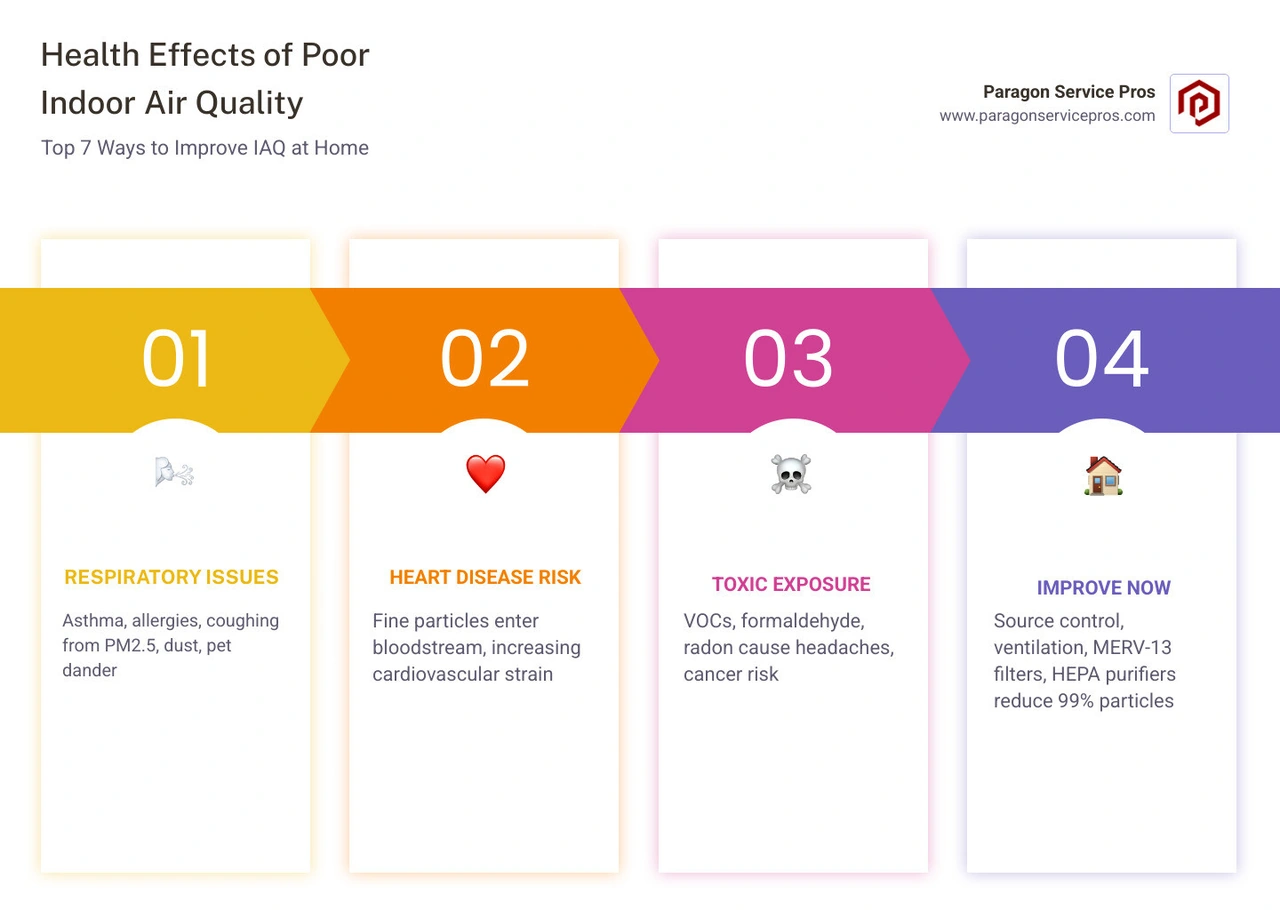
Understanding the Invisible Threats to Your Home's Air
Before we can talk about how to improve indoor air quality at home, we have to understand what we are fighting. In our experience serving the East Valley, we’ve found that many homeowners in Chandler and Mesa are surprised to learn that their "fresh" indoor air is actually a cocktail of microscopic irritants.
The Heavy Hitters of Indoor Pollution
The air in your home isn't just "stale"—it often contains specific pollutants that can have long-term health consequences.
- Radon Gas: This is a naturally occurring radioactive gas that seeps up through the soil and into your home’s foundation through tiny cracks. It is the second leading cause of lung cancer in the United States and is completely odorless and colorless.
- Volatile Organic Compounds (VOCs): These are gases emitted from certain solids or liquids. Think of that "new car smell" or the scent of fresh paint. VOCs are released by cleaning supplies, pesticides, building materials, and even your favorite scented candles.
- Particulate Matter (PM2.5): These are fine particles less than 2.5 micrometers in diameter. They are so small they can bypass your nose and throat, entering your lungs and even your bloodstream. In Arizona, desert dust and wildfire smoke are major contributors to PM2.5 levels.
- Formaldehyde: Often found in the glues used for composite wood furniture (like particleboard) and certain carpets, this chemical can "off-gas" for years, irritating the eyes, nose, and throat.
- Combustion Pollutants: If you use a gas stove, a fireplace, or a space heater, you are potentially releasing carbon monoxide and nitrogen dioxide into your living space.
If you are concerned about what might be lurking in your hallways, we recommend checking out our Gold Canyon Air Quality Testing Guide or our Indoor Air Quality Testing Guide Mesa AZ to see how professional diagnostics can pinpoint these invisible threats.
How to Improve Indoor Air Quality at Home Through Source Control

The single most effective strategy for better air isn't a fancy machine—it’s source control. If you don’t let the pollutants in, you don’t have to worry about filtering them out. Think of it as "stopping the leak" before you start mopping the floor.
Simple Lifestyle Shifts
Many of the most effective ways to improve air quality are completely free. We always tell our neighbors in San Tan Valley and Queen Creek that these small habits add up:
- The No-Shoe Policy: This is the easiest win. Most of the lead, pesticides, and fungal spores in your home are tracked in on the bottom of your shoes. By leaving your shoes at the door, you stop these pollutants at the entryway.
- Choose Low-VOC Products: When it’s time to spruce up the guest room, look for paints and finishes labeled "Low-VOC" or "Zero-VOC." Your lungs will thank you.
- Solid Wood Over Composite: When buying furniture, try to opt for solid wood or used furniture. Used furniture has usually already finished its most intense "off-gassing" period, making it a safer choice for indoor air.
- Natural Cleaning Alternatives: Many commercial cleaners are packed with harsh chemicals. Switching to simple solutions like white vinegar, baking soda, and lemon can significantly reduce the chemical load in your air.
If you’ve recently dealt with a smoke event—whether from a kitchen mishap or a nearby wildfire—you might need more than just a breeze to clear the air. Our guide on Smoke Odor Removal offers deeper insights into reclaiming your home’s scent.
Eliminating Allergens and Pet Dander
For the 10-30% of the population that suffers from allergies, the home can feel like a minefield. Dust mites, pet dander, and mold are the primary culprits.
- Dust Mite Defense: These microscopic critters love your bedding. To kill them effectively, wash your sheets, pillowcases, and blankets once a week in water that is at least 130°F.
- HEPA Vacuuming: Standard vacuums often suck up dust and blow the smaller, more irritating particles right back out the exhaust. A vacuum with a certified HEPA filter traps 99.97% of those particles.
- Grooming Your Furry Friends: We love our pets, but their dander is a major irritant. Regular brushing (ideally outdoors) and wiping them down with a damp towel after walks can keep dander levels low. For more specialized tips, see our post on Pet Dander Removal.
- Microfiber is King: Ditch the feather duster, which just moves dust around. Use a damp microfiber cloth to actually trap and remove dust from surfaces.
Maximizing Ventilation and Humidity Control in Arizona
In the desert heat of Gilbert and Chandler, we tend to seal our homes tight to keep the AC in. While this saves on energy, it creates a "stagnant box" where pollutants concentrate.
The Power of Air Exchange
Proper ventilation dilutes indoor pollutants with fresh outdoor air.
- Cross-Ventilation: When the weather permits (usually those beautiful Arizona spring and fall mornings), open windows on opposite sides of the house to create a natural breeze.
- Exhaust Fans are Essential: Always run your kitchen exhaust fan while cooking—especially if you have a gas stove—and keep it running for 15 minutes after you finish. Similarly, run the bathroom fan during and after showers to pull moisture out before it can settle and grow mold.
- The 30-50% Rule: Mold and dust mites thrive in high humidity. In Arizona, we often struggle with air that is too dry, but localized moisture (like a leaky pipe or a steamy bathroom) can still cause mold. Keep your home’s relative humidity between 30% and 50%. You can monitor this easily with a low-cost hygrometer.
For a deeper dive into managing the unique climate challenges of our area, take a look at our Indoor Air Quality Gilbert AZ Guide.
When to Open Windows for Better Indoor Air Quality at Home
Knowing how to improve indoor air quality at home also means knowing when not to open the windows. In our region, outdoor air isn't always "fresh."
- Check the AQI: Before opening up the house, check the Air Quality Index (AQI). If there are high levels of ozone or particulate matter (common during our summer heatwaves), keep the windows shut.
- Wildfire and Dust Storms: During a haboob or a distant wildfire, your home should be a fortress. Set your HVAC system to "recirculate" to prevent pulling in smoky or dusty air.
- Pollen Counts: If you suffer from seasonal allergies, avoid opening windows in the early morning when pollen counts are typically at their peak.
The Role of HVAC Maintenance and Advanced Filtration
Your HVAC system is the "lungs" of your home. If the lungs are dirty, the body suffers. Regular maintenance is the most reliable way to ensure the air being pushed through your vents is clean.
Upgrading Your Filters
Not all air filters are created equal. Most "standard" filters are only designed to keep large clumps of dust from clogging your equipment—they don't do much for your health.
- MERV-13 Filters: We generally recommend MERV-13 filters for residential systems. They are dense enough to capture bacteria and smoke particles but still allow for proper airflow in most modern systems.
- HEPA Purifiers: For bedrooms or high-traffic areas, portable HEPA air purifiers can be a game-changer. They are incredibly effective at removing viruses, allergens, and fine dust.
- Activated Carbon: If odors or chemical fumes (VOCs) are your main concern, look for filters that include an activated carbon layer, which chemically bonds with gases to remove them from the air.
The Importance of Clean Ducts
Over years of operation, your ductwork can collect a thick layer of dust, pet hair, and even mold. Every time the fan kicks on, some of that debris is blown into your living space.
If you live in Gold Canyon or Mesa, you know how much "desert" can end up inside your home. We recommend professional Duct Cleaning to reset your system to a clean slate. You can learn more about our local services in our Air Duct Cleaning Gold Canyon AZ guide.
Professional Solutions for Indoor Air Quality at Home
Sometimes, DIY steps aren't enough—especially if you have family members with asthma or chronic respiratory issues. That’s where professional intervention comes in.
We provide comprehensive audits and cleaning services across the valley. Whether you need an Indoor Air Quality Testing Chandler Guide to understand your options or are ready to schedule an Air Duct Cleaning Chandler AZ Guide, we have the tools to help.
Our team also specializes in:
- Air Duct Cleaning Mesa AZ Guide
- Air Duct Cleaning Bluffdale UT (for our friends in the North!)
A professional test is often more cost-effective than "guessing" with expensive purifiers. We can tell you exactly what is in your air, allowing you to apply the right solution the first time.
Frequently Asked Questions About Home Air Quality
Do houseplants really improve indoor air quality?
This is one of the most common questions we get! While the famous NASA study from the 1980s showed that plants can absorb VOCs, the reality in a modern home is a bit different. You would need roughly 10 to 100 plants per square yard to achieve the same filtration as a single air exchange from your HVAC system. While they are great for your mental health and provide a nice psychological boost, don't rely on a single spider plant to clean your air. In fact, over-watered plants can actually introduce mold and gnats into your home.
How often should I change my HVAC filters in Arizona?
In a "standard" climate, the rule is every three months. But we don't live in a standard climate! Between the summer dust storms and the constant operation of our AC units, filters in Chandler and Gilbert get dirty much faster. We recommend checking your filter every 30 days. If it looks gray and fuzzy, change it. A dirty filter doesn't just lower your air quality—it puts massive strain on your system, leading to higher energy bills and potential breakdowns.
Is professional air testing better than DIY kits?
DIY radon kits are a great starting point and are generally reliable for a "yes/no" answer. However, for a comprehensive look at VOCs, mold spores, and particulate levels, a professional audit is superior. We use calibrated industrial equipment that provides real-time data and, more importantly, we can help you identify the source of the problem, rather than just telling you that a problem exists.
Conclusion: Breathe Easier with Paragon Service Pros
Improving your home's air quality isn't about achieving "perfection"—it's about making your home a safer, more comfortable sanctuary for your family. By combining smart habits like source control and regular cleaning with professional maintenance and high-quality filtration, you can significantly reduce your exposure to invisible threats.
At Paragon Service Pros, we are dedicated to helping our neighbors in Chandler, Gilbert, Mesa, Queen Creek, and San Tan Valley breathe easier. Whether you're dealing with persistent allergies or just want the peace of mind that comes with a clean HVAC system, we're here to help.
Ready to take the next step toward a healthier home? Consider starting with a professional Duct Cleaning to clear out years of accumulated desert dust. Your lungs (and your AC unit) will thank you!
Keep reading: Indoor Air Quality
Browse every article in Indoor Air Quality or head back to the Learning Center .
Comfort you can count on, all year long.
Same-day service, honest diagnostics, and 24/7 emergency help with no overtime fees. A real Greater Phoenix team is standing by.