
When Should You Replace Your AC in the Desert
Learn when should you replace your ac in the desert with expert tips on spotting warning signs and timing your Arizona AC replacement for peak summer comfort.

Is It Time to Replace Your AC? What Desert Homeowners Need to Know First
Knowing when should you replace your AC in the desert is one of the most important decisions you'll make as a homeowner in Chandler, Gilbert, Mesa, Queen Creek, or anywhere across the East Valley. Unlike the rest of the country, Arizona's brutal summers push air conditioners far beyond their limits — and the national guidelines most people rely on simply don't apply here.
Here's a quick answer before we dive deeper:
Replace your desert AC if any of the following are true:
- Your unit is 8 to 12 years old and showing signs of trouble
- You've had more than one repair in the past two years
- Your energy bills keep rising without a change in usage
- Your system uses R-22 refrigerant (phased out by the EPA)
- A repair estimate exceeds 50% of the cost of a new system
- Your home won't cool evenly, no matter how low you set the thermostat
If two or more of these apply to your unit, replacement is almost always the smarter move — especially before summer hits.
In Arizona, an AC doesn't get a break. From May through October, your system runs nearly around the clock in triple-digit heat, racking up thousands of runtime hours each year. That kind of strain ages equipment fast. Where a unit in a mild climate might last 15 to 20 years, desert AC systems in cities like Chandler and Mesa typically last just 8 to 12 years — sometimes less without consistent maintenance.
The good news: you don't have to wait for a complete breakdown to make a smart decision. Knowing the warning signs early gives you options, saves you money, and keeps your family safe when temperatures push past 110°F.
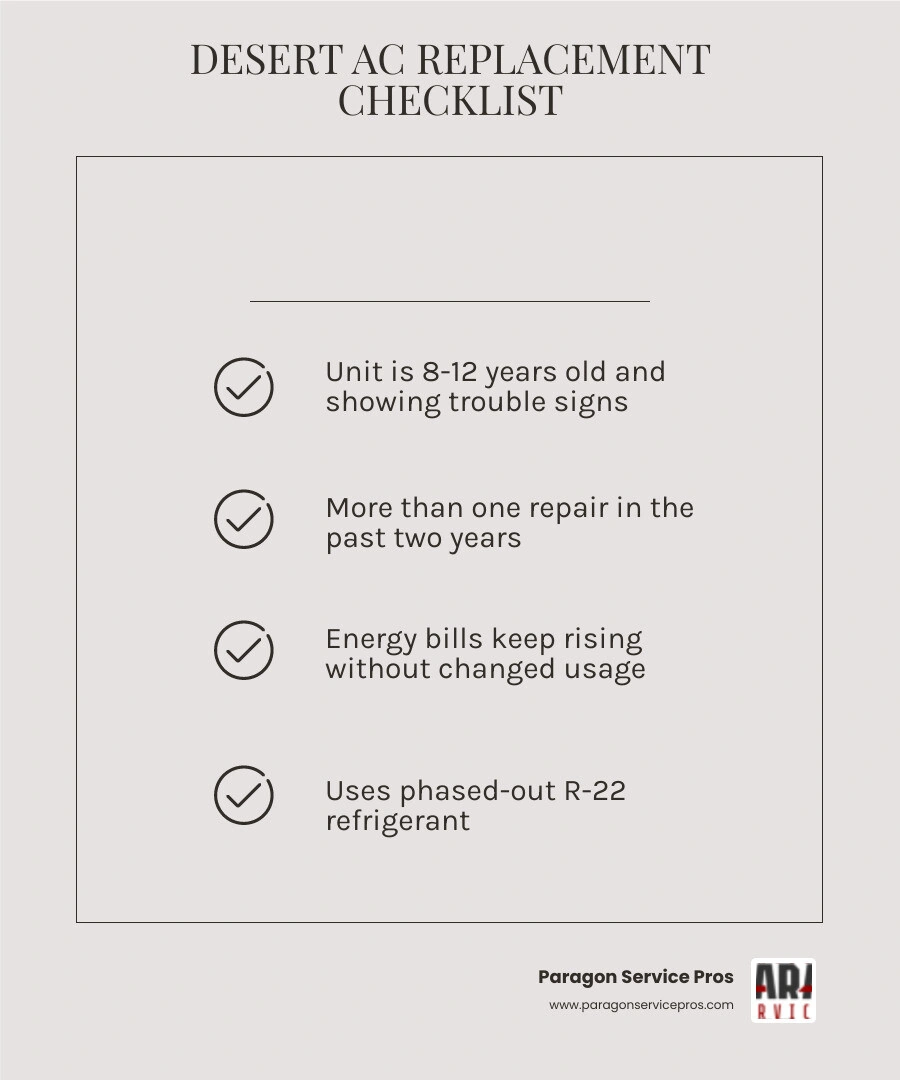
Simple when should you replace your ac in the desert word guide:
Understanding AC Lifespan in Extreme Desert Climates

When we talk about the lifespan of an air conditioner, location is everything. If you look at a national home improvement website, you will likely see advice telling you that a central air conditioning system lasts up to 20 years. In the Sonoran Desert, relying on that estimate is a recipe for a mid-July cooling crisis.
The reality is that our unique desert climate cuts equipment lifespan down significantly. To understand why, we have to look at how much harder our systems work compared to those in more temperate states. Our team at Paragon Service Pros frequently helps homeowners navigate this transition, explaining the direct relationship between climate stress and system longevity. For a deep dive into this topic, you can read our detailed guide on how long does an ac last in the desert.
Why Desert Heat Shortens HVAC Longevity
The extreme environment of the East Valley presents a trio of challenges that degrade mechanical components much faster than normal:
- Relentless Thermal Cycling: During our peak summer months, daytime temperatures regularly soar past 115°F, while nighttime temperatures might hover in the upper 80s or 90s. This extreme temperature swing causes the metal components inside your AC to expand and contract rapidly. This constant thermal cycling puts immense physical stress on soldered joints, electrical connections, and coils.
- Severe UV Degradation: With nearly 300 days of intense Arizona sunshine every year, any outdoor equipment is subjected to high levels of ultraviolet radiation. Over time, UV rays degrade wire insulation, plastic fan blades, and protective coatings on the outdoor condenser unit.
- Abrasive Dust Storms: Our infamous monsoon season brings massive dust storms (haboobs) that sweep across Chandler, Gilbert, and Queen Creek. Fine desert dust particles find their way into every nook and cranny of your outdoor unit. This dust coats the condenser coils, acting as an insulating blanket that traps heat. It also mixes with lubricating oils in the fan motor, creating an abrasive grime that accelerates mechanical wear.
To learn how to combat these environmental stressors, check out our practical tips on how to extend the life of your ac in extreme heat.
When should you replace your ac in the desert vs. milder climates?
To put the wear and tear into perspective, let's look at the numbers. In a milder, northern climate, an air conditioner compressor might run for roughly 800 hours per year. In contrast, an AC compressor in the Arizona desert typically runs between 2,000 and 2,700 hours per year.
By the time a desert AC unit reaches its 10th birthday, its compressor has logged the equivalent of 25 to 30 years of runtime in a milder climate! This is why a system in our area is considered senior at 8 to 12 years old. Expecting a standard residential unit to push past 12 years in San Tan Valley or Mesa without major component failures is simply unrealistic.
Warning Signs: When Should You Replace Your AC in the Desert?
Recognizing the early warning signs of a failing system allows you to plan a replacement on your own terms rather than during a 115-degree emergency. If you want to dive deeper into these indicators, read our comprehensive list of 7 Signs Your Air Conditioner Needs to Be Replaced.
If you're noticing minor issues and wonder if a quick fix is still possible, you can also consult our guide on the Signs Your AC Needs Repair.
Frequent Breakdowns and Mechanical Failures
Are we on a first-name basis yet because our technicians are at your house every other month? While we love seeing our East Valley neighbors, frequent service calls are a clear sign of systemic failure.
In a desert environment, mechanical wear often behaves like a row of falling dominoes. A weak capacitor causes the fan motor to overheat. The overheating fan motor puts extra strain on the compressor. Eventually, the compressor locks up entirely. If you are constantly replacing capacitors, contactors, or fan motors, your system is telling you that its primary components are reaching the end of their operational life. For advice on handling a rapid transition to a new system, see our Fast AC Replacement Complete Guide.
Rising Energy Bills and Decreasing Efficiency
Have you noticed your monthly utility bills climbing higher and higher, even though your thermostat settings and daily habits haven't changed? As air conditioners age, their internal components lose efficiency. Worn compressor valves, dirty coil surfaces, and slow fan motors mean the system has to run longer to achieve the same level of cooling.
Furthermore, older units operate on outdated efficiency standards. In 2023, the Department of Energy implemented stricter SEER2 (Seasonal Energy Efficiency Ratio 2) standards, requiring a minimum of 14.3 SEER2 for residential systems in the Southwest. If you are running an old 10 SEER system, it is consuming significantly more electricity than a modern, high-efficiency SEER2 unit. That drop in efficiency translates directly to wasted money on your monthly power bills.
R-22 Refrigerant and Obsolete Systems
If your air conditioner was installed before 2010, there is a very high chance it uses R-22 refrigerant (often known as Freon). Due to environmental regulations, the EPA completely phased out the production and import of R-22.
Because the supply of R-22 is extremely limited, repairing a system with a refrigerant leak has become financially impractical. If an older system has a leaking evaporator coil or a failed compressor, attempting to recharge it with R-22 is a temporary, highly expensive band-aid. In these cases, upgrading to a modern system that uses eco-friendly, readily available refrigerants is the only logical choice.
The Decision Toolkit: Repair vs. Replace Rules of Thumb
Deciding whether to invest in another repair or move forward with a replacement can feel overwhelming. To make this decision easier, we have created a simple comparison table to help you weigh your options:
| Factor | Lean Toward Repair | Lean Toward Replacement |
|---|---|---|
| System Age | Under 8 years old | 10 to 12+ years old |
| Refrigerant Type | Modern, eco-friendly refrigerant | Obsolete R-22 (Freon) |
| Repair Frequency | First major issue in several years | Multiple breakdowns in the last 24 months |
| Energy Bills | Stable and consistent | Unexplained, steady increases |
| Cooling Performance | Even temperatures throughout the home | Persistent hot spots or weak airflow |
| Warranty Status | Key components still covered | Warranty has expired |
For a complete breakdown of the installation process and what to expect, refer to our comprehensive article on Residential AC Replacement.
Applying the 50% Rule in Arizona
One of the most trusted guidelines in the HVAC industry is the 50% Rule. The math is incredibly straightforward: if the cost of a single repair estimate exceeds 50% of the value of a brand-new system, you should replace the unit.
In the desert, we have to apply this rule even more conservatively. Because our extreme heat accelerates wear, investing a significant amount of money into an 8- or 10-year-old system is highly risky. Even if you repair the current issue, another aging component could fail just a few weeks later.
When should you replace your ac in the desert based on the Age-Frequency factor?
Another excellent tool is the Age-Frequency factor. Instead of looking at a single repair bill, look at your service history over the past two years.
If your air conditioner is over 8 years old and has required more than two professional repairs in the last 24 months, it has entered a phase of systemic decline. At this point, you are likely playing a game of mechanical whack-a-mole. The money spent on repeated service calls, diagnostic fees, and minor parts would be much better utilized as a down payment on a reliable, highly efficient new system.
Why Spring is the Best Time for Desert AC Replacement
When it comes to replacing your air conditioner in the East Valley, timing is everything. While many homeowners wait until their system completely dies in the middle of a July heatwave, proactive homeowners plan their replacements during the spring months (March through May).
Planning ahead ensures a smooth, stress-free experience. If you are located in Gilbert, you can read our specialized AC Replacement Gilbert AZ Guide. For those living further east, check out our resource on how to Find Your Perfect AC Replacement Service in Gold Canyon.
Avoiding the Summer Rush in the East Valley
In Arizona, summer is the peak season for emergency HVAC calls. When temperatures hit 115°F, air conditioning companies are flooded with emergency repair requests. This high demand can lead to:
- Longer Wait Times: You might have to wait several days in a hot home just to get a technician scheduled.
- Limited Scheduling Flexibility: You will have to take whatever installation slot is available, even if it interferes with your work or family schedule.
- Exhausted Crews: Technicians working in 130-degree attics during July are under extreme physical strain.
By replacing your system in the spring, you get first priority on scheduling. Our technicians can take their time to ensure a flawless installation without rushing to the next emergency call. If you do find yourself in an urgent situation, we do offer specialized services like Same-Day AC Replacement in Gold Canyon to get your home cool again as quickly as possible.
Maximizing Efficiency and Home Value Before Summer
Upgrading your system in the spring means you will start enjoying lower utility bills from the very first hot day of the year. Instead of wasting money running an inefficient system through May and June, you can maximize your energy savings immediately.
Additionally, a new, energy-efficient HVAC system is a massive selling point if you plan to list your home. Buyers in Chandler, Mesa, and Queen Creek pay close attention to the age and efficiency of the air conditioner. To learn more about this benefit, read our guide on How a New HVAC System Increases Home Value.
Frequently Asked Questions about Desert AC Replacement
How long do AC units typically last in Arizona?
Due to our extreme summer heat, high runtime hours, and seasonal dust storms, air conditioners in Arizona typically last between 8 to 12 years. This is significantly shorter than the national average of 15 to 20 years. Consistent, professional maintenance is the single most important factor in helping your system reach the upper end of that range.
What is the best month to replace an AC in the desert?
The ideal months to replace your AC are March, April, and May. During this spring window, temperatures are moderate, scheduling availability is wide open, and you can complete the installation comfortably before the extreme summer heat arrives.
Should I replace my AC and furnace at the same time?
Yes, in most cases, we highly recommend replacing both components together. Your indoor furnace (or air handler) and outdoor AC unit are designed to work together as a matched system. Pairing a brand-new outdoor condenser with an old, inefficient indoor coil can prevent the system from reaching its rated SEER2 efficiency, void the manufacturer's warranty, and lead to premature equipment failure.
Conclusion
Deciding when should you replace your AC in the desert doesn't have to be a stressful guessing game. By understanding the unique demands of our Arizona climate, keeping an eye out for the warning signs of system decline, and using smart decision tools like the 50% Rule, you can make an informed, proactive choice that protects your home's comfort and your family's safety.
At Paragon Service Pros, we are proud to serve our neighbors in Chandler, Gilbert, Gold Canyon, Mesa, Queen Creek, and San Tan Valley. We believe in complete transparency, clean workmanship, and helping you find the absolute best cooling solutions for your desert home.
Don't wait for the extreme summer heat to make the decision for you. Schedule professional AC maintenance today with us, and let our friendly, expert team evaluate your system to ensure your home stays perfectly cool all year long!
Keep reading: Air Conditioning
Browse every article in Air Conditioning or head back to the Learning Center .
Comfort you can count on, all year long.
Same-day service, honest diagnostics, and 24/7 emergency help with no overtime fees. A real Greater Phoenix team is standing by.