
The Complete Guide to Ductless Heating and Cooling
Discover how ductless heating and cooling for homes without ductwork delivers zoned comfort and efficiency—learn installation and maintenance tips from.

Ductless Heating and Cooling for Homes Without Ductwork: What Arizona Homeowners Need to Know
If you're exploring ductless heating and cooling for homes without ductwork, the short answer is this: a ductless mini-split system is the most practical, energy-efficient way to heat and cool a home that has no existing duct system.
Here's a quick overview of why ductless mini-splits work so well for duct-free homes:
- No ductwork needed - Installation requires only a small 3-inch hole through the wall to connect the indoor and outdoor units
- Heats and cools - Heat pump models handle both functions year-round with a single system
- Zone control - Each indoor unit operates independently, so you only condition the rooms you're using
- High efficiency - No ducts means no duct losses, which can account for up to 30% of wasted energy in traditional systems
- Minimal disruption - Most installations complete in a single day with no major renovation required
- Flexible placement - Indoor units can be wall-mounted, ceiling-recessed, or floor-mounted to suit your space
Many homes across the Phoenix East Valley — including older properties in Mesa, Gilbert, and Gold Canyon — were built without central ductwork, relying instead on window units, space heaters, or evaporative coolers. Those solutions often leave rooms uncomfortable, drive up energy bills, and fail to handle Arizona's extreme summer heat reliably. A ductless mini-split system solves all of that in one upgrade.
Take the story of a historic home that was retrofitted with seven indoor units across eight comfort zones — all without touching a single original wall or structural element. That kind of flexibility is exactly what makes ductless systems so appealing for homes where adding traditional ductwork simply isn't practical.
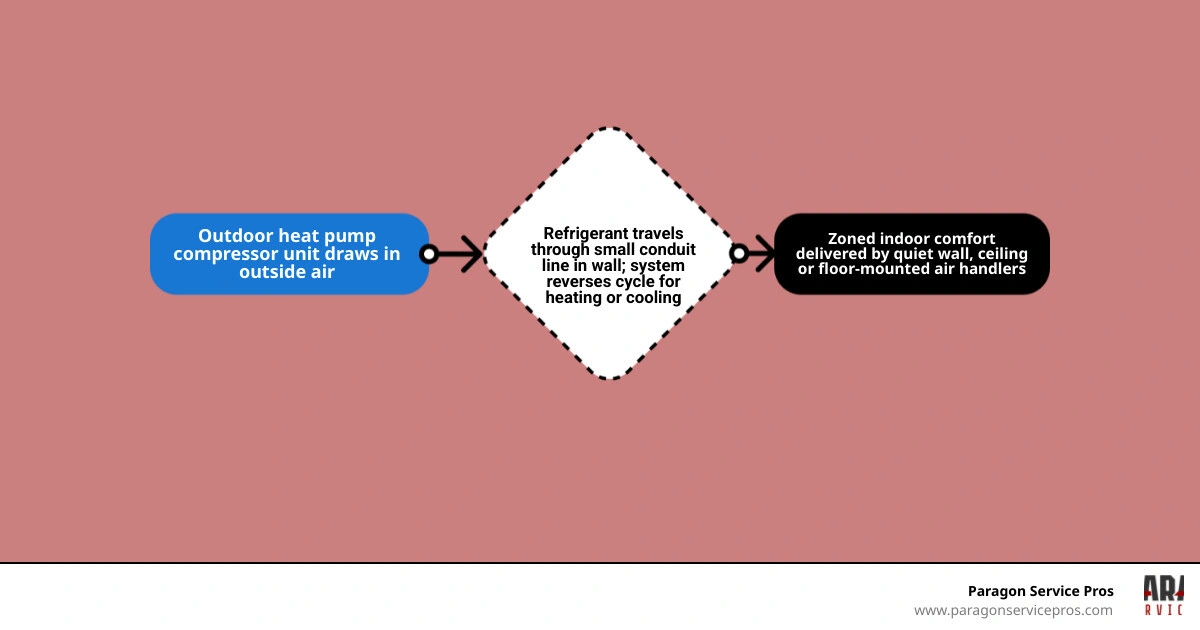
Ductless heating and cooling for homes without ductwork terminology:
- ductless mini split benefits for arizona homeowners
- how ductless systems work for heating and cooling
How Ductless Mini-Splits Work and System Types
To truly appreciate why ductless systems are such a game-changer, it helps to understand how they operate. Traditional central HVAC systems rely on a single, large indoor unit that forces conditioned air through a complex network of metal or flexible ducts hidden in your walls, attic, or crawlspaces.
Ductless mini-splits take a completely different approach. They bypass the middleman (the ductwork) and deliver comfort directly to individual spaces. A standard ductless system consists of three primary components:
- The Outdoor Compressor/Condenser: This unit sits outside your home, pumping refrigerant and dispersing or absorbing heat depending on the season.
- The Indoor Air Handler (Blower): Mounted inside the room, this unit contains a quiet fan and an evaporator coil to distribute conditioned air directly into the living space.
- The Conduit Line: A small bundle housing the power cable, refrigerant tubing, and a condensate drain line. This conduit connects the indoor and outdoor units through a small, unobtrusive 3-inch hole in the exterior wall.
Because the refrigerant lines do all the heavy lifting, there is no need for bulky metal pipes snaking through your ceiling. For a deep dive into the mechanical side of things, check out our resource on How Ductless Systems Work for Heating and Cooling.
Understanding Ductless Heating and Cooling for Homes Without Ductwork
At the heart of modern ductless systems is heat pump technology. While many people associate the word "pump" with water, a heat pump actually pumps heat from one place to another.
During our scorching Phoenix East Valley summers, the system absorbs heat from inside your home and transfers it outdoors, leaving you with cool, refreshing air. In the winter, the process runs in reverse. Even when the desert air feels chilly, the outdoor unit extracts ambient heat from the outside air and pumps it indoors to keep you cozy. This reverse-cycle operation provides efficient year-round comfort without requiring separate furnace and air conditioning units.
Additionally, top-tier ductless systems utilize variable-speed inverter technology. Traditional HVAC systems operate like a single-speed light switch: they are either 100% on or completely off. This constant cycling on and off wastes energy and creates noticeable temperature swings. In contrast, inverter-driven compressors operate like a dimmer switch. They automatically adjust their speed to match the precise heating or cooling demands of the room, running continuously at a low, ultra-efficient level.
To see how this compares to other non-ducted options, read our guide on Adding Cooling Without Ductwork Options Compared.
Single-Zone vs. Multi-Zone Configurations
Ductless systems are incredibly modular, allowing you to customize your setup based on your home's unique layout:
- Single-Zone Systems: These consist of one outdoor compressor connected to a single indoor air handler. They are perfect for targeted comfort in a single problem room, such as a home office, a master bedroom, a converted garage, or a newly added sunroom.
- Multi-Zone Systems: These connect multiple indoor air handlers (typically anywhere from two to eight units) to a single, heavy-duty outdoor condenser. Each indoor unit can be controlled independently, allowing you to create distinct temperature "zones" throughout your home.
You also have choices when it comes to the style of the indoor units. While wall-mounted units are the most common, you can also select ceiling cassettes that sit flush with your ceiling, drop-ceiling units, or floor-mounted consoles that rest low against the wall.

Why Choose Ductless Heating and Cooling for Homes Without Ductwork?
If your home was built without ductwork, you face a major fork in the road when upgrading your climate control: do you pay to have expensive, messy ductwork retrofitted throughout your walls and ceilings, or do you go ductless?
Choosing ductless heating and cooling for homes without ductwork is often the superior choice for several compelling reasons, starting with the elimination of "duct losses."
According to the U.S. Department of Energy, duct losses can reduce the efficiency of central air conditioning systems by up to 30 percent. If your ductwork develops leaks, tears, or poor insulation over time, those losses can rise as high as 40 percent! Because ductless systems do not use ducts, they suffer virtually zero duct losses. In fact, most mini-split HVAC systems lose less than 5 percent efficiency over their entire lifespan due to standard wear and tear.
Benefits of Ductless Heating and Cooling for Homes Without Ductwork
The practical benefits of making the switch to a ductless mini-split system are substantial:
- Up to 40% Energy Savings: Because they eliminate duct leaks and utilize variable-speed inverter compressors, ductless systems can reduce your heating and cooling energy consumption by up to 40% compared to a conventional ducted system.
- Improved Indoor Air Quality: Traditional ductwork can act as a breeding ground for dust, pollen, pet dander, and mold, which is then blown into every room when the system kicks on. Ductless units feature sophisticated, multi-stage filtration systems within each individual air handler, trapping allergens and purifying the air locally.
- Whisper-Quiet Operation: If you are tired of the loud rattling of window units or the deep rumble of a central system kicking on, you will love the near-silent operation of a mini-split. Because the noisy compressor is located outdoors, the indoor air handlers operate at decibel levels as low as a whisper.
For a localized look at how these benefits translate to our unique desert climate, take a look at our Mini Split Benefits Arizona Homeowners Guide.
Comparing Mini-Splits to Traditional HVAC Systems
To help visualize the differences between these two approaches, let's compare them across several key categories:
| Feature | Ductless Mini-Split System | Traditional Ducted HVAC System |
|---|---|---|
| Ductwork Required | None | Extensive network of ducts |
| Energy Losses | Extremely low (<5% over time) | Up to 30% to 40% via duct leaks |
| Zoned Comfort | Standard (independent room control) | Hard to achieve without complex dampers |
| Noise Level | Whisper-quiet indoors | Moderate (duct pinging and airflow noise) |
| Installation Disruption | Minimal (completed in 1-2 days) | Major construction/remodeling required |
| Space Requirements | Minimal (wall or ceiling space) | Requires attic, closet, and wall cavity space |
While traditional central systems are excellent for homes that already have functional, well-insulated ductwork in place, trying to retrofit ducts into a home that wasn't designed for them is a massive, invasive, and costly undertaking.
For a direct comparison tailored to our local communities, read our article on Central Air vs Mini Split for Phoenix East Valley Homes.
Sizing, Installation, and Maintenance Best Practices
To get the absolute most out of your investment, a ductless system must be designed, installed, and maintained correctly. This is not a project where "guesstimate" sizing or generic DIY shortcuts will suffice.
Determining How Many Indoor Units Your Home Needs
A common question homeowners ask is: "Do I need an indoor unit in every single room?"
The answer depends entirely on your home's layout and how you use your living spaces.
- Open-Concept Layouts: A single, larger-capacity indoor unit (such as an 18,000 or 24,000 BTU wall unit) can often successfully heat and cool a combined living room, dining room, and kitchen area.
- Individual Bedrooms and Offices: Smaller, dedicated units (such as 9,000 or 12,000 BTU units) are ideal for bedrooms, ensuring personalized comfort and allowing you to turn off units in unoccupied rooms to save energy.
- Zoning Strategies: Our team can help you map out a zoning strategy that maximizes comfort while keeping the number of indoor units—and your upfront equipment needs—as streamlined as possible.
For a detailed breakdown of how to plan your system layout, check out our Ductless Mini Split Guide Gilbert AZ.
Professional Installation in the Phoenix East Valley
While DIY mini-split kits exist, professional installation is highly recommended to protect your warranty, ensure electrical safety, and guarantee peak performance. Correctly sizing each indoor unit and choosing optimal installation locations high on walls or in ceilings is critical to avoid "short-cycling" (where the unit turns on and off too quickly, wasting energy and wearing out components).
At Paragon Service Pros, we provide expert, seamless installation services across the East Valley. If you're ready to explore your options, we invite you to browse our localized guides:
- Ductless Mini Split Installation Mesa AZ Guide
- Ductless Mini Split Installation Gilbert Guide
- Ductless Mini Split Installation Gold Canyon Guide
Long-Term Maintenance for Peak Performance
Ductless mini-splits are incredibly reliable, but they do require a small amount of regular attention to run efficiently:
- Clean the Air Filters Regularly: Most indoor units feature washable, slide-out filters. In Arizona's dusty environment, we recommend checking and rinsing these filters every four to six weeks.
- Keep the Outdoor Unit Clear: Ensure that desert landscaping, weeds, and debris are kept at least two feet away from your outdoor condenser unit to maintain proper airflow.
- Schedule Professional Tune-Ups: Just like a traditional system, a ductless heat pump benefits enormously from annual preventative maintenance. A professional technician will check refrigerant levels, inspect electrical connections, and deep-clean the coils.
To keep your system running smoothly year after year, refer to our guide on Mini Split Maintenance.
Frequently Asked Questions about Ductless HVAC
Are ductless mini-split systems quieter than window units?
Yes, by a wide margin! Window air conditioners house all of their noisy mechanical components—including the compressor and the exhaust fan—directly inside the window frame, creating a loud, vibrating hum.
With a ductless mini-split, the noisy compressor is located outdoors, often up to 50 feet away from the room. The indoor unit only houses a whisper-quiet fan, resulting in operating levels as low as 19 to 30 decibels (similar to rustling leaves). To learn more about how these options stack up, read our article on Mini Split vs Window Unit for Arizona Rooms.
Can a ductless system heat and cool an entire home?
Absolutely. By utilizing a multi-zone configuration, you can connect multiple indoor units to a single outdoor condenser to provide complete, whole-home heating and cooling.
Each indoor unit operates on its own independent thermostat, allowing family members to set their preferred temperatures in different rooms and eliminating thermostat arguments forever.
How long do ductless mini-split systems typically last?
With proper installation and routine preventative maintenance, a high-quality ductless mini-split system can easily last 20 years. This longevity is significantly higher than that of window units or poorly maintained central systems.
If your existing system ever runs into trouble, our experienced technicians are always ready to help with dependable Mini Split Repair.
Conclusion
Upgrading to ductless heating and cooling for homes without ductwork is one of the smartest investments you can make for your property. By bypassing the need for invasive, expensive duct construction, you get to enjoy whisper-quiet comfort, drastically lower utility bills, and independent temperature control in every room of your home.
At Paragon Service Pros, we are proud to serve homeowners throughout the Phoenix East Valley, including Chandler, Queen Creek, San Tan Valley, Mesa, Gilbert, and Gold Canyon. Our friendly, experienced team is committed to complete transparency, quality workmanship, and fast scheduling to ensure your home remains a comfortable oasis all year long.
Ready to experience the ultimate in energy-efficient comfort? Schedule your professional mini-split installation today!
Keep reading: Heat Pumps & Ductless
Browse every article in Heat Pumps & Ductless or head back to the Learning Center .
Comfort you can count on, all year long.
Same-day service, honest diagnostics, and 24/7 emergency help with no overtime fees. A real Greater Phoenix team is standing by.